Central Asian countries are expected to register growth of 2.6% this year, their lowest collective growth in four years and well below their average growth of 4.7% over the past decade.
Growth prospects are dim across the world as emerging economies face capacity constraints and risks from the European Union region continue to weigh down the global economy, according to the World Bank.
"While there are markers of hope in the financial sector, the slowdown in the real economy is turning out to be unusually protracted," Kaushik Basu, senior vice president and chief economist at the World Bank said in the report.
"This is reflected in the stubbornly high unemployment in industrialized nations, with unemployment in the Eurozone actually rising, and in the slowing growth in emerging economies."
Global GDP growth is expected to expand by a mere 2.2% this year before gaining some momentum next year with a 3.0% growth.
Developing economies will grow at a more pronounced 5.1%, however Central Asia will under-perform the emerging economies, growing at half that rate.
The forecast is in sharp contrast to Asian Development Bank's April forecast of 5% growth in 2013 and around 6% in 2014. Still the ADB had warned that "slower economic activity across the sub-region is expected to outweigh higher public investment in the Azerbaijan and Kazakhstan, keeping Central Asia's growth flat in 2013."
The World Bank estimates foreign direct investment is expected to flow back into the region after a 9% decline in 2012.
Continued deleveraging in the EU financial markets and lethargic growth has affected Central Asia as it depends heavily on demand from the European region.
While FDI was subdued, Azerbaijan (18.5% increase in FDI) and Kazakhstan were outliers last year.
A number of Central Asian governments have also unveiled privatization plans which could lead to higher flows of as much as 20% higher than last year.
The World Bank also expects FDI flows to rebound by 6% in the wider region in 2014. The recovery in FDI, may be particularly important for countries such as Georgia, where FDI accounts more than 30% of gross domestic capital formation, the bank said.
RISING REMITTANCES
Remittances are the lynchpin for many Central Asians who depend heavily from monies sent by overseas citizens from Russia, China, Europe and the Middle East.
Remittances have been steadily rising over the past decade from just over USD 5 billion in 2002 to USD 22.9 billion in 2012, and are set to rise to an all-time record of USD 23.3 billion, according to the bank.
Remittances are an importance source of foreign currency and domestic consumption income for several countries in developing Central Asia, the bank notes.
While remittance flows declined in some countries in the region, Tajikistan, Kyrgyz Republic, Moldova and Armenia saw flows increase by 28%, 14%, 10% and 8.5%, respectively, supported by strong growth in Russia and high oil prices.
Inflation pressures are considerably subdued in places like Azerbaijan and Georgia because of weaker demand and a fall in food prices, which reined in consumer prices. The appreciation of the Georgian currency also helped the country curb inflation.
"Against the backdrop of easing inflation, spare capacity, high unemployment and moderate growth, several central banks in the region including Albania, Azerbaijan, Belarus, and Georgia have cut their policy rates," said the bank.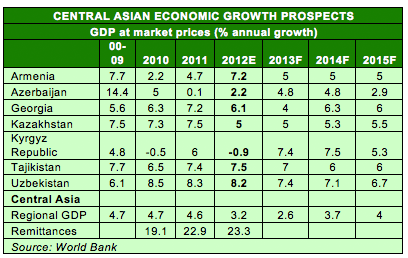
COUNTRY-SPECIFIC FORECAST
Kazakhstan economy is expected to slow down from the aggressive 7%-plus growth, to a more moderate 5% this year, especially as first quarter growth was less than impressive.
"Government consumption is expected to compensate for moderating private consumption and the economic slowdown in Russia. While expected to pick up by 2014 after a new oilfield becomes operational, medium-term growth in Kazakhstan will be held back by supply-side constraints."
The bank is bullish on Kyrgyzstan's growth prospects, expecting the country to post a 7.4% growth on the back of gold production. But the recent tensions in Kumtor, the country's largest gold mine, could scale back growth.
Meanwhile, Armenia's economic growth will ease from 7% plus in the past year to around 5% in 2013, "as prudent fiscal and monetary policies permit the economy to avoid overheating."
Other countries like Uzbekistan is expected to post the region's highest growth, with 7.4% expansion this year, as the government is planning to continue increasing public investment in infrastructure development, industrial modernization, and housing.
The government investment program for 2013 envisages projects equal to 24.7% of GDP. Gross fixed capital formation is forecast to rise by 10% in 2013 and 11% in 2014, the Asian Development Bank had estimated earlier this year.
However, resource-rich Central Asian economies can expect to beat the global gloom around them by fiscal stimulus and greater investment drive by the government.
That should drive away the domestic economic blues till the global economy repairs itself.
© alifarabia.com 2013