Oil industry barons beware: Facebook and other peddlers of social media such as Twitter and LinkedIn.
While it has not set the public markets alight with its initial public offering, Facebook recently launched an office in the Middle East & Africa region, which is another indication of how structural changes are afoot in the regional Internet industry.
And it's not just our social habits that are being altered - social media is having profound implications on - among other businesses - the global oil industry.
Facebook and other social media have already severely disrupted advanced economies. In the United States, oil consumption has fallen 14% since 2007 - long before the start of the global financial crisis - as younger people choose social media and webcam to interact with friends and families rather than get behind the wheel of a car.
Research by the University of Michigan Transportation Research Institute shows only 31% of 16-year-olds had a driver's license, compared to 46% in 1983.
"Adapting to new ways of communication, young and not-so-young people are detouring off the paved highway and virtually transporting themselves onto the information highway," wrote economist Peter Tretzekian.
"With social media applications like Facebook, Skype, and Twitter - as well as physically-immobilizing, multiplayer online video games - it's easier to make the connection that Internet use has something to do with the lower propensity of youth to get a drivers' license."
The licensing trend that started 25 years ago is enforcing structural changes in American oil consumption, and other developed countries are not immune.
MIDDLE EAST TRAJECTORY
While the Middle East is much further behind the U.S. in terms of Internet penetration, its trajectory is similar.
According to Internetworldstats.com, more than 20 million Middle East people are on Facebook, and that will only grow as Internet penetration rises in the region. Facebook itself puts the number of subscribers at 45 million in the wider Middle East North Africa region.
In Egypt, 22.4% of Internet users recently surveyed by the Arab Advisors Group said they use e-commerce services to buy products or services or pay their bills online. The Jordan-based group conservatively estimates the number of these users to be around 2.8 million, which is around 3.4% of the total population in Egypt.

Meanwhile, Iran added 14 million internet users from 2008 to 2011 - the ninth highest number in the world during that period; Saudi Arabia and Egypt have both added close to 10 million mobile subscribers, as young people take to the Internet and mobile devices with tremendous speed.
In Saudi Arabia, 15 of the 18 registered commercial banks in the country offer remote banking and Internet services, according to the Arab Advisors Group.
Online gaming is also keeping young people glued to their couches. Total user base for Arabic games on Facebook reached 2.89 million monthly in late 2011.
"With the emergence of the free-to-play model, demand for online games has increased in the Arab World during the past five years," notes the Arab Advisors Group. "Since the launch of the first Massively Multiplayer Online (MMO) game in the Arabic language in September 2007, the supply of Arabic online games experienced a boom and reached 135 MMO and social games available in Arabic by November 2011. Of these, 95 games are MMO games, and 40 are social games available on Facebook in Arabic.
These incremental technological developments along with the attraction of social media and online gaming is altering the region's social and business habits.
"We hope to rewire the way people spread and consume information," Mark Zuckerberg, founder and CEO of Facebook said in a letter to potential shareholders before the IPO that bombed on the Nasdaq Stock Exchange. "We think a more open and connected world will help create a stronger economy with more authentic businesses that build better products and services."
It's true that social media is not a teenage fad, not a personal consumer phenomenon, and not (just) a B2C tool for business.
"Correctly combined and deployed, social media + social software + social networks equals a new set of tools for reengineering business," note consultant Deloitte & Touche in a new report. "These new tools enable a new set of (potentially disruptive) rules for operating, competing and winning in a market."
A report by Kleiner Perkins Caufield Byers (KPCB), a media consultancy, offers a sample of how technology has already impacted the following businesses: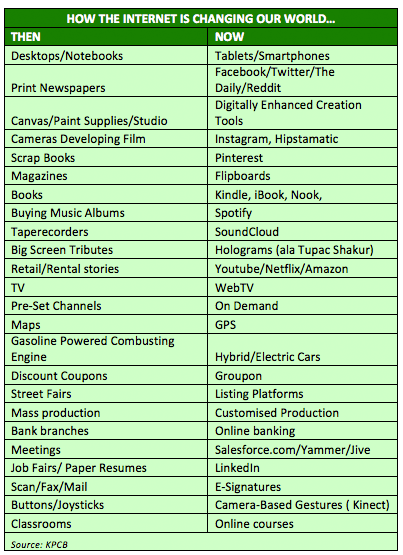
In short, KPCB believes that industries ranging from consumer staples, to financials and energy are set for a great disruption - that's USD36-trillion worth of listed companies in this collective space that will need to rethink its business model to keep abreast of technology, otherwise they could end up like Kodak.
AFFECTING ME EXPORTS?
At the moment, Middle East authorities face a different problem: they are actually consuming more oil domestically for their liking and looking to switch to alternative fuels. That's primarily due to fast-growing populations, expansionary economic policies and lower mobile and Internet penetration compared to the more developed economies.
But that could change - and fast, as young people embrace new technologies and governments open up the telecommunications sector further across the wider region.
Middle East governments should also be aware of similar trends in their prime export markets of U.S., China and wider Asia.
China, the world's biggest consumer of pretty much all commodities, has 384 million Internet users and is growing at 29% a year, while Japanese and Korean 3G subscribers is rising 12% each.
Saudia Arabia has already seen its exports to the U.S. overtime due to a number of factors, including less reliance on Middle East imports.
The chart below shows falling Saudi oil exports to the United States, which underlines the changing dynamics of global energy consumption.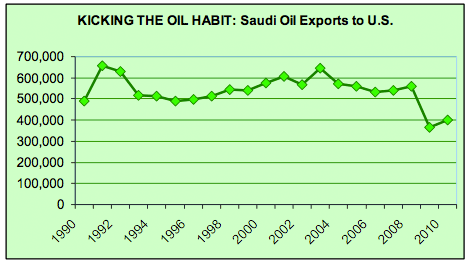
To be sure, it's a trend that will take years to take shape, but it's coming, given how technology has already disrupted OECD economies.
Remember it was a technology company - Apple Inc. - that replaced oil giant ExxonMobil as the United States' most valuable listed company earlier this year.
CONCLUSION
The global and Middle East oil industry faces a number of threats from technological changes within and from outside the industry. The global environmental push is already compelling many oil-importing countries to find cleaner sources of energy, could also reduce crude demand over time. Add to these changes, a great technological shift that's already making its presence felt in the United States, and it could dynamically alter hydrocarbons' consumption over time.
It is
These are minor trends for now, but could have profound changes in the way businesses are structured over time. The oil industry will not be spared these changes.
© alifarabia.com 2012