Protests, unemployment and a spiraling budget deficit are a ticking time-bomb for Jordan. Would inclusion in the GCC economic bloc be the answer?
Easier access for Jordanian workers to jobs in the Arabian Gulf states, stronger trade ties with the nations of the Gulf Cooperation Council and direct aid are only some of the benefits the Kingdom of Jordan can expect if it becomes the seventh member of the GCC.
At the end of their meeting in Jeddah, Saudi Arabia, on September 11, 2011, foreign ministers of the GCC took the first step and announced an aid program for the two countries - Jordan and Morocco - aspiring to join the Gulf bloc. The amount of aid was not decided and left for the GCC summit in December.
The six GCC foreign ministers met their counterparts from Jordan and Morocco to consider "a five-year economic development plan to support Jordan", said the kingdom's Foreign Minister Nasser Judeh.
A working group was formed to study the procedures for accession of Jordan to the GCC, Judeh said, and added that "there is no timetable" for accession.
In the first six months of 2011, Jordan's budget deficit rose by an alarming 55% compared to the same period last year. The kingdom's deficit stood at JOD260.1 million, despite aid from its allies, compared to JOD167.2 million in the same period last year, according to official figures.
The Jordanian government targets a budget deficit at 5.5% of GDP, despite the increase in social spending and a soaring oil bill. It has also revised its 2011 budget, raising its projection for domestic revenue growth to 12% and lowering its allocation for capital spending.
However, the Economist Intelligence Unit considers this projection an ambitious one particularly given that domestic revenue declined by 17% on-year in the first quarter of 2011. The EIU expects the deficit (excluding grants) to widen from an estimated average of 10.7% of GDP (JOD1.6 billion) in 2009-10 to an average of 11.4% of GDP in 2011-12.
With an expected increase in foreign aid, particularly from Saudi Arabia, fiscal revenue (including grants) will increase by a forecast average of 9.5% in 2011-12, adds EIU.
"Buoyed by these grants we expect the deficit (including grants) to widen only slightly to 6.7% of GDP in 2011," the EIU said in recent research.
Gulf grants to Jordan, especially from Saudi Arabia, have been a saving grace. This direct aid is set to grow further with a potential induction in the Gulf council.
"Saudi Arabia's standing by Jordan at a time of difficult global economic conditions and a sharp increase in fuel prices, which have adversely affected the Jordanian economy, indicates your sound stand that calls for the solidarity of the nation and the right of its people to a fruitful future," Jordan's King Abdullah said in a letter to Saudi King Abdullah in July, in appreciation of the Saudi monarch's efforts to secure Jordan's accession to the GCC.
Exceeding Expectations
By July 2011, amid rising tension among Jordan's allies during Arab Spring, foreign grants to Jordan exceeded budget expectations and reached USD1.44 billion. This figure was more than double the JOD440 million set out in the budget, with Saudi Arabia alone providing USD400 million in June, according to EIU data.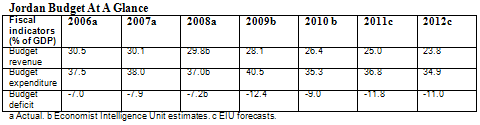
Extra social spending this year has widened the kingdom's deficit. In the aftermath of January demonstrations in Jordan, and despite the country's already expanding fiscal deficit, the government was under pressure to revoke many of its deficit-cutting measures.
In an attempt to absorb the waves of frustration created by rising prices and increasing unemployment rates, the government announced a set of populist measures.
In June, it announced subsidies and tax reduction on basic food items consumed mainly by low- and middle-income earners. In late July, a USD210 million fund was launched to create jobs and improve services.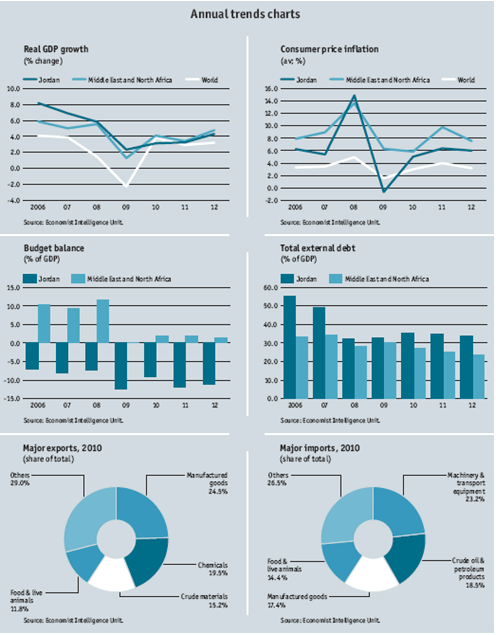
Unemployment
One of major challenges facing the kingdom is an alarmingly high unemployment rate, especially among university degree holders. According to the Jordan Department of Statistics, the unemployment rate increased to 13.3% in the first quarter of 2011 from 12% in the same period last year.
Joining the GCC would ease this crisis with facilitated visa regulations for the Jordanian workforce, which ranks among the most efficient yet low-cost labor in the region.
"Jordan has one of the highest literacy rates among Arab countries and it has remained a major supplier of high-caliber professionals to Gulf countries. Rough estimates suggest some 600,000 Jordanians are working in the GCC," the Dubai Chamber of Commerce and Industry said in a report released in July 2011.
"Free movement of labor from Jordan to the GCC would not only help the GCC acquire cheap labor, but it will also add considerable remittance to Jordan. Foreign remittance accounts for 9% of Jordan's GDP," the report said.
Energy
A key issue pressing on Jordan's budget is its soaring hydrocarbons import bill, especially in light of the recent developments in Egypt.
Jordan had depended on receiving Egyptian gas at almost half the international price to generate around 80% of its electricity needs. However, after the fall of the Hosni Mubarak regime, and the multiple attacks on the Jordan gas pipeline, there were interruptions in gas supplies to Jordan. Adding to the gas shortage, Egypt insisted on new higher prices for its gas exports.
The interruptions caused a huge strain to Jordan's already spiraling budget deficit, with an estimated loss of USD3 million per day, as it was forced to switch to more expensive diesel and heavy oil to meet its electricity needs.
Although Egypt has now resumed gas supplies to Jordan under a new agreement that stipulates higher prices, Jordanian authorities are exploring other long-term alternatives.
Joining the GCC would offer Jordan preferential terms in prices of hydrocarbon imports from the oil-rich Gulf bloc. Accordingly, this cuts Jordan's huge crude imports bill and eases the government's expenditure on its energy needs. The kingdom's costly energy imports constitute around a fifth of its GDP.
Jordan would also ensure more security and consistency of energy supply by intensifying its cooperation with Gulf nations.
FDI & Trade
A drop in foreign direct investment as well as remittances has also been a source of concern for the Jordanian government. Lowered appetite to invest in the region due to the political turmoil has taken its toll on the Jordaninan economy.
GCC membership would increase confidence in Jordan's economy and open the doors for higher investment interests in the country, especially from Gulf nations.
Saudi Arabia alone has invested more than USD4 billion in different projects during the past three years, according to the Jordan Investment Board.
"According to the UAE Ministry of Foreign Trade, UAE investment in Jordan is estimated to be in the range of USD15 billion, which is expected to grow in the coming years. Kuwaiti investment in Jordan increased from USD400 million to USD8 billion in 2010, while Bahraini investment in Jordan stood at USD473 million the same year," the Dubai Chamber reported.
Stronger trade ties would also be among the benefits of joining the council. The GCC is already one of Jordan's major trading partners. In 2010, bilateral trade between Jordan and the six oil-rich Gulf countries exceeded the USD5 billion mark, the DCCI study added.
The GCC accounted for 24.2% of Jordan's imports in 2010, while 18.4% of Jordan's exports were destined for Gulf states, according to the Jordan Department of Statistics.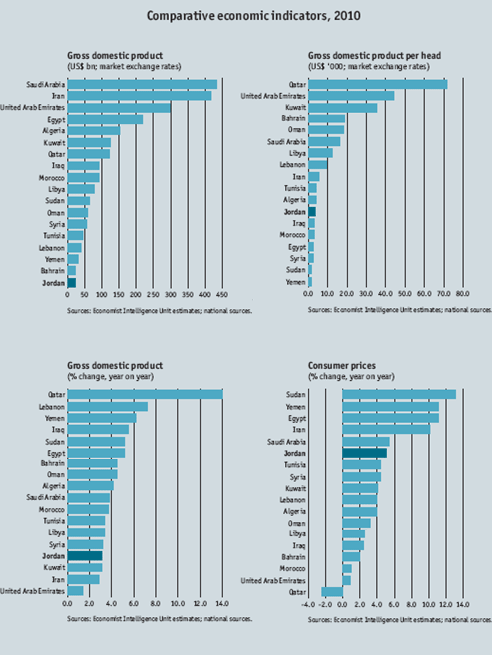
Tourism
Tourism was among the sectors that experienced a sharp drop due to the Arab Spring. In the first half of 2011, Jordan's revenues from tourism dropped to JOD949 million from JOD1.089 billion in the first half of 2010, according to the kingdom's ministry of tourism and antiquities.
However, with facilitated visa regulations from a potential induction in the GCC, Jordan's tourism sector would get a boost from an influx of Gulf tourists. In 2010, 28.2% of tourists to Jordan were from the GCC countries, and around 1.65 million tourists from the GCC countries visited Jordan between 2009 and 2010, according to the Dubai Chamber study, which cited official data. This figure would increase with easier cross border travel, generating higher tourism revenues and creating more employment opportunities in Jordan.
For 2011, the EIU forecasts 3.3% economic growth for Jordan, a slight rise from the 3.1% in 2010, as the strengthening of some of Jordan's export markets offsets any short-term decline in tourism numbers caused by regional unrest.
While joining the GCC would ease Jordan's economic hardships, the kingdom would still have a long way ahead to raise the standard of living of its citizens to bring it on par with its new partners.
© Zawya 2011