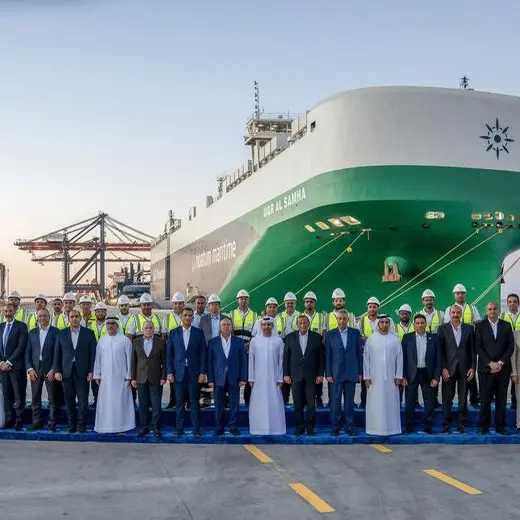
Richards is tight lipped about the details of the deal, which will be formally announced in early May, but estimates that the expansion will thrust Gulftainer into an exclusive group of the worlds top port operators. By doing so it would be in esteemed company, joining industry giants such as A P Moeller, Hutchison and ICTSI, and is the latest step in a carefully planned strategy that has seen Gulftainer acquire port concessions around the world since Richards was promoted to his current position in 2006.
When I took over the reins of the company, I asked our shareholders permission to expand internationally on the basis that because of our reputation we were getting so many invitations from so many government organisations, port authorities and commercial partners the world over who were saying we have heard about you and our port is in need of an uplift, an expansion, an improvement and we would like to bring you on board to do it, Richards explains.
That became the start of Gulftainer International and from 2006 onwards we have taken on concessions in Africa, Brazil, Iraq, Kuwait, Lebanon and Russia.
The company was formed in 1976 to manage the Middle Easts first container terminal, the newly-opened Mina Khalid.
In 1987 Gulftainer was awarded the concession to operate Khorfakkan port on the UAEs East coast, the same year Richards joined the company.
When we started Khorfakkan we could see the potential for it becoming a trans-shipment hub for the area. So we promoted it on the basis that larger vessels - which were about 2,000 TEU (twenty foot equivalent container units) compared to the 18,000 TEU vessels we have now - could trans-ship their containers to smaller vessels at Khorfakkan and it could be a trans-shipment hub for the Upper Gulf and region, he explains.
Khorfakkan Container Terminal [KCT] has always attracted a lot of attention as shipping lines were trying to save money wherever they could. We concentrated on productivity - on turning the ship around as quickly as possible - and we developed not only a loyal customer base but also a reputation as one of the worlds most productive port operators, Richards continues.
He says KCT has topped industry productivity rankings for the past five years, and that both it and Mina Khalid are used as industry benchmarks by shipping lines.
They [the shipping lines] often remark that if you want to service our vessels you have to meet the [productivity] levels of Gulftainer.
Exceptional productivity levels have inevitably translated into healthy throughput and financial performance. The company consistently showed double digit trade volume growth in the crisis years from 2008 onwards, through one of the biggest slumps ever seen in international trade and shipping activity, culminating in an unparalleled 24 per cent volume growth in 2012. However, Richards sees Gulftainers 2009 performance as a more valuable measure of the companys success.
2012 was fantastic and its great to shout from the rooftops that we got 24 [per cent growth] when everybody else was doing four, and six [per cent], but for me a better description of how Gulftainer performed is in 2009 when the logistics world fell apart.
Gulftainer was one of only three port operators in the whole world that showed growth that year and the other two only got growth because they got new business - a shipping line moved from another port to theirs - ours was the worlds only port company to show organic growth in 2009.
We were able to prove to the world that by our mode of operation you can actually survive, still make a profit and still give comfort to your customers that by calling at your port they could save money and perform more productively, he says.
Richards believes it is all about productivity.
Trans-shipment can be done anywhere, shipping companies will go to the best trans-shipment hubs and usually its all about money. However, logically you get a level where you say I cant afford to give you any lower rates but what I can do is give you performance.
The new, huge container ships cost upwards of $140 million to build and cost in the region of $250,000 a day to operate. If you can halve the time they spend in port it makes a huge difference. Shipping lines only make money when their ships are moving.
A perfect example of this is when the 16,000 TEU CMA CGM Marco Polo performed her maiden voyage and called at KCT in March this year. During the call KCT achieved the highest productivity of any port along the vessels route which included calls in China, Indonesia, the Middle East, the Mediterranean and Northern Europe.
Richards says proven performance and long-term commitment are vital in negotiating new concessions.
We always look at opportunities on the basis that we are not just going in as investors but as managers. And because our reputation hinges on it we dont just want to get value for ourselves, we want value for our partners whether it be a government, a port authority or a private commercial enterprise, and by keeping our partners happy we enhance our reputation and we get invited elsewhere.
In many instances the arrival of Gulftainer has not only radically changed the fortunes of an ailing port, it has also transformed the regional economy. A prime example is the port of Moroni, capital of the Comoros Islands where, prior to Gulftainer taking up the concession, ships were taking four weeks or more to discharge their cargoes.
We utilised a crane and barge operation along with the limited berth space, enabling us to drastically reduce the time the vessels had to spend there, says Richards.
Within eight or nine months we were able to reduce the price of cement, sugar and even rice for the islanders because we were able to cut the cost of bringing those goods in, he notes proudly.
It was a similar story at the Brazilian port of Recife, existing in the shadows of the modern port of Suape 70km away, though Richards points out that Gulftainers logisitics arm Momentum, set up in 2008, provided further impetus to that project.
By offering a package we can detract from the fact Recife is a smaller port. By bringing in Momentums expertise we can say call at out port and well arrange customs clearance, the actual processing and delivery to the end user, all done by us.
Momentum was set up in 2008, shortly before, in Richards words, the logistics world fell apart in 2009.
It has been nowhere near as rocket-fuelled as we had hoped, he admits, but we have learnt some valuable lessons because we really had to fight to get business in the hugely competitive logistics environment in the Middle East. Momentum has got itself involved - through our port operations - in Iraq, Brazil, Turkey and Pakistan and now because of that international presence we are starting to see bigger jobs coming our way.
A major part of Momentums business has been supply Iraq; both from Gulftainers port and logistics city in the southern part of the country but also from the North, via Turkey. Richards is particularly proud that Momentum was selected as one of very few logistics companies authorised to supply goods in Afghanistan via Pakistan.
Momentum Pakistan was selected having only been in existence for six months, he explains.
It took a lot of hard work to get such a tight set of requirements set by the authorities to qualify for the short list of recommended companies, and it showed me that with the right push Momentum can really achieve.
Momentum will also play a big role in Gulftainers latest port concession in Tripoli, Lebanon, which could have a huge role to play in the overland transport of goods and materials needed throughout the Middle East. It will also create up to 1,000 much-needed local jobs, in keeping with its mantra to ensure that up to 98 per cent of its workforce is local wherever possible.
While overseas expansion takes the headlines, Gulftainer insists that will not be at the expense of its heartland in the United Arab Emirates.
Rather, plans are already being reviewed to expand KCT with the addition of 850m of quay and additional stacking space, which will increase its capacity from five million to seven million TEU, ready to face the next big challenge - the arrival of the mega carriers.
These 16,000 to 18,000 TEU behemoths are set to change the shipping industry again and Richards is convinced that because of their size and economics they will ply between as few as five or six major trans-shipment hubs worldwide. He has every intention of making sure Khorfakkan is one of them.
Competition [between ports] is going to get hotter: as ships get larger so the number of ports those ships will call at will be reduced. I can see the major shipping lines choosing five or six hubs worldwide. Those huge beasts will travel just between those ports and then the smaller feeder vessels will distribute from there.
Also the time will come when those mother vessels will not pass through the Strait of Hormuz, they will not waste time going 12 hours into the Gulf to discharge and then 12 hours out again to reach the major sea routes.
Jeddah is going to be a huge hub, he says, and not just for the Red Sea. When the Saudi rail links come up that will be the western hub for the Middle East as Khorfakkan will be the eastern hub, he concludes.