Source: Zawya.com
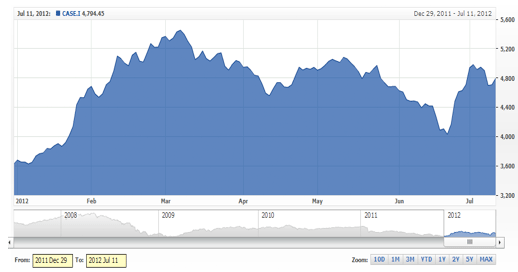
"Egyptian stocks still trade well below their historical averages on a price-to-book basis, but we believe a sustained multi-year rally is highly unlikely until real interest rates fall sharply - this is itself unlikely until pressure on twin balances is permanently reduced," said Simon Kitchen, an analyst at EFG-Hermes.
MACRO ISSUES
But there are a signs of a fragile recovery under way. The economy sprang to life with a 5.2% growth during the first half of the year after a mixture of contractions and insipid growth in the previous few quarters.
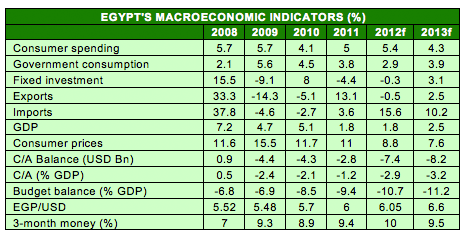
EFG expects the economy to post a 3% growth this year, after contracting nearly 1% in 2011. But it has largely been a jobless recovery as unemployment stands at a decade high of little over 12%.
"We expect growth to moderate over the course of the year as the base effect fades away. The main growth driver remains, by far, private consumption that benefits from higher wages, increased inflows from remittances and a Y-o-Y improvement in tourism revenues. FDI remains at record lows through recovering from last year's net outflows."
HSBC analysts are slightly more conservative, forecasting a 1.8% GDP growth in the year
The authorities have also initiated some new economic measures as well, such as identified by Cairo-based CI Capital:
- Adding EGP10bn to fight food inflation.
- Maintaining the current subsidies scheme.
- Increasing wages by 15% effective April 2011.
- Adding 150,000 families to the pension scheme through the allocation of USD17mn.
- Adding USD480mn for wheat and essential goods.
- Allocating EGP5bn fund to compensate damaged and robbed entities.
- Providing unemployment reimbursement of EGP500-1000 per employee.
- Permanent hiring of Government of Egypt temporary staff that exceeded the 3-year time frame.
- Postponing customs collection on imports of essential goods during February.
- Monthly compensation of EGP1500 for martyrs' families.
FOREIGN FOCUS
Egypt, which had historically been an investment magnet before the crisis, will need to employ all its charms to get foreign investment back to pre-revolution levels.
But the political dynamics have changed in the past year. In the post-Mubarak world, Egypt is still feeling its way through the new alliances. While, the Supreme Council of Armed Forces would be keen to keep the economic arrangements with Israel to ensure steady flow of U.S. aid, Mr Morsi will need to overcome the Muslim Brotherhood's instinctive suspicion of Gulf states to garner FDI.
Clearly, the president will have to have to tiptoe through the minefield of regional
relationships.
"Regionally, the election of an Islamist president is likely to damage relations with Israel and the Gulf monarchies," noted Oxford Analytica.
Gulf states, aside from Qatar, have long made clear their nervousness about the Brotherhood and its possible implications for like-minded domestic opposition.
"They will now have to adapt to a Brotherhood presidency. The Brotherhood appears eager to preserve good relations with these wealthy states that have promised financial aid and provide many jobs for Egyptian migrants -- for this reason it has no intention to irk them."
Almost on cue, Mr, Morsi's first foreign visit began with Saudi Arabia yesterday.
The Kingdom provided USD1.5-billion in grants and bond purchases, and other Gulf countries have also pledged amounts.
Meanwhile, the UAE has also made overtures to the new president.
"We are keen on strengthening these historical and brotherly relations during the upcoming period politically and economically," said foreign minister Sheikh Abdullah bin Zayed al-Nahayan in a statement.
FISCAL TRAP
These are welcome developments that will ensure the flow of foreign funds as Egypt works hard to avoid what EFG-Hermes calls the 'fiscal trap'.
"Egypt's fiscal position remains under intense pressure due to a widening fiscal deficit and pressures on financing sources," said EFG's Kitchen. "The tightness in local currency liquidity at the local banking sector is increasing the pressure on financing the deficit and is pointing to a clearly unsustainable fiscal position. We, therefore, believe that an IMF support package remains instrumental in easing short-term fiscal pressures and will then have to be complemented with structural reforms mainly comprising rationalising subsidies and introducing a value-added tax."
The government will have to strike that tough balance between tough structural reforms and popular policies that could burden expenditures.
Finally, the 2012/13 budget would be a key piece of the policy that will need to come into place very quickly under the new political order.
The draft budget was being debated by the parliament before they were unceremoniously ousted by the courts, leaving a key tool of the government in limbo. The budget had included an expenditure increase of 12% with wages and interest spending making up for more than 40% of the budget. The plan also included a 26% reduction in energy subsidy bill - a move that prove to be very unpopular.
There is a good chance that such policies may be delayed as the country rebuilds itself under the new President.
"Indeed, news reports citing sources in the Presidency indicated that we are not likely to see any increases in consumer fuel prices in the first year of Morsy's Presidency," said EFG's Kitchen. "We therefore exclude the suggested subsidy cuts from our forecasts and expect the budget deficit to widen to 10.6% of GDP in FY2012/13 from an expected 10.3% in FY2011/12."
It is the equivalent of kicking the can down the road, but with so many balls in the air, Mr. Morsi may be inclined to let this one drop, and hope that an economic
resurgence and a return of foreign funds may give him the fiscal flexibility to delay such reforms.
CONCLUSION
All things considered, Egypt has found a way to keep pushing and has refused to descend into chaos, even if it came back from the brink on more than a few occasions over the past 18 months.
Parliamentary elections, presidential elections and the stock market recovery suggests that while the challenges ahead remain daunting, the country should be able to pull through, perhaps even in a manner that's not appealing to everyone.
© alifarabia.com 2012