Azerbaijan and Armenia will be Central Asia's economic laggards, as the region grows 5.8% this year, with many of its countries growing north of 7%.
Fresh data from the International Monetary Fund this month shows, Azerbaijan will post the weakest growth, rising 4.1% in 2013, while Armenia will do slightly better with a 4.3% growth.
Meanwhile, Turkmenistan (7.7%), Uzbekistan (7%) and Tajikistan (7%) will grow at some of the fastest pace in the world. Kyrgyz Republic will also grow 7.4% this year, but after contracting just below 1% last year due to falling gold production.
While these figures look impressive, the IMF worries that growth is "moderating". Some of these economies had been growing at double-digit rates but growth is slowly tapering off as the impact of earlier reforms wear off.
Central Asian economies have managed to attain high growth on the back of strong commodity exports and early-stage reforms, but more needs to be done.
"To sustain the growth momentum, it will be important to further strengthen market-supporting institutions across all sectors - in the corporate sector, infrastructure, energy and finance and making further advances in the area of competition policy and its consistent implementation," said Eruk Berglof, chief economist at the European Business for Reconstruction and Development.
"These actions, together with improved cross-border infrastructure and greater regional economic cooperation and linkages, will help promote and diversify exports. This should make growth more inclusive and broad-based, benefiting populations at large."
Emerging markets
Analysts worry that Central Asian countries are dragging their feet on important political and economic reforms that are crucial to unlock the next wave of growth in the region.
Countries of the Caucasus and Central Asia (CCA) should aim to become dynamic and diversified emerging market economies over the next decade, said participants at a recent conference held in Kyrgyz Republic, highlighting reforms that focus on raising the business environment, moving away from vested interests and forging closer regional partnerships.
It is tough to see where the next wave of growth will come from, beyond the oil and gas and commodities sector.
Most of the countries are managed by dictatorial regimes, which actively stamp out dissent and directly and indirectly control the public and private lives of their citizens.
While high commodity prices have helped regimes control their respective countries, it may no longer be enough to gloss over the problems facing them.
Oil, natural gas and gold prices are falling, which could crimp growth in Central Asian countries heavily dependent on natural resources for their financial well-being.
As such, the IMF data shows there is very little difference between the economic performances of oil-exporting and oil-importing countries. In addition, oil and gas exporters are facing declining surpluses, while oil and gas importers are seeing their deficits flatten.
There is still time though for the countries to correct their paths.
"Policymakers across the CCA economies should take advantage of the still-favorable outlook to re-establish fiscal policy buffers," the IMF said. "This should be done through enhancing the quality and efficiency of public spending, avoiding further increases in hard-to-reverse items, revising the numerous existing tax exemptions, improving tax collection, and reining in general subsidies."
Freedom to unlock growth
Most Central Asian states fare poorly in most freedom surveys. The Heritage Foundation data shows most regional economies depend heavily on government spending, where business freedom, property rights, freedom of corruption are distant dreams.
Georgia, ranked 21st, Armenia at 38th are considered free or moderately free economies, while Turkmenistan and Uzbekistan were in the "repressed" category. Azerbaijan, Kyrgyz Republic and Tajikistan - were considered "mostly unfree".
These rankings highlight the bigger problems of lack of entrepreneurship, freedom to act and make business plans largely unencumbered by government interference.
"There will be a lot of high-risk moments in the next decade in Central Asia and the region's population is young and is entering into the job market when the global economy is weakening and in one of its least competitive regions," noted Carnegie Endowment for International Peace in an earlier report on the region. "All one can hope for is that the next generation of leaders emerging in these countries will be up to the challenges that they seem certain to face."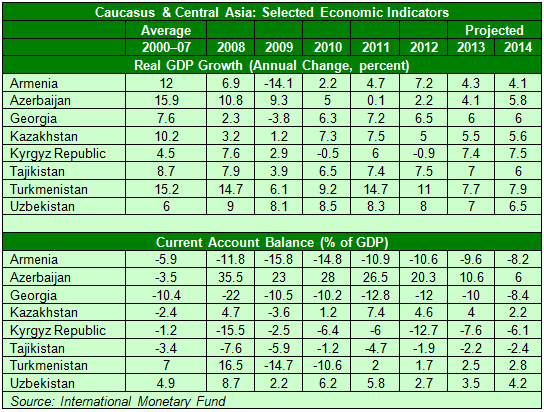
© alifarabia.com 2013