As the two-term Azeri president Ilham Aliyev prepares to run in the October presidential elections, his opponents are looking to field a credible candidate to rid the country of the Aliyevs' dynastic rule.
Aliyev's family has had an uncomfortable relationship with democracy. His father Hyder, who was once a senior KGB officer, launched a successful coup against Azerbaijan's only democratically elected leader Abulfaz Elchibey in 1993 to become president.
After ruling for 10 years, he stepped aside and nominated his son as his party's sole candidate in 2003. Aliyev secured majority votes but opposition groups claimed the process was deeply flawed. Aliyev won a second term in 2008 after the opposition boycotted the elections.
And now there are some concerns among the Azeri political elite whether the president should run a third term.
There are even rumors that the president's 48-year-old wife Mehriban Aliyev could mock-compete against him to further divide the opposition vote and perhaps orchestrate a political transition within the family.
A pro-government party had nominated the first lady, but she appears to have distanced herself from running for office - at least for now. Rumors, however, persist as she has recently been elevated to the position of deputy chair of her husband's New Azerbaijan Party.
Analysts think that the government may have released a trial balloon to gauge Aliyev's political stock among potential voters.
THE CHALLENGER
The president is looking to change the status quo because for the first time he may be up against a credible opposing candidate: Rustom Ibrahimbeyov.
The 74-year-old writer won an Oscar for his screenplay 'Burnt From The Sun' in 1995, and has emerged as a candidate that could be acceptable to a number of opposition groups after they came together under the National Council coalition.
Earlier this month, Ibrahimbeyov was in Washington to meet senior US officials in the hopes that the White House may see him as a viable candidate in contrast to the pro-Russia Aliyev.
Frosty relations between Russia and the United States may well inspire Washington to support Ibrahimbeyov and upset Moscow.
The playwright also offers an alternative to many Azeris who believe that the country's economic success has not been inclusive and has only entrenched Aliyev and his wider family into the political fabric of the country.
While Azerbaijan may have prospered, it has received dismal marks from virtually every human rights institution and NGO in the world.
Human Rights Watch says that since March 2012, the Azeri authorities have arrested or convicted at least 22 political activists, journalists, social media bloggers, human-rights defenders, and others who criticized the government. This year alone, people have been charged or convicted in 16 cases.
"Aliyev has also signed into law scores of regressive legislative amendments, further tightening the space for independent groups to operate by imposing new restrictions on freedom of expression, assembly, and association," said Giorgi Gogia, a senior Europe and Central Asia researcher at Human Rights Watch, urging the European Union to take action.
However, the EU will do little, given that it is keen to move away from Russian natural gas supplies and diversify its energy sources by tapping into Azerbaijan's abundance in the commodity.
STATUS QUO
It is unclear, though, whether Azeris are ready for a major change.
The International Monetary Fund (IMF) says that Azerbaijan has been one of the world's fastest growing economies in the past decade and has held up pretty well during the global financial crisis. Poverty has fallen rapidly, GDP growth has averaged 13% over the past decade and per capita income has risen six-fold to USD 6,000.
"Yet the country is at a critical juncture given the foreseeable decline in oil production and gas reserves amounting to only about 1/3 of oil wealth," the IMF said.
Most analysts are predicting oil production to decline within two decades and while natural gas revenues are on the rise, they may not be enough to offset falling oil receipts.
The age-old recommendation to diversify away from the hydrocarbon economy has been falling on deaf ears.
In fact, Azeri is hurriedly trying to position itself as a major supplier of natural gas to Europe.
On June 18, cash-strapped Greece signaled it would sell its natural gas grid operator DESFA to the State Oil Company of Azerbaijan Republic (SOCAR).
The Azeri energy company had proposed a 66% stake for USD 536 million for the Greek company, and marks a major breakthrough for the Azeri company to get into the European natural gas market.
The news comes hot on the heels of another major development that would push Azeri natural gas into Europe.
Trans-Adriatic Pipeline (TAP) and the Nabucco West Pipeline are competing for a piece of the 40 trillion cubic feet of natural gas reserves from Azerbaijan's Shah Deniz field, located in the Caspian Sea and considered one of the world's largest gas-condensate plays.
The field is operated by BP and Statoil, which own 25.5% each in the development, and also counts Azerbaijan's SOCAR (10%), Russia's Lukoil (10%), France's Total (10%), Iran's Naftiran Intertrade Company (10%) and the Turkish Petroleum Corporation (9%) as key partners in the project.
The consortium is set to decide on June 30, and TAP is expected to be the winner, according to some analysts.
"The most important message today is the following: the Southern Gas Corridor is not a theoretical project on the drawing board. It is about to be realized, to the benefit of all involved. It will bring initially 10 billion cubic meters to Europe by 2019, but we will not stop here," Aliyev said in a June 21 meeting with Herman Van Rompuy, president of the European Council, and Jose Manuel Barroso, president of the European Commission.
"The corridor could, in the medium term, cover more than 10% of our annual needs in Europe and thus contribute to our energy security, price stability, growth and jobs," noted Barroso.
GAS IS POLITICAL
The focus on natural gas is crucial to maintaining the Azeri economy's growth trajectory, especially as Aliyev needs a healthy flow of revenues to keep his citizenry content and opposition parties at bay.
But the country could face a number of challenges as commodity prices are falling, which is inconvenient for a president fighting for re-election.
"The government's planned spending program, including in the 2013 budget, is exacerbating oil dependence and increasing risks to a potential fall in global oil prices," said the IMF.
"The near-term fiscal position envisaged in the authorities' plans is also unsustainable over the longer term, given the short oil profile horizon."
"Reducing fiscal vulnerabilities while promoting a self-sustaining expansion of private-sector activity would thus require scaling down government spending, resisting pressures for a mid-year supplementary budget, and guarding against evasion from recent tax amendments."
Azerbaijan watchers will be curious to see how Aliyev plays his next few moves in the run-up to elections. For once, Azeris have a choice.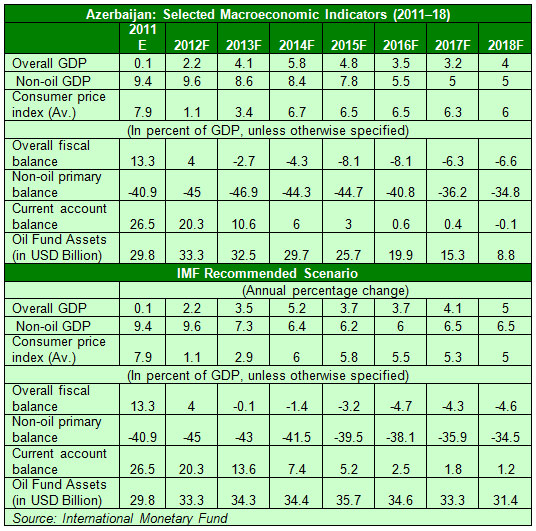
© alifarabia.com 2013