Africa's demand for electricity is expected to grow at an annual rate of 3% over the next two decades opening up lucrative opportunities for global utility companies and international investors, according to a new study.
Africa would require an additional 300 gigawatts (GW) of capacity to meet demand for a rising population and growing economic activity, according to EcoBank, a pan-African bank based out of Togo. This would require new capacity to double to around 7GW a year in the very near-term and perhaps quadruple by 2030.
"Given the obvious investment opportunity in the sector, a challenge for investors seeking power assets in Middle Africa will be to find ways to unlock financial value across the value-chain of power generation, transmission and distribution infrastructure, for both assets being sold and for new projects," the bank said.
Indeed, while electricity demand is rising 3%, most regional economies are expected to clock growth rates of 6-8%, which would further widen the gap between demand and supply.
In a bid to arrest the alarming power deficiencies, African governments have been seeking partnerships with the private sector to help deepen its infrastructure, fund the projects and take a stake in the developments.
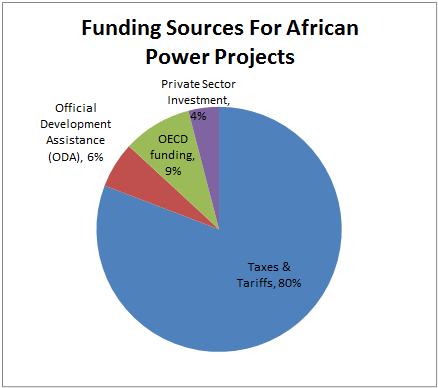
However, regulatory frameworks in many African countries are not conducive to investment.
"While access rates are improving in some countries, the business environment and policy framework are still not sufficiently robust to attract the level of private investment required to install the additional 250 GW by 2030," notes International Renewable Energy Agency (IRENA).
THE BIG SWITCH
Inability to access power may be the biggest challenge for Africans in their quest to lift themselves out of poverty, help their economies grow, create jobs and improve the standard of living in the African continent.
While citizens of most emerging markets take access to Internet, heating and light as basic necessities, more than 587 million Africans are deprived of basic electricity services today.
That number could actually grow in recent years, if governments do not initiate strategies to make the availability of electricity just a switch away for their citizens.
Average electricity use in Africa currently stands at 620 kWh per capita. For sub-Saharan Africa without South Africa, it stood at 153 kWh per capita, which is expected to rise to 235 kWh in 2020. In comparison, India currently consumes 640 kWh per capita and the world average is 2,730 kWh per capita.
More than 30 of the 48 African states face daily power outages. The blackouts are costly affairs, as they typically erase 5% of the GDP of Malawi, Uganda and South Africa, and around 1-5% of Senegal, Kenya and Tanzania's GDP each year.
An inefficient Transmission and Distribution (T&D) system further exacerbates the situation. Ecobank estimates the inefficiencies cost the continent approximately USD 5 billion each year.
"Utilities across the region actually lose up to 25% of power consumed as a result of these inefficiencies, compared to a 10% global average."
INVESTOR OPPORTUNITY
Investor interest has been piqued as arguably the world's most powerful man has backed the initiative to light up Africa.
Last July, US president Barrack Obama committed USD 7 billion to sub-Saharan Africa's electricity network, which has sparked strong interest from foreign investors.
It is, however, nowhere near the USD 300 billion needed for the region to achieve universal access to electricity over the next two decades.
Other countries such as China are also offering loans, facilities and investments to ensure African economic activity is uninterrupted by power shortages, while companies from Japan and India are also major investors in the continent's power sector.
Ernst & Young, the advisory group, notes that Africa offers large transactional opportunities, particularly in Nigeria's reform processes; and sub-Saharan infrastructure investment will drive rapid foreign investment into the continent.
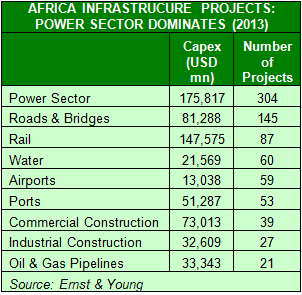
"Growing energy demand, regulatory and social reforms and the need for infrastructure investment have seen Africa become one of the world's top energy investment destinations. Infrastructure spending hit USD 700 billion in 2012, with the power sector accounting for 25%, or USD 176 billion, of this investment," E&Y noted from the latest available figures.
Clearly, there is a huge gap in funding the power infrastructure, which should be attractive to many international investors.
Ecobank notes that the annual funding requirement for the region's power sector between now and 2015 is estimated to be at least USD 40.6 billion, with an annual funding gap of around USD 20 billion.
RENEWABLE VS FOSSIL FUEL
There is a great debate among analysts whether Africa should be powered by fossil fuels or renewable energy.
Proponents of green energy argue that the continent will benefit from solar, wind and hydroelectricity and the developments will also be easier on the environment, while fossil fuel developers note that the discovery of new reserves of crude oil and natural gas across Africa makes hydrocarbons the cheaper choice.
The reality - as is often the case in such arguments - falls somewhere in between.
In 2012, Kenya and Morocco secured a combined USD 2.9 billion in clean energy investments, while South Africa received USD 5.7 billion of investment in 2012.
"As more African countries try to attract inbound utility investment, the value of partnerships is clear. This was highlighted during Nigeria's recent USD 2.5 billion privatization process where local players -- in consortia with foreign players, including Siemens, Manila Electric, Symbian Power and KEPCO -- emerged as winners of most projects," E&Y noted.
As the countries move to privatize power plants, foreign investors are expected to swoop in, leading to a spirited round of merger and acquisition opportunities in the sector.
A whole host of financial investors and utility firms are circling around countries like Nigeria. Indeed, Power China Corporation's USD 20 billion memorandum of understanding to invest in the country's electricity infrastructure is the most powerful evidence of the opportunity available for deep-pocketed, and often fearless, investors. The deal will see the company develop gas and coal-fuelled capacity and facilitate resources to build 10,000 kilometers of super-grid.
"The long-term viability of [many of] these projects is yet to be seen, as at least one-third of Africa's power projects are still in the conceptual stages and half of all capital is also locked in the planning stages. But companies with strong capex management programs and thorough due diligence should do well," E&Y noted.
GAS TO THE RESCUE
The high cost of electricity in the continent is also part of the problem. Fossil fuels are expensive due to high shipping costs of diesels from ports. Landlocked countries find it even more challenging to access imported fuel, which adds to the high costs.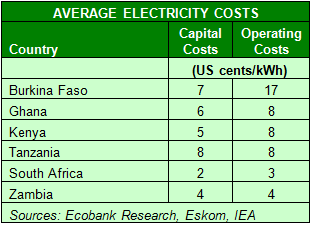
However, the development of natural gas resources could turn the tide for many African nations.
"Domestically, the power sector will be the most crucial off-taker of gas in Middle Africa," Ecobank noted.
Natural gas makes up around 25% of total power generation in Sub-Saharan Africa, and appears poised to account for an increasing proportion of the region's fuel mix.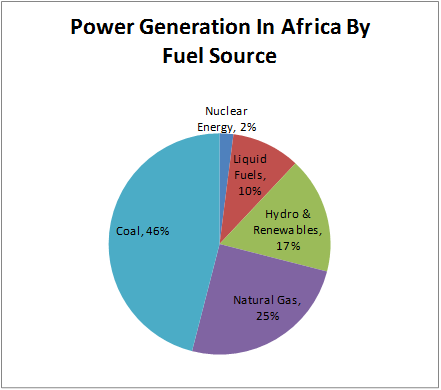
As Sub-Saharan Africa looks to spend an estimated USD 23 billion each year over the next decade to meet its power needs, government will need to introduce policies that are conducive to supporting gas supplies to the domestic market, EcoBank said.
"Gas-fired power projects in the region are likely to consume over 5 billion cubic meters of gas every year, in order to generate at least 2,892MW of electricity. ... The expanding gas reserves in Middle Africa will prove increasingly attractive for investors and firms seeking an integration strategy that secures gas supplies and feedstock for those firms' thermal power plant projects at competitive prices."
The feature was produced by www.alifarabia.com exclusively for www.zawya.com.
© Zawya 2014