Tahseen Consulting research finds underrepresentation of GCC women in science, technology, engineering, and mathematics (STEM) fields is increasingly a problem that compromises regional development. Why, with so much effort directed at attracting women to STEM fields, are the results so dismal and what should be done?
Dubai, UAE - GCC nations face similar challenges in transitioning towards knowledge-based economies -- they remain natural resource dependent, employ large numbers of nationals in the public sector, and rely on foreign workers to fill the private sector. While demand for workers in STEM fields has surged, traditionally much of this demand has been filled by foreign labor. According to new research by Tahseen Consulting, GCC governments are gradually restructuring technical vocational education and training (TVET) systems along with introducing labor market reforms to reorient national employment towards the private sector and in-demand STEM fields.
"TVET in the GCC currently faces an identity crisis in which people are unhappy with the name, the image, and reputation. GCC nations are particularly struggling with increasing TVET enrollment and employment of women in STEM fields," said Walid Aradi, Chief Executive Officer of Tahseen Consulting and coauthor of the report. "The success of females in accessing higher education, in which females now make up the majority of enrollments in nearly all of the GCC countries, to some degree has masked the emerging regional challenge of attracting women to STEM programs and emerging high skill, knowledge-intensive, STEM fields."
In recognition of the potentially powerful addition that women can play in regional economies, GCC governments have set ambitious goals to expand the number of women enrolled in TVET programs and working in STEM fields. However, the research finds women are still much less likely to study STEM fields, and, when they enter employment, they tend to be concentrated in fields that are inconsistent with national economic ambitions for transitioning to diversified, knowledge economies. 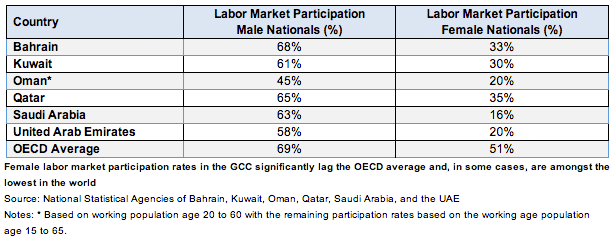
Why So Few? Barriers to Engaging GCC Women in STEM Education
Women are often directed by family members away from pursuing STEM programs, despite their interest or aptitude, due to ingrained cultural ideas about appropriate educational pathways and career tracks for women. While female role models can provide aspirational examples for women's education and employment decisions that might challenge existing cultural ideas, there are very few female role models presently who received TVET training and are employed in STEM fields. The lack of female faculty available to teach TVET programs in the GCC also implicitly sends the message that STEM fields are less appropriate for females.
"By offering few secondary TVET options to girls, the structure of academic pathways in many GCC countries contributes to female preferences for non-STEM programs. Female enrollment in secondary TVET has remained significantly lower than males. While career guidance can help girls consider broader education and employment paths, career advisors are often focused on coaching students towards non-STEM higher education fields," said Wes Schwalje, Chief Operating Officer of Tahseen Consulting and lead author of the report. "GCC nations have launched ambitious sponsorship and scholarship programs yet many of these programs perpetuate gender-biased labor market segmentation by incenting women to study fields such as clerical and administrative work over STEM fields. Higher education enrollment statistics show that women tend to pursue concentrations such as nursing, education, arts, and social sciences, rather than technical or scientific fields." 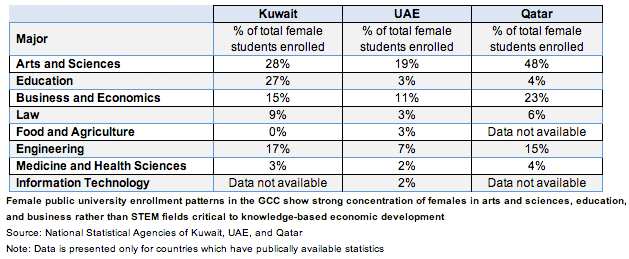
What Holds Women Back? Barriers to GCC Female Employment in STEM Fields
Women interested in STEM fields are often exposed to negative social pressure to avoid more diverse professions in favor of culturally acceptable roles in the public sector and state owned companies. The high concentration of females in the public sector serves to reinforce social views that the public sector is the only appropriate employer for females. The difficulties women experience transitioning to the labor market and between jobs also makes them more likely to retain jobs in the public sector or become discouraged and voluntarily remove themselves from the labor market.
Women also encounter difficulties finding employment in more diverse STEM fields due to structural labor market features. In most GCC countries, the extractive industries remain the major economic sector. However, the extractive industries and many of the emerging fields that have fueled recent GCC growth tend to be heavily male-dominated fields that attract few women. High percentages of foreign males in the private sector labor force encourage women to seek more culturally and socially acceptable employment in fields with more women or those in gender-segregated environments. Personal status laws and vague language in national labor laws, although recently reformed in many of the GCC countries, continue to restrict some women from entering STEM fields. While all GCC nations have undertaken nationalization policies to increase the number of national workers in the labor force and specifically in crucial private sector professions, nationalization initiatives have historically targeted male dominated industries, such as oil and gas, which are less attractive to women. 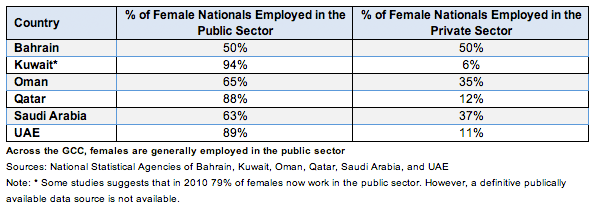
What GCC Countries Can Do
Increasing female enrollment and employment in STEM fields will require addressing a variety of national education and training system and labor market challenges in addition to influencing individual behavior change.
Overcoming Policy, Planning, and Systemic Challenges to Equitable TVET Provision
Across the GCC, some STEM options are not open to women, including many advanced engineering sub-disciplines critical to regional development. Addressing the supply of TVET programs means not only increasing the number of options available to women but also ensuring that institutions are female-friendly and offer high quality programs attractive to females.
Increasing Female Enrollment in STEM Programs
To increase the number of females studying in STEM programs at the secondary and tertiary levels, GCC countries will have to address socio-cultural barriers to enrollment. Addressing these barriers will involve interventions and policies aimed at students and parents that positively influence persistent beliefs about the kinds of students who attend TVET and the post-graduation opportunities available to women.
Encouraging Women to Enter Employment in STEM Fields
Ease of entry, effective labor market and social policies, and female-friendly workplaces are critical to attracting outgoing technically trained females from national education and training systems to employment in technical fields. However, regional employers remain resistant to offering more flexible employment modalities to attract and retain highly skilled female employees.
Increasing Employer Demand for Technically Trained Females
Increasing female employment rates in technical fields will require increasing employers' demand for female labor in a way that overcomes existing preferences for public sector employment. In several GCC countries policy experiments with training and wage subsidy programs have proven effective in incentivizing companies to hire more women.
To arrange an interview with one of the authors, please contact Wes Schwalje at wes.schwalje@tahseen.ae or visit www.tahseen.ae
About Tahseen Consulting
Tahseen Consulting is a specialized advisor on strategic and organizational issues focusing on governments, social sector institutions, and corporations in the Arab World. Applying substantive industry knowledge, evidence-based insights, and analytical rigor, we work alongside our clients to help optimize strategic decision-making, solve organizational challenges, and appraise the impact of strategic initiatives. To learn more, please visit www.tahseen.ae
Media Contact
Wes Schwalje Tahseen Consulting
wes.schwalje@tahseen.ae
© Press Release 2014