PHOTO
Sharjah: The UAE’s agriculture sector has developed by leaps and bounds in the last decade. To boost the country’s production, the Sharjah Research Technology and Innovation Park (SRTI Park) has been developing innovative technologies, including hydroponics, that will also help ensure food security in the region.
Hussain Al Mahmoudi, CEO of SRTI Park, said: “SRTI Park is a hub for researchers, entrepreneurs, start-ups and industry experts who develop solutions that can shape food food production not only in the UAE but also regionally and globally.
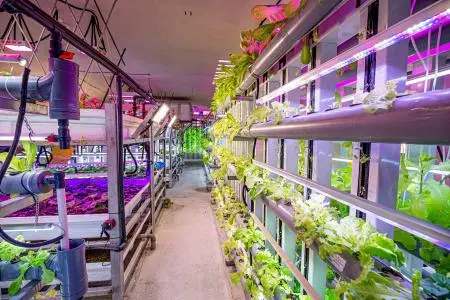
“We have been harnessing technology for agricultural production and food security. We develop hydroponics and located inside SRTI Park is Merlin Agrotunnel, an aquaponics farm (combination of raising fish and cultivating plants in tanks) with an area of around 150 square metres that can produce over one ton of organic vegetables and fruits every month,” he noted.
Better yield with less resources
Al Mahmoudi explained: “Hydroponics requires a rather large cost in the beginning but it significantly reduces the consumption of water – it saves about 70 per cent of water – and use less or no fertilisers, which makes it perfect to grow food in a desert environment with less agricultural space and far less water resources.”
Aquaponics, meanwhile, is a form of agriculture that combines raising fish in tanks with soil-less plant culture (hydroponics). The nutrient-rich water from raising fish provides a natural fertiliser for the plants and the plants help to purify the water for the fish.
Indoor farming eliminates extreme outdoor temperatures and makes particular sense in our desert environment. We use very little water – about 90 per cent less than conventional farming – and because it is aquaponics, we also produce fresh fish along with a range of vegetables and fruits.
The water that is used to irrigate the fruits and vegetables is seawater, desalinated through solar energy, thus completing the development of an integrated system ensuring sustainability of our natural resources.
Sustainable food in a land-scarce environment
Al Mahmoudi noted a team of botanists, agriculturists and engineers from Merlin International, has been conducting researches to develop a soil-free vertical cultivation (farming) technology that is the ideal way to produce sustainable food in a land scarce environment.
“This agricultural system at SRTI Park is one of the solutions to the problems of agriculture and food production. The agrotunnel can be combined into multiple units to create a commercial farm to provide fresh organic produce for multiple households daily. The agrotunnel can work in any environment and weather condition – even in the middle of the desert. We use advanced cooling technologies that can work on solar energy and can harvest water from sea or air,” he added.
Al Mahmoudi underlined: “The searing summer temperature, a desert landscape and inadequate rainfall are the main challenges to UAE’s agricultural activities. The coronavirus (COVID-19) pandemic has also highlighted concerns of global food supply chains being disrupted. But we have the technology to boost local agriculture and foster arming innovation.”
He further explained: “By focusing on research and developing more advanced technology for agriculture, we can definitely overcome the challenges. For instance, we can enhance the soil to have a higher water retention and allow us to have better water management. We can explain to local farmers how best to deal with crops and maximise their yield. We can teach them about hydroponics and aquaponics. We should also promote vertical faming to control the amount of water needed. This type of farming also uses artificial light as an alternative to sunlight.”
Accelerating agricultural growth
“Research and further development of farming methods agricultural technology will definitely accelerate the sector’s growth. We can also use AI (Artificial Intelligence) and big data to boost agricultural produce. We can use drones to map out plants suitable on outdoor farms to save resources,” he continued.
“We want to grow more plants and learn how to grow them better. We want to invite farm owners, agri-business investors, start-ups and anyone interested in this vital sector to collaborate with SRTI Park and advance our agricultural technology,” concluded Al Mahmoudi.
Ends
About Sharjah Research Technology and Innovation Park:
The aim of SRTI Park is to provide an environment that nurtures creativity and innovation by creating an attractive, sustainable park with world-class infrastructure and services. The Park supports, promotes, and develops innovation within the UAE and enhances the Emirate's status as a global destination in the fields of research and technology.
© Press Release 2021
Disclaimer: The contents of this press release was provided from an external third party provider. This website is not responsible for, and does not control, such external content. This content is provided on an “as is” and “as available” basis and has not been edited in any way. Neither this website nor our affiliates guarantee the accuracy of or endorse the views or opinions expressed in this press release.
The press release is provided for informational purposes only. The content does not provide tax, legal or investment advice or opinion regarding the suitability, value or profitability of any particular security, portfolio or investment strategy. Neither this website nor our affiliates shall be liable for any errors or inaccuracies in the content, or for any actions taken by you in reliance thereon. You expressly agree that your use of the information within this article is at your sole risk.
To the fullest extent permitted by applicable law, this website, its parent company, its subsidiaries, its affiliates and the respective shareholders, directors, officers, employees, agents, advertisers, content providers and licensors will not be liable (jointly or severally) to you for any direct, indirect, consequential, special, incidental, punitive or exemplary damages, including without limitation, lost profits, lost savings and lost revenues, whether in negligence, tort, contract or any other theory of liability, even if the parties have been advised of the possibility or could have foreseen any such damages.