PHOTO
Abu Dhabi, United Arab Emirates - Solar and wind energy paired with battery storage are reliable and already today deliver cost-effective, round-the-clock electricity, according to a new report by the International Renewable Energy Agency (IRENA).
24/7 renewables: The economics of firm solar and wind confirms that in prime solar and wind regions, hybrid solutions combined with storage deliver round-the-clock power at lower costs than fossil fuels.
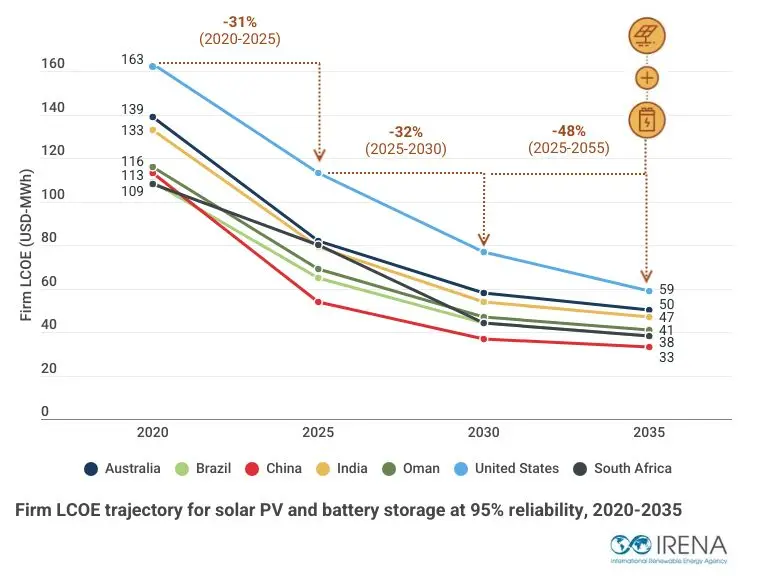
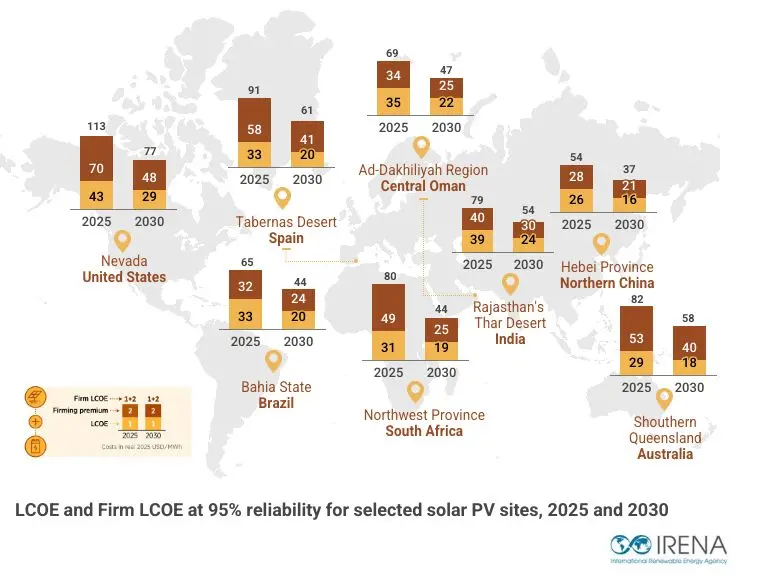
Firm levelised costs of electricity (‘firm costs’) for solar plus storage range from USD 54 to USD 82 per megawatt-hour (MWh) in high-quality resource regions, compared with USD 70–85 per MWh for new coal in China and more than USD 100 per MWh for new gas globally.
Commenting on IRENA’s new report, United Nations Secretary-General António Guterres said: “The worst energy crisis in decades has exposed the true cost of fossil fuel dependence. But another path is now possible. Renewable power is increasingly the most affordable, reliable and secure option. Let us accelerate the transition, invest in energy infrastructure, and strengthen international cooperation to finally deliver clean, homegrown power to people everywhere.”
IRENA Director-General Francesco La Camera added: “24/7 renewable power is now cost-competitive with fossil fuels. The long-standing argument that renewables lack reliability no longer holds. Today, renewables can deliver reliable, round‑the‑clock power. As oil and gas markets remain exposed to geopolitical shocks, including ongoing disruptions in the Strait of Hormuz, we must insulate our economies with resilient renewable systems. The economics of the entire energy system have shifted: the battery revolution has driven down costs while accelerating advances in storage. The advantage of renewables is not only economic but strategic, strengthening resilience, stability, and energy security in times of crisis.”
24/7 renewable power optimises the use of constrained grid connections, shifts electricity production to higher-value hours and reduces exposure to price volatility. These hybrid solutions are well positioned to serve the most demanding electricity users, including artificial intelligence (AI) and data centres that require uninterrupted supply as one of the key commercial benchmarks. Firm renewables also enable the production of clean fuels for hard-to-abate sectors, where economic viability depends not only on costs but also on the ability to operate at high utilisation rates.
IRENA’s analysis shows that firm costs have declined rapidly, driven by falling costs for solar PV, wind power and battery storage. Since 2010, total installed costs declined by 87% for solar PV and by 55% for onshore wind. Battery storage costs fell even more sharply, declining by 93%.
Construction timelines are also shortening with projects typically being built within one to two years of securing permits and grid connection, well ahead of new gas-fired alternatives in most markets.
Continued technology learning, manufacturing scale and supply chain integration are expected to drive further cost reductions across all three technologies. As costs fall simultaneously across solar, wind and batteries, their combined effect on hybrid systems is already significant.
IRENA analysis of solar-plus-battery configurations across multiple countries shows that firm costs have fallen from above USD 100 per MWh in 2020 to around USD 54-82 per MWh by 2025 at high-irradiance solar regions and strong wind corridors.
Further cost reductions of roughly 30% by 2030 and around 40% by 2035 are projected, bringing firm costs below USD 50 per MWh at the best-performing sites by 2035. The United Arab Emirates' Al Dhafra complex for example, that pairs solar PV with battery storage, already illustrates what this means in practice: delivering a firm 1 gigawatt of clean electricity at around USD 70 per MWh.
Firm wind‑plus‑storage systems are also becoming increasingly competitive. IRENA’s estimates for 2025 show that firm wind-plus-storage costs ranged from around USD 59 per MWh in Inner Mongolia to around USD 88-94 per MWh across Brazil, Germany, and Australia, with costs projected to fall to roughly USD 49-75 per MWh across these markets by 2030.
Costs decline further when wind is combined with solar PV, leveraging complementary generation profiles to reduce storage requirements and overall system cost.
24/7 renewables: The economics of firm solar and wind provides a robust benchmark for evaluating and comparing the costs of round‑the‑clock renewable power, while analysing cost trends, cost drivers and regional variations in hybrid, round-the-clock solar, wind and storage systems.
About the International Renewable Energy Agency (IRENA)
IRENA is the lead intergovernmental agency for the renewables-based energy transition in pursuit of a systemic change across the energy sectors. A global energy agency comprised of 171 members, with 14 additional countries in accession, IRENA provides knowledge, technical assistance and capacity building, project and investment facilitation. The Agency enables international cooperation and partnerships to fight climate change and promote sustainable development, energy access, energy security and resilient economies and societies.
Contact information:
Nicole Bockstaller, Chief, Communications Officer, IRENA, nbockstaller@irena.org