With Mat Green, Associate Director – Research & Consultancy, CB Richard Ellis Middle East
HOP TOPICS
Successful opening of Dubai Metro, a major infrastructure event;
Commercial office lease rates are reflecting the rates that prevailed in 2006;
Residential lease terms becoming more flexible;
Residential sales rates continue to slip with increasingly more competition.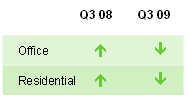
OVERVIEW
The market continues to seek signs of stabilisation amid hopes of a modest recovery in fortunes during 2010.
One glimmer evident in Q3 was downward movement in interest rates as market dynamics continued to shift.
At start of downturn, mortgages were virtually impossible to secure as banks reined in credit.
In terms of lease & sale rates, we believe the bottom is nearing but we can expect a further nominal decline before year end.
In 2010, rate declines will become more project specific, with areas of significant oversupply typically suffering the most.
The last quarter saw another addition to Dubai’s improving infrastructure with partial opening of Dubai Metro.
Although it is too early to determine price movements, it is very likely that developments within a 200-300 metre radius of stations will enjoy positive impacts on occupancy and pricing in the long run.
OFFICE SECTOR
Pressure on lease rates continued during the quarter as demand for office space remained low.
Situation was aggravated further by considerable new supply on top of an increasing availability of existing stock.
Lease rates are currently below 2006, a reflection of true extent of financial downturn.
Although lease rates have dropped across all commercial districts of Dubai, occupancy levels in Central Business District (between Trade Centre and Interchange 1) are faring better than newly established districts.
Lease rates in Central Business District during Q3 ranged between AED 2,152 – 2,422 sq/m/per annum for smaller units and AED 1,958 – 2,204 sq/m per annum (8-10% lower) for larger offices.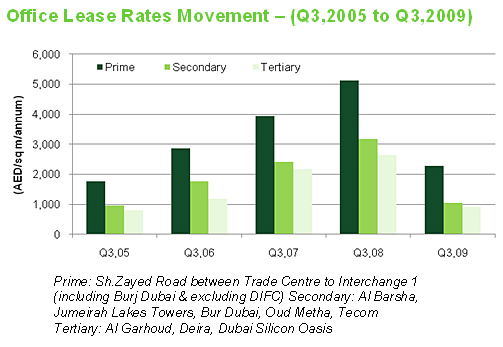
On average, lease rates in CBD dropped approx 55% year-on-year, while secondary locations experienced a downward movement of 67%.
Main reasons for sharp fall in secondary locations can be attributed to ownership status as well as timing of new stock entering the market.
Locations worst effected have been Al Barsha, Jumeirah Lake Towers and Tecom C.
Drop in lease rates in tertiary locations on a year-on-year basis has been around 65%.
Market downturn has resulted in the creation of two-tier market for prime rents in the Emirates.
The first tier of office space in DIFC development is holding firm, significantly above levels in other locations within the CBD.
DIFC lease rates range between AED 3,250 – 4,300 sq/m per annum for accommodation from private developers.
Other prime locations within CBD are now transacting at AED 2,150 – 2,420 sq/m per annum, around 50% down on Q3 2008.
RESIDENTIAL SECTOR
Pressure on residential market as a whole has continued during Q3.
Compared to previous quarters, drop in rates has been marginal and this easing of rental levels is expected to persist during remainder of 2009.
One trend that has emerged as lease rates have dropped has been the offering of properties furnished at unfurnished rates.
They were 10-20% higher (than unfurnished) but in current market, the probability of leasing furnished residential units is much higher than unfurnished.
Another trend has been shift in payment terms with multiple cheques instead of one; with some even offering get-out clauses.
The drop in lease rates among list of locations year-on-year has been circa 39%.
For comparison, lease rates in non-freehold locations have performed marginally better than the freehold locations.
Highest drop among non-freehold locations has been in Al Barsha (1 bed) – 48%:
Q3 2008 average lease rate was AED 110,000 – 120,000 /pa.
Q3 2009 average lease rate is AED 55,000 – 65,000 /pa.
This is despite Al Barsha emerging as popular residential district due to proximity to local retail, hospitality and office destinations.
Newly developed areas are faring comparatively badly in downturn compared to more established communities. Issues pertaining to ongoing infrastructure and construction works are some of the more commonly quoted issues that have led to this disparity arising.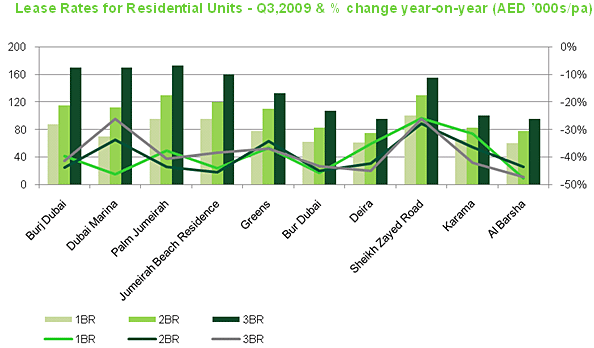
Generally, at the higher end of market, sales prices are not being discounted on availability lists provided by developers; however deals are being made with extras such as furniture packages increasingly included.
- Similar to commercial and residential leasing markets, the demand & supply balance is further aggravated by the rapidly growing number of residential towers complete and available.
- This is on top of increasingly high number of re-sales, resulting in oversupply and high competition.
- In many developments we are seeing re-sales at 2006 rates, a stark reminder of the extent of the market downturn in space of just one year.
MARKET OUTLOOK
Shortterm outlook for both residential and commercial properties across Dubai likely remain slow-moving.
We anticipate continuation of rising vacancy ratios, however, this will be project-specific and largely dependant on location, quality and amenities offered by each development
As rental and sales rates drop in residential sector, we foresee continued inward migration from neighbouring Emirates and increasing pressure to negotiate both sale and lease terms.
We have already witnessed a notable rise in tenant movements to either larger apartments which were previously too expensive or to the lower end of the market where terms are more flexible and rates lower, due to continued fear of job security.
OTHER SECTORS
Metro
Unlike so many other public service projects strung around the world, it will actually deliver to a long-term timeline commitment.
The commercial and social impacts are simply immense, for advanced public transport plays a crucial role in facilitating faster and more sustainable growth.
Transportation and land use are of course inextricably linked.
Exemplary urban transportation systems expand both the range of housing locations and livelihood options. Facilitating non-motorised modes of transport and giving priority to public transportation also helps to reduce transport costs and protects the environment.
- Urban density is generally more cost effective than urban sprawl which leads to low public transportation cost in medium to high density cities. Dubai's existing developments are spread from Deira north of the Creek to Jebel Ali in the south along the main highways in the shape of the Emirates and Sheikh Zayed Roads.
- Hope does remain that improving transport infrastructure, such as the Metro, will eventually help bring the UAE in line with its European counterparts, like Germany, where high car ownership levels do not automatically equate to high vehicle usage. Regular motorists living within walking distance of core networks need to be incentivised to leave the car at home and use public transport instead, but the hot summer months will become the acid test.
Free Zones
Free Zones are popular areas of business due to varying benefits including, 100 percent repatriation of capital and profits, multi-year leases, easy access to sea and airports, energy connections and assistance in labour recruitment.
In addition, the Free zone authorities provide significant support services, such as sponsorship, labour accommodation, dining facilities, recruitment and security for a fee.
The most well known Free Zones over the years have been TECOM (Dubai Internet City, Media City), Jebel Ali Free Zones and Airport Free zone.
The success of these Free Zones along with the demand for office space has over the years resulted in the emergence of new Free Zones.
These include Dubai International Financial Centre (DIFC), Jumeirah Lake Towers, Dubai Healthcare City and Dubai Silicon Oasis.
Declining demand for office space and significant new supply over the last nine months has resulted in a notable drop in lease rates in Dubai’s Free Zones
This has created a ripple effect that has steadily moved towards the emerging Free Zones which offer office space on a freehold basis.
Decline has been felt the most in the emerging new Free zone areas of Jumeirah Lakes Towers (JLT) and Dubai Silicon Oasis, which have suffered a heavy drop in price since the beginning of this year.
The drop in sales rates has seen individual owners extending holding periods and frequently opting to lease their properties rather than looking to sell.
On average, rents in JLT were AED240-280/ft²/pa in Q3 2008 but are now being offered at AED70-120/ft²/pa.
- However, there was a notable supply factor in the development during this period with just circa 2.5million ft² across eight towers in Q3 2008.
- This space almost doubled over the past year with close to 5.2million ft² currently completed.
- Additional space along with the weak demand has resulted in a drop in lease rates of 63%.
Other developments to have witnessed a sharp drop in lease rates include Dubai Silicon Oasis and TECOM C, with properties in these developments being largely sold to private investors.
Office space from private developers in Dubai Silicon Oasis is typically offered at AED50/ft² to max of AED80/ft² while in TECOM C the rents are in the range of AED85-130/ft²/pa.
The highest office lease rates among the Free zones exists in the DIFC where the lease rates in the buildings managed by private developers stand in the range of AED 280-325/ft²/pa.
-Ends-
Further press information
Matt Green is available for comment and interview.
The full report can be sent on demand. Please contact Tom Watterson (momentum) on +971 4 390 1630 / +971 56 605 2854 for further details.
Disclaimer 2009 CB Richard Ellis
Information herein has been obtained from sources believed to be reliable. While we do not doubt its accuracy, we have not verified it and make no guarantee, warranty or representation about it. It is your responsibility to independently confirm its accuracy and completeness. Any projections, opinions, assumptions or estimates used are for example only and do not represent the current or future performance of the market. This information is designed exclusively for use by CB Richard Ellis clients, and cannot be reproduced without prior written permission of CB Richard Ellis.
© Copyright 2009 CB Richard Ellis
© Press Release 2009