Notebooks of the Bookseller wins 2021 International Prize for Arabic Fiction
Jordanian poet and novelist Jalal Barjas wins 14th edition of International Prize for Arabic Fiction, having been previously longlisted for the prize in 2019
His novel tells the story of a book lover’s experience with schizophrenia and a crime spree he commits using the names of characters from fiction
Notebooks of the Bookseller by Jalal Barjas was today announced as the winner of the International Prize for Arabic Fiction (IPAF). The novel, published by The Arabic Institute for Research and Publishing, was named as this year’s winner by Chair of Judges Chawki Bazih during a virtual winner ceremony.
In addition to being awarded USD $50,000, funding will be provided for the English translation ofNotebooks of the Bookseller, and Barjas can expect to see an increase in book sales and international recognition.
Chawki Bazih, Chair of the 2020 IPAF Judging Panel, says:
“Apart from its rich, refined language and tight, thrilling plot, this bold winning novel is distinguished by Jalal Barjas’ impressive ability to strip the masks from the face of tragic reality. The author presents us with the darkest portraits of homelessness and poverty, where meaning has been lost and hope torn up by the roots, turning life into a realm of nightmares. Despite this, the novel does not call for despair. Rather, through it, the author is saying that reaching the depths of pain is a necessary condition for finding new dreams and standing up once more with hope on firmer ground.”
Professor Yasir Suleiman CBE, Chair of the IPAF Board of Trustees, says:
“Evoking times of unprecedented change, incipient corruption and simmering turmoil hissing away in the background, Notebooks of the Bookseller reflects on the lives of those who have been left behind in an alienating and expanding city landscape, mercilessly displacing the intimacy of olden times and the obligations of time-honoured norms. The crisscrossing tales in the novel mark multiple descents into unforgiving despair. Sometimes pacy, but often slow and rich in detail, the novel paints a gripping picture of social and psychological fracture writ large.”
Set in Jordan and Moscow between 1947 and 2019, Notebooks of the Bookseller tells the story of Ibrahim, a bookseller and voracious reader, who loses his shop and finds himself on the street. Experiencing schizophrenia, he assumes the identities of the protagonists of the novels he loved, to commit a series of crimes of burglary, theft and murder. He attempts suicide, before meeting the woman who will change his life. This story and others are told through a series of notebooks and multiple narrators whose paths sometimes collide. It is the painful, fragmented tale of marginalised people who are ignored or invisible to others, while a corrupt ruling class thrives. Against this background, the importance of the house is highlighted, as a symbol of the homeland. Barjas’s novel audaciously tackles a difficult reality not just in Jordan but the Arab world as a whole.
Barjas is a Jordanian poet and novelist, born in 1970. He works in the field of aeronautical engineering. For many years, he wrote articles for Jordanian newspapers and headed several cultural organisations. He is currently head of the Jordanian Narrative Laboratory and presents a radio programme called “House of the Novel”. His published work includes two poetry collections, short stories, travel literature and novels. His short story The Earthquakes (2012) was winner of the Jordanian Rukus ibn Zaʼid ʻUzayzi Prize. His novel Guillotine of the Dreamer (2013) won the Jordanian Rifqa Doudin Prize for Narrative Creativity in 2014, and Snakes of Hell won the 2015 Katara Prize for the Arabic Novel, in the unpublished novel category, and was published by Katara in 2016. His third novel Women of the Five Senses (2017) was IPAF-longlisted in 2019.
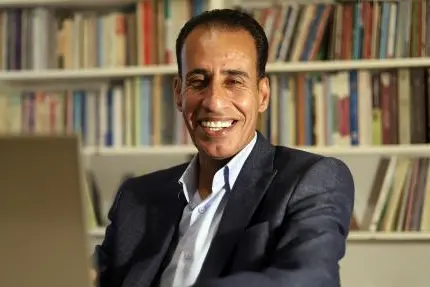
Jalal Barjas, winner of the 2021 International Prize of Arabic Fiction, said:
“Thank you to the International Prize for Arabic Fiction which has opened all these beautiful paths to readers so my words could reach them. Through these words, I endeavoured to sow joy into the field of humanity.”
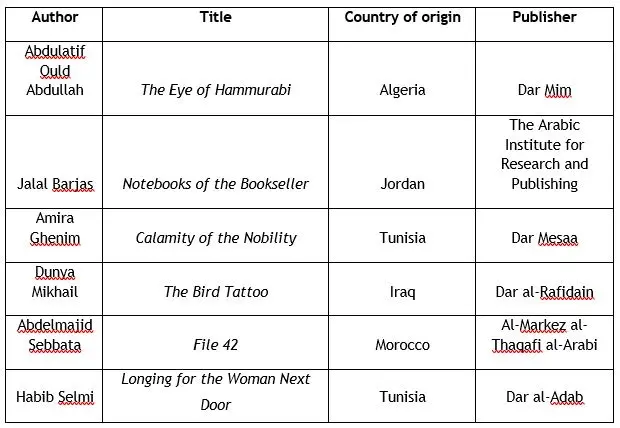
Notebooks of the Bookseller was chosen by the IPAF judges as the best work of fiction published in Arabic between 1 July 2019 and 31August 2020 from a shortlist of six novels by authors from Algeria, Iraq, Jordan, Morocco and Tunisia. The shortlisted finalists — Abdulatif Ould Abdullah, Amira Ghenim, Dunya Mikhail, Jalal Barjas, Habib Selmi and Abdelmajid Sebbata — will each receive USD $10,000.
Barjas will participate in media interviews on 25 and 26 May. On Thursday 27 May at 3pm BST / 6pm GST he will take part in an event at the Abu Dhabi International Book Fair alongside the shortlisted authors. In the session entitled ‘IPAF: Honouring the 2021 Winner and Shortlisted Authors’, Lebanese scholar Bilal Orfali will interview the authors about their journeys, from initial idea to finished book.
The 2021 judging panel was chaired by Lebanese poet and author Bazih, and consisted of: Mohammed Ait Hanna, a Moroccan writer, translator and lecturer of Philosophy at the Regional Centre for Teaching Careers and Training in Casablanca; Safa Jubran, a lecturer of Arabic Language and Modern Literature at the University of São Paulo in Brazil; Ali Al-Muqri, a Yemeni writer twice longlisted for IPAF, in 2009 and 2011; and Ayesha Sultan, an Emirati author, journalist, founding director of Warrak Publishing House and Vice President of the Emirates Writers Union.
In fulfilling its ambition to increase the international reach of Arabic fiction, the prize provides funding for the English translation of its winners. Winning novels published in English include Hoda Barakat’s The Night Mail (translated as Voices of the Lost, Oneworld); Rabai al-Madhoun’s Fractured Destinies: Concerto of the Holocaustand the Nakba (Hoopoe); Shukri Mabkhout’s The Italian (Europa Editions); Ahmed Saadawi’s Frankenstein in Baghdad (Oneworld, UK, and Penguin Books, US); Saud Alsanousi’s The Bamboo Stalk; Mohammed Achaari’s The Arch and the Butterfly; Raja Alem’s The Dove’s Necklace (Duckworth, UK, and Overlook Press, US); Abdo Khal’s Spewing Sparks as Big as Castles; Youssef Ziedan’s Azazeel (Atlantic Books); and Bahaa Taher’s Sunset Oasis (Sceptre).
Since the start of 2020 a number of novels recognised by the prize have been published in English, including All the Women Inside Me by Jana Elhassan (shortlisted in 2013 as Me, She and the Other Women), translated by Michelle Hartman and published by Interlink Books (USA); The Slave Yards by Najwa Bin Shatwan (shortlisted in 2017), translated by Nancy Roberts and published by Syracuse University Press; The Frightened Ones by Dima Wannous (shortlisted in 2018), translated by Elisabeth Jaquette and published by Knopf; The Critical Case of a Man Called K by Aziz Muhammed (shortlisted as The Critical Case of “K” in 2018), translated by Humphrey Davies and published by Hoopoe; The Girl with the Braided Hair by Rasha Adley (longlisted as Passion in 2018) and The Book Smuggler by Omaima Al-Khamis (longlisted as Voyage of the Cranes in the Cities ofAgate in 2019), both translated by Sarah Enany and published by Hoopoe; Summer with the Enemy by Shahla Ujayli (shortlisted in 2019) and; The King of India by Jabbour Douaihy (shortlisted in 2020), translated by Paula Haydar and published by Interlink Books (USA).
This year will also see the translation into English of Hot Maroc by Yassin Adnan (longlisted in 2017), translated by Alex Elinson and published by Syracuse University Press; and Firewood of Sarajevo by Said Khatibi (shortlisted in 2020), translated by Paul Starkey and published by Banipal Publishing.
The International Prize for Arabic Fiction is an annual literary prize for novels in Arabic. It is currently sponsored by the Abu Dhabi Arabic Language Centre, at the Department of Culture and Tourism – Abu Dhabi, and has been mentored by the Booker Prize Foundation in London.
- Ends -
Winner Jalal Barjas will participate in a press conference alongside Chawki Bazih, Chair of the 2020 Judging Panel and Professor Yasir Suleiman CBE, Chair of the Board of Trustees, today at 10.45 am (BST) / 1.45pm (GST) today.
Attendees are invited to put questions to the panel via the Live Chat Function in both English and Arabic. Please include your name (and outlet if media)
English interpretation is available. Please select the ‘Interpretation’ icon (small globe) on screen and choose preferred language.
You will be muted throughout however your video may be visible.
To arrange an interview with the winner or a spokesperson for the prize, please contact Four Culture:
The 2021 shortlist, listed in alphabetical order by author name, is as follows:
>
This press release is also available in Arabic. Please request via email if required
For further information on the Department of Culture and Tourism – Abu Dhabi, please contact: Amena Abdulla Khoori +971 2 599 5395 / AKhoori@dctabudhabi.ae
For further information on the Arabic Language Centre, please contact: Ikram Atitar iatitar@dctabudhabi.ae
The International Prize for Arabic Fiction is an annual literary prize for novels in Arabic. Each of the six shortlisted finalists receives $10,000, with a further $50,000 going to the winner.
The 14 winners of the prize to date are:
2008: Sunset Oasis by Bahaa Taher (Egypt)
2009: Azazeel by Youssef Ziedan (Egypt)
2010: Spewing Sparks as Big as Castles by Abdo Khal (Saudi Arabia)
2011: The Arch and the Butterfly by Mohammed Achaari (Morocco) and The Dove’s Necklace by Raja Alem (Saudi Arabia)
2012: The Druze of Belgrade by Rabee Jaber (Lebanon)
2013: The Bamboo Stalk by Saud Alsanousi (Kuwait)
2014: Frankenstein in Baghdad by Ahmed Saadawi (Iraq)
2015: The Italian by Shukri Mabkhout (Tunisia)
2016: Destinies: Concerto of the Holocaust and the Nakbaby Rabai al-Madhoun (Palestine)
2017: A Small Death by Mohammed Hasan Alwan (Saudi Arabia)
2018: The Second War of the Dog by Ibrahim Nasrallah (Palestine)
2019: The Night Mail by Hoda Barakat (Lebanon)
2020: The Spartan Court by Abdelouahab Aissaoui (Algeria) 2021: Notebooks of the Bookseller by Jalal Barjas (Jordan)
An independent Board of Trustees, drawn from across the Arab world and beyond, is responsible for the overall management of the prize. Yasir Suleiman CBE, Professor of Arabic, University of Cambridge, is Chair of Trustees and Evelyn Smith, Booker Prize Foundation, is a Trustee and Company Secretary. The remaining Trustees are, in alphabetical order: Isobel Abulhoul OBE, CEO & Trustee, Emirates Literature Foundation; Yassin Adnan, Moroccan journalist, broadcaster and writer; Abdulla Majed Al Ali, executive director of the UAE national archive, columnist, formerly involved in a number of cultural initiatives in the UAE, including the Sheikh Zayed Book Award, the Kalima Translation Project, the Abu Dhabi Book Fair and Abu Dhabi libraries; Nujoom Alghanem, poet, script writer and a multi-award-winning Emirati filmmaker; Rasheed El-Enany, Professor Emeritus of the University of Exeter; Omar Ghobash, author, businessman, and diplomat, currently serving the United Arab Emirates as Assistant Minister for Culture and Public Diplomacy; Rana Idriss, Director of publisher Dar al-Adab, Beirut; Michel S. Moushabeck, Founder and President of Interlink Publishing Group, Inc., writer, editor, and musician, USA; Zaki Nusseibeh, Cultural Advisor to the President and Chancellor of the UAE University; Sherif-Joseph Rizk, Director of publishing house Dar al-Tanweer, Egypt; Ahdaf Soueif, author and political and cultural commentator; and Jonathan Taylor, former chair of the Booker Prize Foundation. The prize’s Administrator is Fleur Montanaro.
In addition to the annual prize, IPAF supports literary initiatives including its Nadwa (writers’ workshop) for emerging writers from across the Arab world. Established in 2009, the nadwa was the first of its kind for Arab writers. Each Nadwa results in new fiction by some of the Arab world’s most promising authors, some of whom have gone on to be shortlisted and even win the Prize. Nine Nadwas have taken place in Abu Dhabi (eight under the patronage of His Highness Sheikh Hamdan bin Zayed Al-Nahyan and in 2017 supported by Abu Dhabi Music and Arts Foundation). Others have been held in Jordan, Oman and Sharjah, in partnership with, respectively, the Abdul Hameed Shoman Foundation, the Muscat Cultural Club and the Department of Culture — Sharjah Government.
About the Abu Dhabi Arabic Language Centre
The Abu Dhabi Arabic Language Centre, established as per a directive from HH the UAE President, as part of the Department of Culture and Tourism – Abu Dhabi, works to support Arabic language development and modernisation through comprehensive strategies and frameworks, enrich the scientific, educational, cultural and creative contributions of the Arabic language, promote Arabic language proficiency and cultural understanding, and support Arab talents in the fields of writing, translation, publishing, scientific research, arts, content creation, and organizing book fairs. The Centre works to realise its foundational vision through dedicated programmes, human expertise, and meaningful partnerships with the world’s most prestigious technical, cultural and academic institutions.
About the Department of Culture and Tourism – Abu Dhabi (DCT Abu Dhabi)
The Department of Culture and Tourism – Abu Dhabi (DCT Abu Dhabi) drives the sustainable growth of Abu Dhabi's culture and tourism sectors, fuels economic progress and helps achieve Abu Dhabi's wider global ambitions. By working in partnership with the organisations that define the Emirate's position as a leading international destination, DCT Abu Dhabi strives to unite the ecosystem around a shared vision of the Emirate's potential, coordinate effort and investment, deliver innovative solutions, and use the best tools, policies and systems to support the culture and tourism industries. DCT Abu Dhabi's vision is defined by the Emirate's people, heritage and landscape. We work to enhance Abu Dhabi's status as a place of authenticity, innovation, and unparalleled experiences, represented by its living traditions of hospitality, pioneering initiatives and creative thought.
The prize is also supported by the Abu Dhabi International Book Fair
Disclaimer: The contents of this press release was provided from an external third party provider. This website is not responsible for, and does not control, such external content. This content is provided on an “as is” and “as available” basis and has not been edited in any way. Neither this website nor our affiliates guarantee the accuracy of or endorse the views or opinions expressed in this press release.
The press release is provided for informational purposes only. The content does not provide tax, legal or investment advice or opinion regarding the suitability, value or profitability of any particular security, portfolio or investment strategy. Neither this website nor our affiliates shall be liable for any errors or inaccuracies in the content, or for any actions taken by you in reliance thereon. You expressly agree that your use of the information within this article is at your sole risk.
To the fullest extent permitted by applicable law, this website, its parent company, its subsidiaries, its affiliates and the respective shareholders, directors, officers, employees, agents, advertisers, content providers and licensors will not be liable (jointly or severally) to you for any direct, indirect, consequential, special, incidental, punitive or exemplary damages, including without limitation, lost profits, lost savings and lost revenues, whether in negligence, tort, contract or any other theory of liability, even if the parties have been advised of the possibility or could have foreseen any such damages.
ZAWYA NEWSLETTERS
Get insights and exclusive content from the world of business and finance that you can trust, delivered to your inbox.