PHOTO
Dubai, UAE: Meeting adequate energy demands of data centres has become a critical challenge for global technology companies one that directly affects initiatives to develop smart, sustainable cities for the future and drive economic growth. Energy and artificial intelligence (AI) together form the backbone of global development. As competition for energy intensifies, energy providers are ramping up production and accelerating the adoption of renewable energy sources that are both inexhaustible and scalable.
“The world is currently undergoing a delicate phase in which the demands of the digital revolution and artificial intelligence intersect with the urgent need to ensure energy security and sustainability. In the UAE, guided by the vision of our wise leadership, we are working to build an advanced energy ecosystem capable of meeting the growing needs of data centres and technological transformation projects, without compromising our sustainability goals. Therefore, the UAE has adopted an ambitious path aimed at increasing the share of clean energy to 35% by 2030, tripling renewable energy capacity by 2030, achieving one of the lowest grid emission factors globally and enhancing energy consumption efficiency,” said HE Suhail Mohamed Al Mazrouei, Minister of Energy and Infrastructure.
Al Mazrouei added: “The efforts undertaken by the UAE form a central pillar and a fundamental cornerstone in strengthening the green economy based on innovation. They reinforce the country’s position as a global model capable of balancing technological advancement with environmental responsibility, ensuring sustainable development and a more competitive economy for the future.”
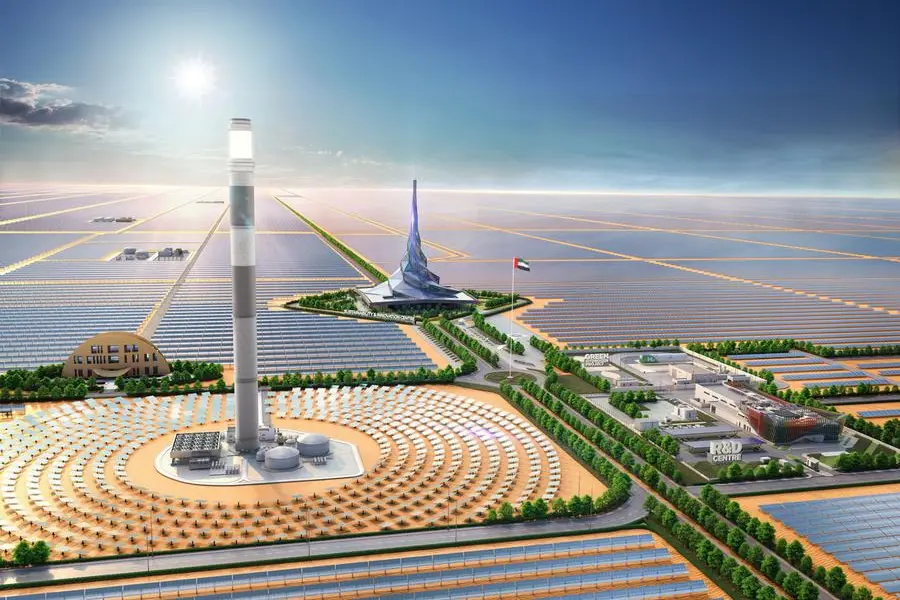
HE Saeed Mohammed Al Tayer, MD & CEO of Dubai Electricity & Water Authority (DEWA), said: “Thanks to the forward-looking vision of HH Sheikh Mohamed bin Zayed Al Nahyan, President of the UAE, and HH Sheikh Mohammed bin Rashid Al Maktoum, Vice President and Prime Minister of the UAE and Ruler of Dubai, the UAE is experiencing remarkable advancements in energy and AI infrastructure. These efforts keep the nation at the forefront of key sectors – driving sustainable development, strengthening global competitiveness and improving community well-being and quality of life. In line with Dubai’s sustainability vision, the Dubai Clean Energy Strategy 2050 and the Dubai Net Zero Carbon Emissions Strategy 2050, DEWA is implementing the Mohammed bin Rashid Al Maktoum Solar Park, the world’s largest single-site solar park based on the independent power producer (IPP) model. Its current capacity stands at 3,860MW and will exceed 8,000MW by 2030, far surpassing the initial target of 5,000MW. The Mohammed bin Rashid Al Maktoum Solar Park underpins Dubai’s green digital economy, supplying reliable, uninterrupted clean energy to the world’s largest solar-powered green data centre, certified by Guinness World Records and operated by Data Hub Integrated Solutions (Moro Hub), a subsidiary of Digital DEWA, the digital arm of DEWA.”
“We adopt disruptive Fourth Industrial Revolution technologies, including AI, across our services and operations, supported by our investments in advanced digital infrastructure to drive transformation. We support the UAE Strategy for Artificial Intelligence, and promote the integration of AI across various vital sectors. To boost productivity and efficiency, we are implementing AI technologies across DEWA’s electricity and water production, transmission and distribution networks. DEWA is the first government entity in the UAE to obtain the ISO/IEC TR 24028:2020 certification for trustworthiness in AI,” added Al Tayer.
As AI spreads across every sector, a major challenge arises: massive energy consumption. This surge is primarily due to the complexity of large-scale models that require extensive computing power and vast data centres, placing unprecedented pressure on energy infrastructure. Addressing this requires strategies that balance technological innovation with sustainability. The UAE exemplifies this approach, leveraging substantial investments in AI alongside advanced digital and energy infrastructure. By prioritising clean and renewable energy, the nation continues to keep pace with the technical revolution while safeguarding environmental and economic goals.
According to a recent study by McKinsey titled The State of AI in GCC Countries, the UAE is spearheading AI adoption in the Gulf region through substantial investments in infrastructure and advanced technologies, cementing its position as a regional hub. This leadership extends to clean energy, according to an Emirates NBD report titled UAE Clean Energy Ambitions, which notes significant infrastructure investments. The latest data from MEED Projects (July 2025), the largest projects tracking platform in the Middle East and Africa region, reveals that the UAE currently has 25 energy projects worth USD 28.2 billion in the pipeline, set to add nearly 21,000 megawatts (MW) of generation capacity – a 38% increase over the current 56,000MW. The 25 projects are distributed according to energy source, with 14 solar energy projects at the top of the list.
Global tech companies’ challenge to power the heart of the digital revolution
According to Microsoft, the problem of powering data centres is less about chip supply and more about energy scarcity and the ability to build facilities fast enough to meet soaring computing demand. Solar energy offers the quickest, most scalable, cost-effective and emissions-free solution.
Technology giant Google revealed in a post on its official blog that a typical Gemini app text prompt consumes 0.24 watt-hours of energy and 0.26 millilitres (approximately five drops) of water for cooling. The energy use per prompt is equivalent to watching TV for less than nine seconds. This unprecedented announcement from a leading global technology company underscores the impact of AI and its data centres on worldwide energy and water consumption. It also illustrates the immense cumulative effect of this technology when deployed across billions of applications.
As a major player in the AI race, OpenAI has secured deals worth billions of dollars to purchase chips that will enable it to maintain its competitive edge. In less than a month, the company that created ChatGPT pledged to buy 26 gigawatts of computing capacity (equivalent to the energy output of about 20 nuclear reactors), through deals for more than 10 million processors from Nvidia, AMD and Broadcom.
The UAE embodies a pioneering global model, demonstrating that the future is built on two fundamental pillars: clean energy as a pillar of environmental sustainability, and AI as a driver of progress and efficiency. The country has succeeded in integrating these two pillars into a single strategic vision, transforming it from a consumer of technology to an active industry partner.
In conclusion, the most important lesson that the UAE experience offers us stands out: building the digital future cannot be achieved through fragmented efforts, but rather requires an integrated holistic vision that unites infrastructure, legislation and human resources within a single collaborative framework. Through this comprehensive vision, the UAE is not only preparing for its future but is positioning itself as a global leader in creating a smarter, more sustainable and more prosperous future for all.
For more information, please visit DEWA’s website www.dewa.gov.ae