PHOTO
United Arab Emirates: The UAE Government has issued a Federal Decree-Law amending certain provisions of the Federal Decree-Law concerning the donation and transplantation of organs and tissues. The amendments form part of the UAE’s ongoing efforts to advance its health legislative framework, enhance patient safety, and ensure alignment with the nation’s objectives for modernising healthcare legislation in line with the latest international medical and technical practices.
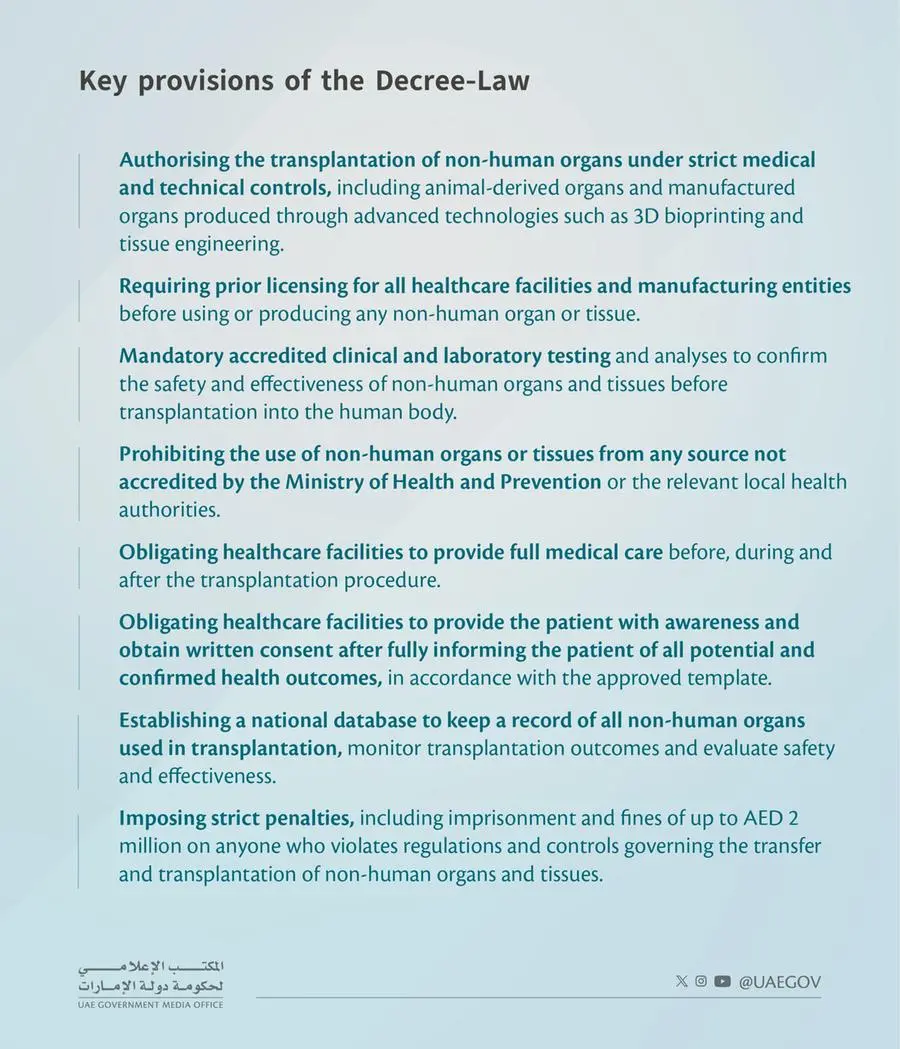
The Federal Decree-Law aligns with global health policies that recognise the use of animal-derived organs or manufactured organs as advanced therapeutic options, subject to strict medical and technical controls that safeguard patient wellbeing and prevent unregulated or unsafe practices. The amendments reaffirm the UAE’s commitment to strengthening the rule of law, ensuring the highest levels of health protection, and providing access to treatment options based on modern and scientifically validated technologies.
The Decree-Law also replaces the text’s title to read “Concerning the Donation and Transplantation of Organs and Tissues”, reflecting the comprehensive nature of the legislation following the expansion of its scope to include non-human organs and tissues. The amendments further define “non-human organ” to include animal organs and manufactured organs, and establish a regulatory framework governing their use.
The Federal Decree-Law affirms that non-human organs and tissues may be transplanted under clearly defined conditions, including that transplantation must represent the most appropriate medical option for the patient’s condition. It prohibits the removal of any animal organ for transplantation without a licence from the Ministry of Health and Prevention or the relevant health authorities, and requires that health facilities and manufacturing entities obtain all necessary permits.
The amendments also mandate the completion of all clinical and laboratory testing to confirm the safety and effectiveness of the organ or tissue. The specialist physician is required to ensure biological compatibility between the organ and the patient’s body, inform the patient or their legal representative of all potential and confirmed health implications of the transplant, and obtain written consent.
A dedicated committee must approve the procedure prior to transplantation. The Ministry will issue procedural guidelines, technical standards and updated regulatory templates to ensure proper implementation in line with the latest medical and scientific developments.
The Federal Decree-Law stipulates the creation of a national database at the National Centre in which all non-human organs used for transplantation are recorded, including the biological composition of manufactured organs, results of clinical trials and all safety and efficacy data. All stages of transplantation procedures must be documented in detail.
The amendments grant the UAE Cabinet the authority to determine the controls and procedures regulating the transfer of non-human organs, their components and non-human tissues between health facilities within the UAE or to and from the UAE.
The Federal Decree-Law introduces stringent penalties on any health facility, manufacturing entity or specialist physician for any violation of the controls governing the transfer or transplantation of non-human organs, their components or non-human tissues. The violator who breaches these regulations shall be subject to imprisonment and a fine of not less than AED 100,000 and not more than AED2million or one of them.
These amendments reaffirm the UAE’s commitment to adopting advanced health legislation that keeps pace with scientific progress in biomedical innovation and organ and tissue manufacturing technologies.