PHOTO
Kuala Lumpur: Artificial Intelligence (AI) is no longer a distant frontier—it is reshaping how Islamic finance operates, innovates and safeguards trust.
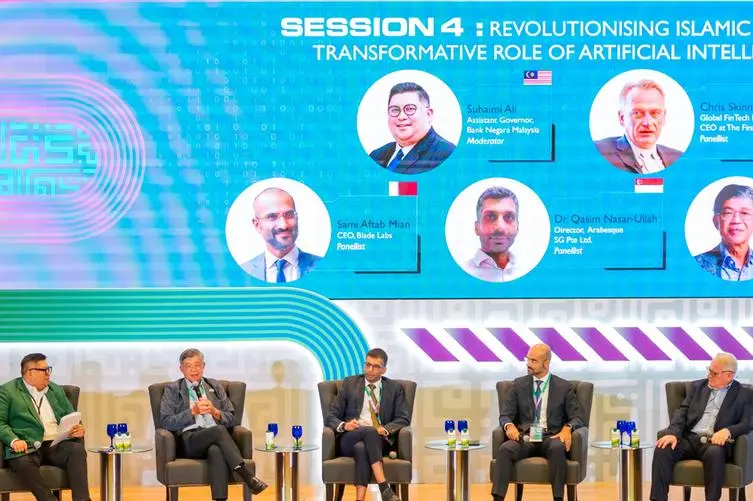
At the Global Islamic Finance Forum (GIFF) 2025, the session titled “Revolutionising Islamic Finance – Transformative Role of Artificial Intelligence” gathered global and regional thought leaders to examine how AI can drive efficiency, uphold ethical principles and expand financial inclusion.
Moderated by Suhaimi Ali, Assistant Governor of Bank Negara Malaysia, the discussion featured Chris Skinner, CEO of The Finanser (UK); Sami Aftab Mian, CEO of Blade Labs (Qatar); Dr. Qasim Nasar‑Ullah, Director of Arabesque SG Pte Ltd (Singapore); and Goh Peng Ooi, Founder and Group Executive Chairman of Silverlake (Malaysia).
Opening the session, Suhaimi highlighted that Malaysia’s financial institutions are increasingly deploying AI for customer analytics, cyber risk management and fraud prevention. The challenge, he said, is ensuring that technology “deepens our commitments rather than dilutes them.”
Chris Skinner traced the evolution of digital transformation in finance— from mainframes to the “intelligence revolution.” He described the shift to a data‑centric model where AI enables real‑time decision‑making and financial inclusion. “If you’re still doing digital transformation, you’re already behind,” he remarked.
He stressed that AI and blockchain together can enhance transparency and traceability: “If I invest in a green sukuk bond, I should know that the money reached the project it was meant for.”
From the industry side, Sami Aftab Mian outlined three layers of AI application: process automation, AI‑enabled products such as the firm’s Mudarabah smart contract system, and AI platforms capable of creating new financial products.
“The goal is not to replace human roles but to elevate them,” he said, emphasising that AI must be designed from the ground up on Sharia‑based principles such as Isnad and provenance. “Without these, AI risks becoming a black box.”
Dr. Qasim Nasar‑Ullah cautioned that while AI models are becoming more capable, transparency remains vital. “We’ve made progress on effectiveness, but explainability is still essential,” he said.
He noted that regulatory initiatives—such as the Monetary Authority of Singapore’s FEAT principles and the EU AI Act—offer valuable lessons for Islamic finance in balancing innovation and accountability.
Goh Peng Ooi emphasised the importance of data integrity. “Garbage in, garbage out,” he warned, explaining that Islamic finance’s principle‑based framework offers a natural safeguard against such risks. He likened Islamic principles like Muamalat and Kafalah to the reinforcement learning structures in AI: “They’ve guided responsible behaviour for over a thousand years.”
Closing the session, Suhaimi observed that regulators, innovators and scholars must collaborate to ensure AI adoption enhances—not erodes—ethical finance. “This is about stewardship,” he said. “AI can only strengthen the financial system if it serves humanity and upholds trust.”
About AIBIM
Established in 1995 as the Association of Interest-free Banking Institutions Malaysia, the association was rebranded in May 2018 to the Association of Islamic Banking and Financial Institutions Malaysia (AIBIM). Over the past three decades, AIBIM has grown into a dynamic, visible, and responsive association, championing the advancement of Islamic finance in Malaysia and beyond.
AIBIM advocates for a Shariah-based, ethical, and socially responsible financial system aligned with both national priorities and global aspirations. In fulfilling its mandate, AIBIM provides strategic advisory and support to its members, fosters industry-wide collaboration, strengthens human capital development, and promotes greater public understanding of Islamic finance.
Driven by its renewed aspiration, AIBIM aims to be the foremost voice in driving Shariah-based value financing and leading transformation, sustainable growth, and ethical practices in the financial industry.
As of today, AIBIM comprises 26 member banks, including 11 domestic Islamic banks, 3 development financial institutions, 10 locally incorporated foreign Islamic banks, and 2 Islamic digital banks. For more information, please visit: www.aibim.com.
Media enquiries, please contact:
Tan Wai Fong (Ms)
Media Officer
Email: waifong@twfcomms.com