PHOTO
Dalian, China – Khaled Ahmed Sharbatly, Chief Executive Officer of Desert Technologies and a member of the 2026 Young Global Leaders Class, stated that the Middle East is entering a historic phase of economic and industrial transformation driven by massive investments in infrastructure, advanced technologies, and artificial intelligence.
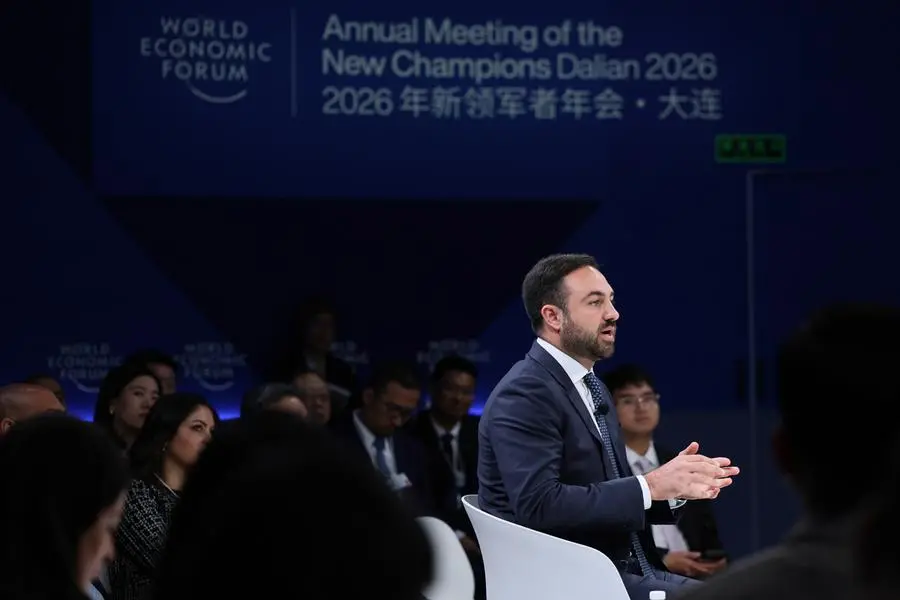
Sharbatly made these remarks during his participation in the 17th Annual Meeting of the New Champions, organized by the World Economic Forum in Dalian, China, from June 23 to 25, under the theme "Entrepreneurship for a New Era." This year's edition brings together more than 1,500 leaders from business, government, academia, and innovation ecosystems worldwide to explore how technological breakthroughs can translate into economic growth, investment opportunities, and job creation.
Sharbatly participated in a panel discussion titled "What Next for The Middle East?" The session featured prominent regional and international leaders, including Lina Noureddin the President and Founder of Lamar Holding, Mazen S. Darwazeh the Executive Vice-Chairman and Deputy Chief Executive Officer of Hikma Pharmaceuticals, and Dr. Sanam Vakil the Director of Middle East and North Africa of Chatham House. The discussion was moderated by Dr. Karen E. Young the Senior Research Scholar at the Center on Global Energy Policy of Columbia University.
The panel explored the rapidly evolving global economic landscape, examining how trade and industrial policy are increasingly shaping where technologies scale, where investment flows and how supply chains are configured. Governments are taking a more active role in directing capital, setting standards and protecting critical industries.
During his intervention, Sharbatly noted that Saudi Arabia's modern infrastructure is the result of decades of sustained investment, but that development has accelerated at an unprecedented pace over the last ten years under Saudi Vision 2030, driving transformation across virtually every economic and development sector.
He pointed to renewable energy as a clear example of this transformation, explaining that the Kingdom's initial target was to generate only four gigawatts of renewable power, which later increased to nine gigawatts. Today, national ambitions exceed 60 gigawatts, with expectations of surpassing 120 gigawatts by 2030.
According to Sharbatly, these vast energy capacities will support three sectors poised to shape the global economy in the years ahead: artificial intelligence, advanced manufacturing, and smart mobility. He described these sectors as representing the most significant investment opportunities currently emerging across the region.
He also highlighted the rapid transformation of the logistics sector, particularly in western Saudi Arabia, where ports and economic zones have become key hubs for global trade. He noted that Jeddah Islamic Port and King Abdullah Economic City currently handle approximately 15 million containers annually, while major projects such as NEOM Port and the airports of Yanbu and Jazan are further strengthening Saudi Arabia's position as a regional and global logistics center.
"Today, I see more global companies entering the market and actively seeking investment opportunities in logistics, whether in Saudi Arabia or across the Middle East as a whole," Sharbatly said. "The opportunity is enormous, and I believe the next ten years will be decisive in transforming the region from merely a trade corridor into a value-added industrial powerhouse."
“The biggest mistake is to view the Middle East as a single homogeneous market. Economic environments and regulatory frameworks differ significantly from one country to another," he explained. "However, the GCC countries enjoy a high degree of economic integration, regulatory alignment, and governmental coordination, making them among the world's most attractive destinations for investment."
He added: "I believe many people still underestimate the true value this region will acquire over the next ten to fifteen years. That is why we must continue investing aggressively in infrastructure and strengthening our economic position, especially by investing in AI infrastructure."
Sharbatly stressed that future global competition will extend beyond technology itself to encompass cybersecurity and data sovereignty. "The real questions are: Where will your data be stored? Who will control that data? And where will you source the hardware and software on which you depend?" he said.
"The challenge today is not simply adopting AI but owning the infrastructure capable of supporting it and safeguarding its data. Investment in digital infrastructure and artificial intelligence has become a strategic necessity because it will determine the ability of countries and companies to compete in the new global economy."
Sharbatly concluded by emphasizing that despite the challenges it faces, the Middle East remains one of the world's most important regions, offering vast growth opportunities that are inseparable from both the global economy and the technological transformations reshaping the world.