MoU will allow transport of raw materials to the factory and distribution of cement to the customers throughout UAE by rail, marking the first customer for Stage Three of the national rail project
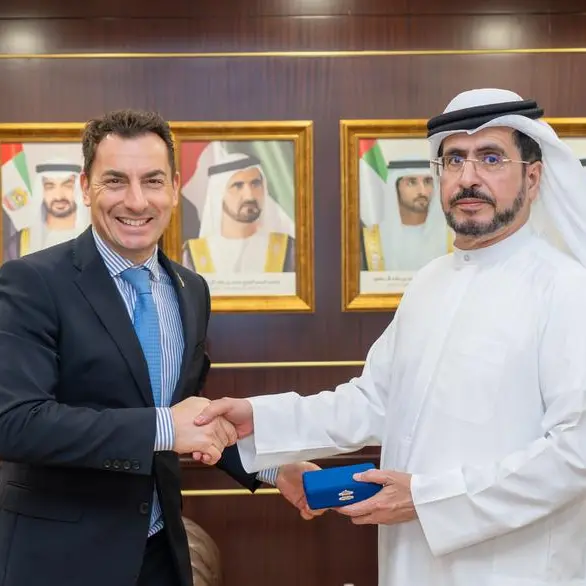
Abu Dhabi, UAE, 20 November, 2012: Etihad Rail - the master developer and operator of the UAE's national railway network - yesterday announced the signing of a Memorandum of Understanding (MoU) with Sharjah Cement Factory, a venture of Sharjah Cement & Industrial Development Company (SCIDC), marking the first prospective customer for Stage Three of the rail network. The agreement will see Sharjah Cement Factory use rail for the efficient transport of basic raw materials and cement to its customers throughout the UAE.
The MoU, signed by H.E. Dr. Nasser Saif Al-Mansoori, CEO of Etihad Rail, and Mr. Ahmad Abdalla Al Noman, Chairman of Sharjah Cement Factory, will facilitate the transport of more than five million metric tonnes (MT) of cargo per year - a volume that matches more than half of the factory's existing logistics needs. The agreement will offer Sharjah Cement Factory a logistics solution that will enhance its competitive advantage, reduce transport costs and improve efficiency through allowing the Company to use a mode of transport that is safer and more environmentally friendly than trucks.
Sharjah Cement Factory was the first venture set up by the Sharjah Cement & Industrial Development Company to help support the industries in the northern emirate. Since its inception 35 years ago, the factory now has the total installed capacity of clinker at 2.2 million MT per year and an annual cement grinding capacity of 4.27 million MT.
Commenting on the MoU, H.E. Dr. Al-Mansoori, CEO of Etihad Rail, said: "The agreement with Sharjah Cement Factory is of great significance as it marks Etihad Rail's first customer for Stage Three of the strategic national rail project, which will contribute to the UAE's economic growth. We are delighted to provide the local factory with a sustainable transport solution that will positively impact their customers and the UAE community, in line with UAE Vision 2021."
Mr. Ahmad Abdalla Al Noman, Chairman of Sharjah Cement Factory, added: "As a local building materials manufacturer, an efficient distribution system is critical for our competitive growth. Rail is globally preferred as a more cost-effective and environmentally friendly mode of transport for cement than trucks, and we look forward to using the Etihad Rail network to further enhance the efficiency of our distribution system to our customers."
Today's signing with Sharjah Cement Factory marks Etihad Rail's first prospective customer for Stage Three, with an impressive list of customers Stage Two already secured. The company recently signed MoUs with HOYER Global Transport, who will use the railway for the transport of liquid bulk, and DHL, who will use the railway network to meet its customers' growing logistical needs. Etihad Rail has also signed agreements with other customers across a range of industries including Al Dahra, Emirates Steel, Arkan, Etisalat and du. While Al Dahra will use rail to transport hay, Emirates Steel and Arkan plan to transport their raw and finished materials via the railway, and du and Etisalat will benefit from access to the network's infrastructure to expand their growing network and customer base.
Upon completion, the Etihad Rail network - which will cater to both freight and passengers - will span a total of 1,200 km across the Emirates. It will connect urban and remote communities, facilitate trade, open up communication channels and foster economic development. The network will also form a vital part of the GCC Railway Network - linking the UAE to Saudi Arabia via Ghweifat in the west and Oman via Al Ain in the east.
Construction work on Stage One, which links Shah and Habshan to Ruwais, is well advanced, and the tendering process is already in progress for Stage Two, which will connect the railway to Mussafah, the Gulf ports of Khalifa and Jebel Ali, and the Saudi and Omani borders. Preliminary engineering for Stage Three, which will connect the rest of the Northern Emirates, is also well underway.
-Ends-
About Etihad Rail
Etihad Rail was established in June 2009 under Federal Law no. 2, with a mandate to manage the development, construction and operation of the UAE's national freight and passenger railway network.
The railway network will be built in phases to link the principal centres of population and industry of the UAE, as well as to form a vital part of the planned GCC railway network linking the six countries of the GCC.
Built to international standards, Etihad Rail's state of the art network will act as a catalyst for economic growth and sustained social development. Once complete, the railway will redefine logistics and transport in the region, providing a modern, safe, efficient, sustainable network that will connect all regions of the UAE, and the UAE to its wider GCC neighbouring countries.
Etihad Rail has recently announced a number of contract awards for Stage One of the rail network including:
- The Civil & Track Works contract was awarded to a consortium comprising Italy's Saipem, Tecnimont and UAE-based Dodsal Engineering and Construction
- The Project Management Consultant (PMC) contract which was awarded to joint venture Parsons-Aecom
- PCM Strescon Ventures was awarded the contract for the provision of railway sleepers. The Indian-based company will be responsible for the provision of railway sleepers in a purpose-built sleeper manufacturing facility at our rail head
- Electro-Motive Diesel, from North America, was assigned to deliver seven locomotives custom-built for desert conditions by 2012
- CSR Corporation Limited China was appointed to supply 240 covered hopper wagons for the movement of granulated sulphur in the Western Region
Etihad Rail has also signed several Memorandums of Understanding with the following companies:
- DP World, for the development of an intermodal rail terminal in Jebel Ali Port which will enable the more efficient transfer of containerised freight arriving at the port inland
- DHL, who will use the rail network as soon as Etihad Rail's second stage is operational, helping DHL first and foremost with connections between Jebel Ali in Dubai and Ghweifat at the Saudi Arabian border, and subsequently assisting with transportation across the rest of the Emirates
- HOYER Global Transport BV, who will be working with Etihad Rail to develop a safe and sustainable bulk liquid transportation system across the UAE, and linking to the GCC
- Arkan and Emirates Steel, leading manufacturers who seek to use rail as the main method of transportation for their raw and finished materials
- Al Dahra Agriculture Company, who plan to use rail as a more efficient means of transporting hay as soon as Etihad Rail's second stage is operational
- Etisalat and Du, whose expertise in telecommunications services will benefit Etihad Rail while both companies gain access to and use of the railway infrastructure to magnify their growing network and customer base in the UAE
For more information, please visit the Etihad Rail website at: www.etihadrail.ae
Or please contact:
Nora Layous, Hill+Knowlton Strategies
Tel: +971 5010 62130
Email: Nora.Layous@hkstrategies.com
About Sharjah Cement Factory
Sharjah Cement & Industrial Development Co. (SCIDC) was established in 1977 for the promotion of industries in Sharjah. Its first venture was the setting up of Sharjah Cement Factory.
Sharjah cement factory started its operation with a 800 TPD long dry kiln in 1977 with a Cement grinding capacity of 30 TPH cement mill aggregating a Clinker production capacity of 0.26 Million MT per year and Cement grinding capacity of 0.24 Million MT per year. After installation of a new Cement mill and packing plant in 1983 by UBE industries, Japan, the total grinding capacity of the Factory was increased to 1.1 Million MT per annum.
Cement factory had two cement storage silos each of capacity of 3,500 MT. Two additional cement silos, each of 10,000 MT were built in 1983 and a storage silo of 1200 MT was constructed in 1998. The total product storage capacity thus went up to 28,200 MT.
In 2002 an Additional Kiln with a rated capacity of 3800 TPD with Raw mill were installed to boost up the clinker capacity to 1.38 Million MT per year.
In the year 2004, Cement grinding capacity was increased to 1.90 Million MT per year with installation of a Cement mill of 100 TPH by CPB. In the year 2006 Cement grinding capacity was further increased to 2.97 Million MT per year with installation of a Cement mill of 135 TPH by CPB.
In the year 2007, Clinker capacity was further enhanced to 2.2 Million MT per year with upgradation of 800 TPD long dry kiln with installation of 5 Stage Pre-heater and associated equipment to 2000 TPD.
One additional Cement silo of 10,000 MT was constructed for storing GGBS exclusively in 2007. The total product storage capacity thus went up to 38,200 MT.
In the year 2009, Cement grinding capacity was increased to 4.27 Million MT per year with installation of a Cement mill of 165 TPH by CPB.
Now, the total installed capacity of Clinker is 2.2 Million MT per year and Cement grinding capacity is 4.27 Million MT per year.
© Press Release 2012