PHOTO
As a global pioneer in Islamic finance, Malaysia aims to harness the growth of Islamic finance and financial technology (FinTech) to enhance financial inclusion and open up access to financial services for the underserved individuals as well as micro, small and medium enterprises (MSMEs).
Over 1.7 billion adults or one-third of the world’s adult population are estimated to not have access to formal financial services – many of them in developing countries. According to the Global Findex Database, 40 out of the 48 member countries in the Organisation of Islamic Cooperation (OIC) have formal account penetration rates that are lower than the world average of 50 percent.
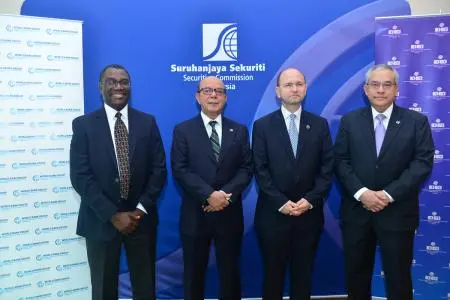
This issue, along with elements required for the sustainable use of Islamic finance to address financial inclusion, were discussed at a conference today jointly organised by the Securities Commission Malaysia (SC), World Bank Group Global Knowledge and Research Hub in Malaysia, and the International Organisation of Securities Commissions (IOSCO) Asia Pacific Hub also located in Malaysia.
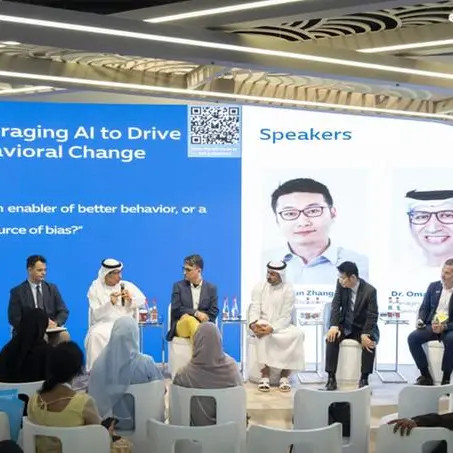
Themed “Islamic Finance: A Catalyst for Financial Inclusion”, the annual conference gathered over 300 development practitioners, policy makers, regulators and experts to explore policy, regulatory and institutional challenges and opportunities. The conference featured discussions on the role of Islamic finance including Islamic social finance, such as waqf and zakat, in enabling greater access to financial services to enhance social well-being as well as drive economic activities. The use of technology to support Islamic finance in facilitating greater inclusion was also deliberated.
Datuk Syed Zaid Albar, Chairman of the SC said, “Islamic products and services for financial inclusion hold the promise for a shared and better future. Therefore, increased digitisation will certainly reduce costs and enhance speed, convenience and appeal. In this regard, the capital market provides entrepreneurs and MSMEs both conventional and Shariah-compliant avenues to access alternative sources of financing. Equity crowdfunding and peer-to-peer financing platforms, as well as venture capital and private equity, are available to meet their needs at different stages of their businesses.”
Dr. Firas Raad, World Bank Group Representative to Malaysia and Country Manager said, “Islamic finance can play a role in addressing the high levels of poverty in the OIC countries, which account for over 40% of those living on less than USD1.25 a day and is home to one-third of the global population living in extreme poverty, defined as those living on less than USD1.90 per day.”
SECURITIES COMMISSION MALAYSIA WORLD BANK GROUP IOSCO ASIA PACIFIC HUB
About Securities Commission Malaysia
Securities Commission Malaysia (SC), a statutory body reporting to the Minister of Finance, was established under the Securities Commission Act 1993. It is the sole regulatory agency for the regulation and development of capital markets. SC has direct responsibility for supervising and monitoring the activities of market institutions, including the exchanges and clearing houses, and regulating all persons licensed under the Capital Markets and Services Act 2007. More information about SC is available on its website at www.sc.com.my. Follow SC on twitter at @SecComMy for more updates.
Media contact:
Delyana Nordin
Corporate Affairs Department
Mobile :+60122072787
Office : +603 62048265
e-mail : delyanan@seccom.com.my
About World Bank Group in Malaysia
The World Bank Group Global Knowledge and Research Hub in Malaysia is the first of its kind, serving both as a field presence in Malaysia and as a global knowledge and research hub. The new hub focuses on sharing Malaysia's people-centered development expertise and creating new innovative policy research on local, regional and global issues.
Joshua Foong
Communications Officer
Mobile :+60166901822
Office : +603 22634952
e-mail : jfoong@worldbank.org
About IOSCO Asia Pacific Hub
Operationalised in mid-2017, the International Organisation of Securities Commissions (IOSCO) Asia Pacific Hub, located in Kuala Lumpur is the first regional hub of IOSCO established outside of its headquarters in Madrid. Hosted by the Securities Commission Malaysia, the IOSCO Asia Pacific Hub plays a key role in regulatory capacity building, particularly in the region. Through its initiatives, the Asia Pacific Hub facilitates greater cross border regulatory cooperation and promotes the transfer of knowledge, expertise and best practices from across IOSCO’s wide membership.
By way of background, the IOSCO is the leading international body of capital market regulators and is recognised as the global standard setter for securities regulation. Established in 1983, IOSCO members from more than 115 jurisdictions, collectively regulate more than 95% of securities markets worldwide.
© Press Release 2019Disclaimer: The contents of this press release was provided from an external third party provider. This website is not responsible for, and does not control, such external content. This content is provided on an “as is” and “as available” basis and has not been edited in any way. Neither this website nor our affiliates guarantee the accuracy of or endorse the views or opinions expressed in this press release.
The press release is provided for informational purposes only. The content does not provide tax, legal or investment advice or opinion regarding the suitability, value or profitability of any particular security, portfolio or investment strategy. Neither this website nor our affiliates shall be liable for any errors or inaccuracies in the content, or for any actions taken by you in reliance thereon. You expressly agree that your use of the information within this article is at your sole risk.
To the fullest extent permitted by applicable law, this website, its parent company, its subsidiaries, its affiliates and the respective shareholders, directors, officers, employees, agents, advertisers, content providers and licensors will not be liable (jointly or severally) to you for any direct, indirect, consequential, special, incidental, punitive or exemplary damages, including without limitation, lost profits, lost savings and lost revenues, whether in negligence, tort, contract or any other theory of liability, even if the parties have been advised of the possibility or could have foreseen any such damages.