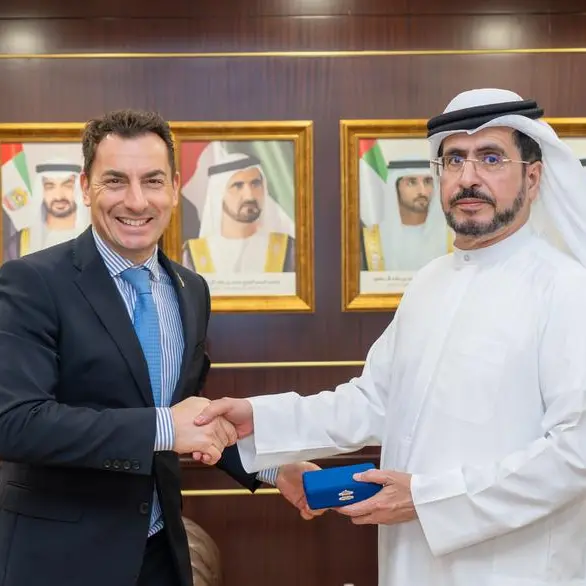
New agreement signed to support the development of National Greenhouse Gas Inventory Systems (NIS)
Dubai - United Nations Environment Programme (UNEP) and Dubai Carbon Centre of Excellence (DCCE) have signed an agreement to develop National Greenhouse Gas Inventory Systems (NIS) for Oman and Kuwait, helping these countries to monitor progress towards the international climate targets agreed in Paris, in December.
Signed by Ivano Iannelli, CEO of Dubai Carbon and Iyad Abumoghli, Director and Regional Representative of UNEP, the agreement also allows for future collaboration in other Gulf Countries.
UNEP Regional Representative in West Asia, H.E. Dr. Iyad Abumoghli, said: "This Memorandum of Understanding represents a special and significant commitment to engage and establish the best possible solutions to develop climate change strategies for the nations involved. We will continue to partner with leading industry bodies to bring about an improvement in the systems and processes to effectively manage climate change".
Ivano Iannelli, CEO of Dubai Carbon stated: "This agreement represents a step forward in the right direction towards the larger mission as outlaid by the government of Oman and Kuwait. We firmly believe that the partnership with UNEP will develop a comprehensive NIS to monitor the critical data on climate change and implement effective strategies to monitor the results it will deliver."
Data received from the new systems will inform the decisions of greenhouse-gas-emitting entities, their regulatory bodies and respective environment agencies. UNEP and DCCE will also implement an online reporting system and database to capture baseline data as of 2015 and maintain records on annual basis.
The project will devise procedures and protocols for reporting in line with the Intergovernmental Panel on Climate Change (IPCC) standards, with definitions for reporting data tailored to national conditions. It will also propose quality assurance and control procedures, capturing them in a user-friendly manual.
A strong emphasis will be placed on training personnel in the use of the new reporting system and on communicating its benefits to decision makers.
-Ends-
About Dubai Carbon Centre of Excellence
The Dubai Carbon Centre of Excellence was launched by the Dubai Supreme Council of Energy in partnership with the United Nations Development Programme (UNDP) in 2011 as a public-private partnership to fast-track clean energy project development in the last years of the Kyoto Protocol.
The Centre is the first body of its kind in the region and aims to leverage Dubai's economic potential in carbon through the Clean Development Mechanism and other best practices. The DCCE is a key component of the Supreme Council's efforts to develop a sustainable-energy economy for Dubai and its plans to offset several million metric tons of carbon annually by selling carbon credits on the international market.
Dubai Carbon conceptualizes, manages, executes and monetizes greenhouse gas reduction measures. By doing so, it addresses climate change and promotes sustainable development across the region in an economically viable way. The Emirate of Dubai is becoming a low-carbon economy and Dubai Carbon is both the enabler and knowledge repository of this process.
About UNEP
The United Nations Environment Programme (UNEP), established by the United Nations General Assembly in its resolution 2997 of December 1972, is the leading global environmental authority that sets the global environmental agenda and promotes the coherent implementation of the environmental dimension of sustainable development. UNEP works through its divisions, regional, sub-regional, liaison and other offices in discharging its mandate and assisting countries in the implementation of their national environmental policies.
For more information, please contact:
Suzanne Joseph
suzanne@mccollinsmedia.com
McCollins Media
Marie Daher
Marie.daher@unep.org
UNEP
© Press Release 2016