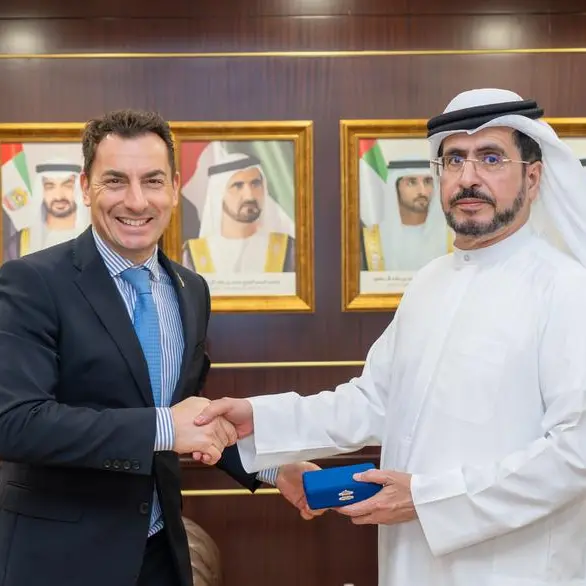
The Secretariat-General of Dubai Economic Council (DEC) will organize a workshop titled "Sukuk: Nature and Applications" on 31st March, 2010 at Dubai. A number of representatives of economic-making circles in federal and local levels, and of local business community will attend the event. Additionally, representatives of Islamic financing institutions such as Dubai Islamic Bank, Dubai Financial Market, Abu Dhabi Securities Market, Emirates Islamic Bank, in addition to the UAE Central Bank will also be participated in this workshop. Four key speakers who are working as experts in Islamic financial institutions in the UAE will participate in this event.
Hani Al Hamli: The workshop aims to enhance the sukuk market in the UAE
HE Hani Al Hamli, Secretary-general of Dubai Economic Council stated that this event is stemmed in terms of DEC role to propose economic policies aiming at enhancing the local business environment through strengthening and modifying the legal and regulatory framework of monetary and fiscal institutions to enhance the economic growth in one hand, and to cope with the present developments in regional and global economy in the other hand.
Al Hamli also said that the workshop aims to highlight various economic and legitimacy issues related to Sukuk namely one effective Islamic financial instrument which is increasingly and widely used not only in Islamic countries but in many other countries worldwide.
Al Hamli pointed out that sukuk has raised many issues concerning their uses, in addition to their challenges in the financial markets. He also asserted that such issues have fostered the DEC to consult a number of experts in Islamic financing industry to organize this workshop in order to highlight the sukuk nature, uses, markets, and the key challenges facing them.
Notably, four key papers will be presented in this event.
The first paper titled "Sukuk: Characteristics, Issuance, Uses, and the Main Related Issues" will be delivered by Dr Hussein Hamed Hassan, Chairman of Shari'a Board, Emirates Islamic Bank-Dubai.
The second joint paper titled "Sukuk Markets and Approaches of Their Improvements Including Structural, Supervisory and Their Applicability to the State's Development Strategy" will be delivered by Dr Mabid Al Jarhi, Secretary-general, Fatwa & Shari'a Supervisory Board, Dubai Financial Market-Dubai, and Dr Abdul Azeem Abu Zayed, Advisor, Emirates Islamic Bank-Dubai.
The third paper titled "The Challenges facing the Islamic Banking Industry Generally, and Those Related to Sovereign and Non-sovereign Sukuk Specifically" will be delivered by Dr Abdulsatar Al Khuwaildi, Secretary-general, International Islamic Center for Reconciliation and Arbitration-Dubai.
The forth paper titled "Sukuk: Legal Considerations and Implications- UAE and International Practice" will be presented by Mr. Aymen A. Khaleq, Partner-Vinson and Elkins LLP-Dubai.
Worth mentioning, in 2002, Malaysia has issued sukuk at about $2b. After that, the issuance of sukuk has been increased remarkably. In 2007, the value of sukuk exceeds $94b. Based on this background, it was expected that this overwhelming issuance and transactions of sukuk be increased, however, the subprime crises emerged in 2007, followed by the global financial crisis in 2008 and the slowdown resulted in 2009 have flipped the picture.
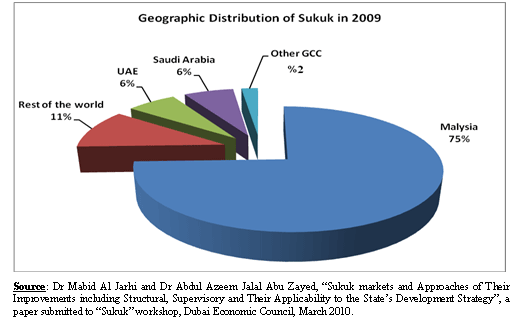
In 2007, UAE was on the top of countries that issued sukuk. The value of sukuk reach $33b compared to Malaysia $31 b. The UAE retains its leading position in 2008. However, the issuance volume has been decreased in 2008, then dropped in 2009. According to the updated statistics, Malysia captured the largest share of global sukuk market (75%). UAE and Saudi Arabia each (6%), Other GCC state members (2%). Thus, the entire GCC members dominate about (14%) of global sukuk market in 2009.
- Ends -
© Press Release 2010