PHOTO
Abu Dhabi, UAE: Researchers at NYU Abu Dhabi have demonstrated that artificial intelligence can independently rediscover fundamental principles of particle physics, a breakthrough that could accelerate future discoveries about the universe’s underlying laws.
In a study published in the Journal of High Energy Physics (JHEP), NYU Abu Dhabi scientists show that relatively simple AI techniques can uncover the same patterns that took human physicists decades to identify during the development of the Standard Model, the framework that describes the fundamental particles and forces of nature.
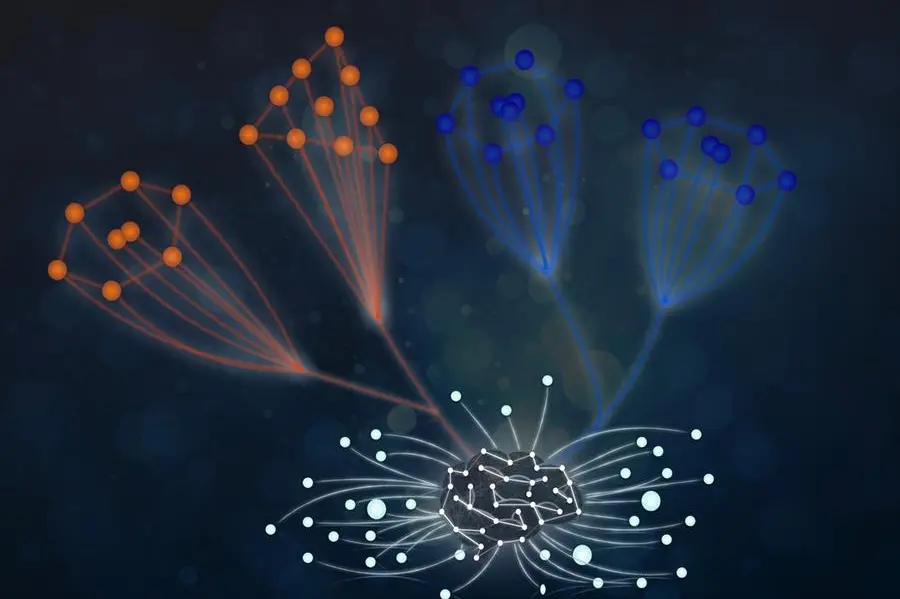
The research team, Aya Abdelhaq, Pellegrino Piantadosi, and Fernando Quevedo, used experimental data from particle discoveries of the 1950s and 1960s. Without prior knowledge of the mathematical tools used at the time, the AI system identified organizing principles behind dozens of particles.
Among the rediscovered features were fundamental symmetries such as baryon number, isospin, and charm, as well as the “Eightfold Way,” a classification scheme that groups particles into structured families. The AI also reproduced Regge trajectories, patterns that relate a particle’s mass to its spin and closely match experimental observations.
The Standard Model emerged over decades through theoretical insight and experimental breakthroughs, including the discovery of quarks, the building blocks of protons and neutrons inside atomic nuclei. Showing that AI can reach similar conclusions using data alone highlights its potential as a powerful tool for scientific discovery.
“This study shows that AI can uncover deep physical laws directly from data, opening the door to discovering new particles and patterns that humans may have missed,” said Pellegrino Piantadosi, NYUAD postdoctoral associate and one of the paper’s authors.
Artificial intelligence is already transforming research across disciplines. Demonstrating that AI can reconstruct major past discoveries is an important step toward using it to uncover new particles or previously unknown patterns in nature. The findings suggest that future AI systems could help identify unseen phenomena and deepen our understanding of the fundamental laws that govern the universe.
About NYU Abu Dhabi
www.nyuad.nyu.edu
NYU Abu Dhabi is the first comprehensive liberal arts and research campus in the Middle East to be operated abroad by a major American research university. Times Higher Education ranks NYU among the top 31 universities in the world, making NYU Abu Dhabi the highest globally ranked university in the UAE. NYU Abu Dhabi has integrated a highly selective undergraduate curriculum across the disciplines with a world center for advanced research and scholarship. The university enables its students in the sciences, engineering, social sciences, humanities, and arts to succeed in an increasingly interdependent world and advance cooperation and progress on humanity’s shared challenges. NYU Abu Dhabi’s high-achieving students have come from over 120 countries and speak over 100 languages. Together, NYU's campuses in New York, Abu Dhabi, and Shanghai form the backbone of a unique global university, giving faculty and students opportunities to experience varied learning environments and immersion in other cultures at one or more of the numerous study-abroad sites NYU maintains on six continents.