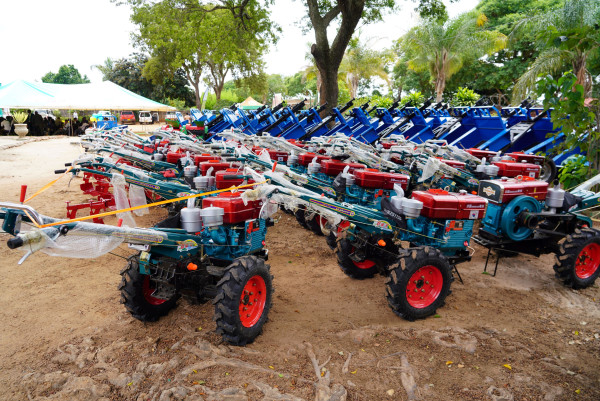
The Government of Zimbabwe commissioned a tranche of small-scale agricultural equipment to support climate-smart agriculture, sustainable land management and rural livelihoods in the country’s dryland areas, under the Drylands Sustainable Landscapes Impact Programme (DSL-IP) funded by the Global Environment Facility (GEF-7) and supported by the Food and Agriculture Organization of the United Nations (FAO).
The commissioning ceremony, held at the Community Technology Development Organisation (CTDO) in Harare, was officiated by the Minister of Environment, Climate and Wildlife, Hon. Evelyn Ndhlovu, with senior officials from the Ministry of Lands, Agriculture, Fisheries, Water and Rural Development, FAO, project implementing partners and members of the development sector.
Speaking at the event, Hon. Ndhlovu said the provision of mechanised equipment marks a critical milestone in the Government’s efforts to transform agriculture in Zimbabwe’s most climate-vulnerable dryland regions, while safeguarding ecosystems and natural resources.
“Today’s commissioning represents a strategic shift from environmentally destructive coping practices towards productive, climate-smart and land-positive livelihoods. Mechanisation is not merely about increasing output. It is a powerful enabler of sustainable land management, reducing labour drudgery for women and youth while improving productivity and resilience,” said Hon. Dr. Ndhlovu.
Part of a global drylands programme
The DSL-IP project is implemented by the Ministry of Environment, Climate and Wildlife, through the Environmental Management Agency (EMA), with FAO as the GEF-accredited entity, in partnership with CTDO, World Vision, the Forestry Commission and the Zimbabwe Parks and Wildlife Management Authority.
The Zimbabwe child project forms part of a global FAO-led Drylands Sustainable Landscapes Impact Programme being implemented in eleven countries in Southern Africa, West Africa and Asia, supporting countries to meet their Land Degradation Neutrality (LDN) targets under the United Nations Convention to Combat Desertification (UNCCD).
“The equipment commissioned today builds on earlier distributions in 2025 that have significantly reduced labour requirements, improved timeliness of farm operations and encouraged wider adoption of sustainable practices, even beyond project-supported Farmer Field Schools,” noted Rene Czudek, FAO Forestry Officer Rene Czudek and Lead Technical Officer for the DSL-IP.
Scaling up farmer-centred mechanisation
A total of 1 050 additional pieces of small-scale agricultural equipment were commissioned, bringing the cumulative total to 1 960 units procured under the project. The equipment includes two-wheel tractors, double-furrow ploughs, planters, trailers, multi-crop threshers, earth augers and post-harvest processing machinery, and is supporting 600 Farmer Field Schools across the Save and Runde catchments.
The labour-saving technologies are benefiting 15 000 direct beneficiaries, of whom at least 52 percent are women, by improving land preparation, planting precision and post-harvest handling, while reducing pressure on forests, rangelands and riverbanks.
According to the Permanent Secretary for Lands, Agriculture, Fisheries, Water and Rural Development, Obert Jiri, in a speech read on his behalf, smallholder mechanisation is a key driver of agricultural modernisation and rural transformation.
“Research has shown that mechanisation enhances productivity through timeliness and precision of operations. By increasing output on existing arable land, it limits the expansion of agriculture into forests and fragile ecosystems, directly contributing to Zimbabwe’s land degradation neutrality commitments,” said Obert Jiri.
Delivering national and global commitments
The DSLIP contributes directly to National Development Strategy 2 (NDS2) priorities on food security, climate resilience and rural development, while aligning with the Government’s Pfumvudza/Intwasa climate-smart agriculture programme and broader national mechanisation initiatives.
Across the Save and Runde landscapes, the project is expected to restore 2 150 hectares of degraded land, bring 172 540 hectares under improved sustainable land and forest management practices, mitigate 1.26 million tonnes of CO₂-equivalent greenhouse gas emissions, and strengthen resilience across 44 wards in eight districts.
As the project approaches completion, stakeholders emphasised the importance of strong governance, maintenance systems and equitable access to ensure that the equipment continues to deliver benefits beyond the life of the project.
“Every piece of equipment commissioned today must translate into improved productivity, restored landscapes and dignified livelihoods for our rural citizens,” said Andrew Mushita, CTDO Director, in his remarks.
Distributed by APO Group on behalf of Food and Agriculture Organization of the United Nations (FAO): Regional Office for Africa.