Parliament on Tuesday, 05 May 2026 passed the Protection of Sovereignty Bill, 2026 adopting amendments that significantly narrow its scope, remove contentious provisions and introduce safeguards aimed at aligning the law with the Constitution and existing regulatory frameworks.
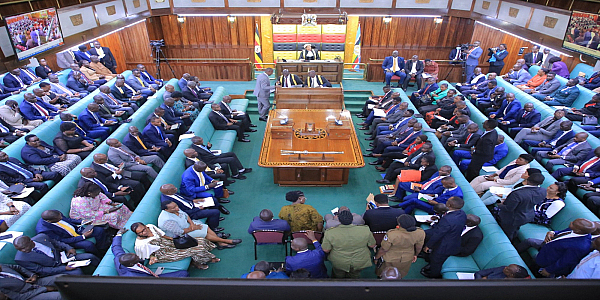
The Bill, which had attracted intense public interest over controversial clauses in its original form was considered during a packed plenary sitting chaired by the Speaker, Anita Among.
The Minister of State for Internal Affairs, Hon. David Muhoozi who moved and justified the motion, said Uganda faces challenges that threaten its ability to self-govern.
Presenting the majority report, the Chairperson of the Committee on Defence and Internal Affairs, Hon. Wilson Kajwengye said the scrutiny process drew from extensive consultations involving over 200 stakeholders across government institutions, civil society, the private sector, academia and the diaspora.
He noted that although the objective of protecting Uganda’s sovereignty is legitimate, the original drafting of the Bill was overly broad and risked far-reaching consequences.
“The amendments are intended to harmonise the definitions with the scope of the Bill to limit the application of the law to only agents of foreigners and not any other person,” the report stated in part.
A key outcome of the amendments is the restriction of the law strictly to agents of foreigners, with earlier provisions that applied to any person deleted.
Clause 2 was revised to ensure the Act targets only individuals or entities acting on behalf of foreigners in specified influence-related activities, particularly in political processes and public decision-making.
Lawmakers also overhauled key definitions narrowing the meaning of “foreigner” and excluding Ugandan citizens living abroad.
The definition of an “agent of a foreigner” was refined to cover only those who formally and knowingly act on behalf of foreign interests to influence policy, elections or national security.
“The amendments exclude the application of the Bill to Ugandan citizens residing outside Uganda,” the committee noted.
Parliament further deleted the definition of “person” and introduced clearer terms, including “political activities”, to enhance legal precision.
The House also scaled back the powers of the minister, removing provisions that allowed the minister to declare any person a foreigner and replacing broad discretionary authority with more structured, rules-based mechanisms.
The committee warned that the original provisions risked creating a permission-based system that would undermine legal certainty and constitutional safeguards.
In a significant policy shift, Parliament replaced blanket ministerial approval requirements, particularly on foreign funding, with a declaration regime. Clause 22 now requires agents of foreigners to declare funds rather than seek prior approval, a move the committee said would avoid disruption to financial flows and economic activity.
The amended law also introduces wide-ranging exemptions to protect key sectors.
Financial institutions, academic and research bodies, health facilities and individuals receiving funds for legitimate commercial or domestic purposes are excluded.
Lawful financial flows such as diaspora remittances, foreign direct investment, trade and humanitarian assistance are explicitly protected.
To address concerns about duplication, Parliament adopted recommendations exempting entities already regulated under existing laws, with the committee warning that the original Bill risked creating overlaps in regulation.
Lawmakers further revised criminal provisions, introducing clearer definitions of offences and requiring proof of intent, while reducing penalties from 20 years’ imprisonment to a maximum of 10 years.
Several controversial provisions were removed, including mandatory mental and physical health examinations for applicants and inspection powers without court orders. Timelines and procedural safeguards were introduced to ensure transparency and adherence to natural justice.
Clause 13 of the Bill prohibits economic sabotage, attracting a fine of Shs2 billion for legal entities and Shs1 billion for individuals, or 10 years’ imprisonment.
Economic sabotage is defined as an agent of a foreigner who knowingly publishes false information or participates in any disruptive act that weakens, undermines or damages the economic system.
Despite the amendments, several Members of Parliament led by Hon. Jonathan Odur (UPC, Erute County South) tabled dissenting reports strongly opposing the Bill.
Odur said 18 amendments were proposed by the Attorney General rather than the originator of the Bill and alleged that the co-chairpersons of the committee were partial, claiming microphones of members opposed to the Bill were switched off.
Ndorwa County East, Hon. Wilfred Niwagaba said the Bill criminalises free speech and infringes on Article 1of the Constitution by interfering with the sovereignty of the people.
Kilak South County, Hon. Gilbert Olanya argued that the Bill fundamentally contradicts the Constitution and poses risks to civil liberties, the economy and Uganda’s global standing.
Hon. Abdallah Kiwanuka (NUP, Mukono County North) said several amendments were made to the Bill, estimating them at up to 87 per cent, which he argued exceeded the permissible threshold.
Busiro County East Representative, Hon. Medard Sseggona said there was insufficient consultation, arguing that Parliament conducted the process within its precincts without broader public engagement. He also described the Bill as redundant in addressing any mischief.
The Leader of the Opposition, Hon. Joel Ssenyonyi raised a procedural concern on Clause 2, citing Rule 215(2) of the Rules of Procedure regarding minority reports.
He questioned why members presenting the minority reports likeHon. Jonathan Odur, were given less time.
Ssenyonyi also raised concern over a letter reportedly written by the President disowning the Bill and argued that the extent of amendments effectively transformed it into a new piece of legislation.
“There is precedence set by this House where ministers have been told, with so many changes, just withdraw the Bill … because the majority of the clauses were amended,” he said.
The Speaker, however, said the amendments had not altered the object of the Bill.
Distributed by APO Group on behalf of Parliament of the Republic of Uganda.