The Libya Energy&Economic Summit (LEES) 2026 opened in Tripoli on Saturday with a series of strategic announcements underlining its renewed upstream momentum and investment appeal. Prime Minister Abdulhamid Al-Dbeibeh confirmed that the country’s first major oil and gas licensing round in more than 17 years – launched in March 2025 – will have its results announced in February 2026. The round, covering 22 onshore and offshore blocks under revised fiscal and profit-sharing terms, is designed to improve competitiveness and support Libya’s push toward higher production and diversified investment.
Prime Minister Al-Dbeibeh framed the summit as a turning point for Libya’s energy sector, highlighting rising output, stronger partnerships and structural reforms. He cited crude oil production exceeding 1.4 million barrels per day (bpd) and total oil equivalent production of more than 1.52 million bpd in early 2026 as evidence of progress following years of disruption.
Waha Re-Entry Agreement: $20B Investment to Boost Output
In one of the summit’s biggest deals, Libya signed a 25-year oil development agreement with France’s TotalEnergies and the U.S.’s ConocoPhillips via Waha Oil Company, backed by more than $20 billion in foreign-financed investment. The deal aims to modernize upstream operations and boost production capacity by up to around 850,000 bpd over the medium term – a major vote of confidence in Libya’s hydrocarbons sector.
The amendment to the Waha re-entry agreement, signed at LEES by TotalEnergies CEO Patrick Pouyanné and ConocoPhillips CEO Ryan M. Lance, reinforces long-term IOC commitment to one of Libya’s most strategic producing assets and is widely viewed as a benchmark for future upstream investment structures.
Libya and Egypt Deepen Petroleum Cooperation
Libya and Egypt formally signed a memorandum of understanding (MoU) to expand technical cooperation, capacity building and institutional coordination in the oil and gas sector. The agreement reflects a shared regional approach to energy security and infrastructure development, reinforcing ties between two of North Africa’s largest hydrocarbon producers.
Chevron Signs MoU on New Exploration Opportunities
In another key development, U.S. oil major Chevron signed an MoU with Libya’s National Oil Corporation (NOC) to study potential new exploration and development opportunities. This marks Chevron’s re-engagement in Libya after more than a decade since its previous exit, and signals growing interest from major international players in the country’s upstream potential.
Ministerial Panel: Production Targets and Strategic Focus
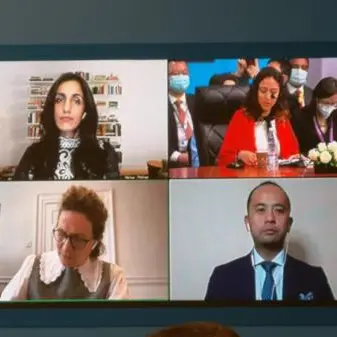
During a high-profile ministerial panel, Libya’s Oil&Gas Minister Dr. Khalifa Abdulsadek said the nation is targeting an increase in crude oil output from roughly 1.375 million bpd to 1.6 million bpd by the end of 2026, reflecting the progress the country has made in stabilizing production and attracting investment. Minister Abdulsadek also highlighted the importance of agreements like the Waha re-entry amendment as central to the country’s strategy for scaling production.
IOC Panel: Gas Expansion, Infrastructure and Drilling Capacity
Italian major Eni confirmed plans to bring its Bahr Essalam gas compression project online by the end of Q1 2026, adding around 100 million standard cubic feet per day (mmscfd) to Libya’s gas output. A second gas utilization project is expected by Q3 2026, potentially delivering an additional 100–120 mmscfd and reinforcing gas as a core pillar of Libya’s energy strategy.
OMV highlighted Libya’s significant stranded gas potential, estimating associated gas volumes of between 7 and 9 billion cubic meters, while stressing that infrastructure constraints – particularly evacuation and processing capacity – remain a key barrier to development. During the same panel, Libya’s NOC outlined plans to invest $2 billion to modernize gas infrastructure, including pipelines and processing systems, addressing bottlenecks that have constrained evacuation and processing capacity.
Operational readiness and drilling capacity also featured prominently. Assail Drilling Company (ADC) hosted a technical workshop focused on rig technology upgrades, outlining how modernized rigs and enhanced drilling efficiency could support Libya’s near-term production targets and reduce downtime across mature fields.
Repsol executives echoed the need for long-term visibility and stable frameworks, noting that predictable contracts and infrastructure readiness are essential for mobilizing rigs, capital and skilled personnel at scale.
Bottom Line: A Turning Point for Libya’s Energy Sector
Announcements from day one of LEES 2026 indicate that Libya’s oil and gas sector is moving decisively from recovery into an expansion phase. With long-term IOC re-entry agreements, advancing gas projects, renewed exploration interest and a focus on infrastructure and drilling efficiency, Libya is positioning itself for higher production, deeper regional integration and renewed relevance in global energy markets.
Distributed by APO Group on behalf of Energy Capital&Power.