The fifth edition of the African Development Bank's (www.AfDB.org) Trade Finance Report paints a picture of resilient African financial institutions in the post Covid-19 years, despite a challenging global environment.
Download Report: https://apo-opa.co/4uNLXj6
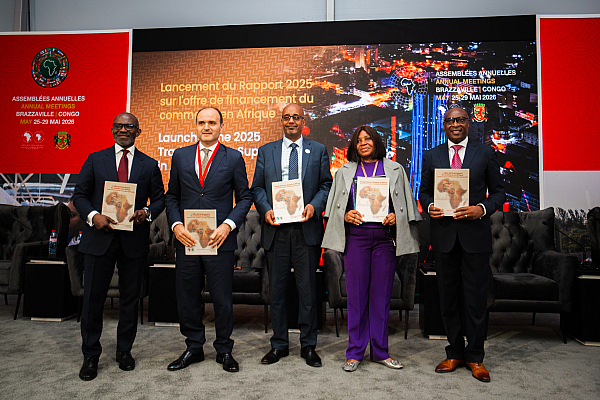
The 2025 Trade Finance Report, which provides an updated assessment of Africa's trade finance landscape over the 2020–2024 period following the COVID-19 pandemic, was released on Wednesday, during the Bank Group’s 2026 Annual Meetings, taking place in Brazzaville, Republic of Congo.
The report examines trade finance from a bank-intermediation perspective, filling important knowledge gaps while introducing new dimensions such as digitalization and environmental sustainability. It also, for the first time, quantifies the contribution of Development Finance Institutions (DFIs) to trade finance on the continent.
Presenting the report, Anthony Simpasa, Director of the Macroeconomic Policy, Forecasting and Research Department at the African Development Bank, said unmet demand for trade finance declined by nearly 10% between 2019 and 2024, supported by strong interventions from multilateral development banks, governments, export credit agencies, and global banks. These interventions were critical in sustaining trade flows, with estimates suggesting that, in the absence of DFI support, the annual trade finance gap could have exceeded $100 billion during the 2020-2024 period.
“Renewed geopolitical tensions and disruptions to global supply chains and trade flows could reverse post-pandemic progress in narrowing the trade finance gap. For instance, tighter correspondent risk appetite could widen the trade finance gap to $86.6-$102.6 billion by 2027 under a moderate to severe scenario. This is at least 17.7 % above the 2024 level, potentially erasing a decade of gains,” Simpasa cautioned.
The report launch event was attended by policymakers, private-sector leaders, Development Finance Institutions (DFIs), Financial Institutions, and trade finance experts from across the continent.
Some highlights of the report:
- The unmet demand for trade finance in Africa ranged from $74 billion to $92 billion in 2024. The estimated gap of $ 74 billion represents 5.4% of the region's total merchandise trade value in 2024.
- African trade remains underserved by commercial banks. Over the five years of the study, commercial banks intermediated an average of 23% of Africa's total trade, down from 40% during 2011-19.
- Between 2020 and 2024, intra-African trade accounted for 34% of total bank-intermediated trade, representing an 89 percent increase above pre-pandemic levels (2011-2019).
- Foreign exchange liquidity shortages have become the primary barrier limiting banks' growth in trade finance. About 36% of banks cited limited foreign exchange liquidity as the primary constraint to their trade finance growth between 2020 and 2024, compared with 18% in the 2015-2019 period.
- The adoption of digital trade finance solutions by banks remains low, primarily due to high implementation costs and inadequate technological infrastructure. Only 28% of the banks surveyed reported having adopted digital tools or platforms for their trade finance operations.
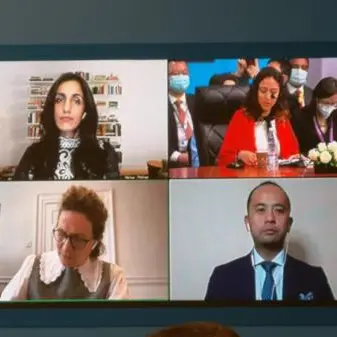
In a short panel discussion following the launch, Didier Acouetey, Senior Advisor to African Development Bank President Sidi Ould Tah for the Private Sector, Francisca Tatchouop Belobe, Commissioner for Economic Development, Trade, Tourism, Industry and Minerals for the African Union Commission, Admassu Tadesse, Group President and Managing Director, Trade and Development Bank; and Mehdi Tanani, Regional Director for Central Africa, Proparco, discussed the report's findings, noting opportunities and challenges to unlocking sustainable bank-intermediated trade finance in Africa.
Although trade finance remains a major constraint for most of Africa, exciting innovations are gaining ground, such as digitization, guarantees and asset management initiatives to expand the trade finance asset class and related offerings to the market, Tadesse said. “This should be advanced further by new systemic initiatives such as New African Financial Architecture for Development (NAFAD) and related thrusts such as derisking and smart partnerships that should multiply the impact of African capital and unlock more global capital,” he added.
“NAFAD gives us, for the first time, a coherent continental framework to close the trade finance gap — not project by project, but systemically. That is the shift that changes everything for African SMEs," Acouetey noted.
Commissioner Belobe called for eliminating the 'missing middle' in African banking. “SMEs are too large for microfinance, too small for corporate banking, but far too commercially important to be left outside the trade finance system. It is time for commercial banks to treat SME trade finance as a deliberate, core business line, not a residual activity,” he said.
“Africa will not close its trade finance gap by adding constraints, but by building a more resilient, more digital, and more sustainable trade finance ecosystem — one that protects SMEs against global shocks while accelerating the continent’s economic integration,” Tanani said.
The African Development Bank and other DFIs have played a significant role in reducing the trade finance gap in Africa. Development finance institutions facilitated about $32 billion in trade finance annually between 2020 and 2024, accounting for about 3% of Africa's total merchandise trade on average over the same period.
The African Development Bank’s Trade Finance Program was established in 2013, with an inaugural survey conducted in 2014. Since 2014, AfDB has produced 4 periodic surveys, including two country-specific reports on Kenya and Tanzania.
Read the full report here https://apo-opa.co/4uNLXj6.
Distributed by APO Group on behalf of African Development Bank Group (AfDB).Contact:
Amba Mpoke-Bigg
Communication and External Relations Department
Email: media@afdb.org.