PHOTO
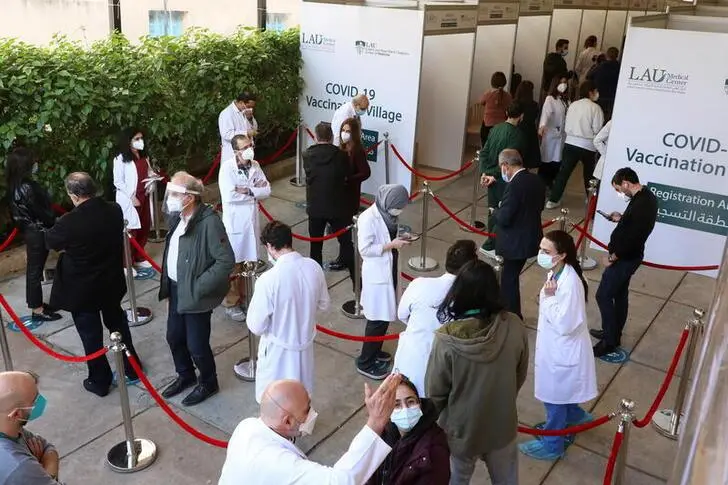
BEIRUT: Walk-in vaccine appointments are now available at hospitals offering the Oxford-AstraZeneca jab to citizens aged over 40, the Health Ministry confirmed Tuesday, in a much needed move to speed up the rollout in Lebanon.
Those who have already registered for the jab on the Health Ministrys platform and are over 40 years old are invited to one of 34 accredited vaccine centers to either book an appointment or receive the vaccine dependent on its availability.
Registered citizens need to provide ID and evidence of their registration at one of 34 accredited vaccine centers offering the AstraZeneca jab across Lebanon, including Rafic Hariri University Hospital, Keserouan Medical Center, and Marjayoun Governmental Hospital.
A full list of centers is available on the Health Ministry's website.
Rafic Hariri University Hospital announced Wednesday that citizens can show up at the center from 10 a.m. to early in the afternoon to either have the vaccine or book an appointment to receive the jab at a later date.
The center will be giving vaccines leftover from missed appointments, in order to preserve the number of vaccinations that the center received from the Health Ministry the statement said.
The ministry also stated that those aged between 55-59 years with chronic diseases registered on the platform before May 17 will be sent invitations over the next week to book an appointment for the Pfizer-BioNTech jab.
Since the vaccine rollout began in February, 190,788 individuals have received both doses, just 50,000 more than a month ago and only 4 percent of the 5.1 million people eligible in Lebanon.
The low percentage puts Lebanon greatly behind other Middle Eastern nations vaccine rollouts, including in Bahrain where 40 percent of people have been fully vaccinated, and also in Qatar where 30 percent of residents have.
The ministry has been criticized for the slow pace considering the pressing need to obtain immunity among the population in light of the precarious economic state of the country that has been aggravated by COVID-19 safety measures and lockdowns.
Dr. Petra Khoury, public health advisor to caretaker Prime Minister Hassan Diab, told The Daily Star that the lower number of second doses having been given was a result of the Health Ministrys decision to change the administration of the second shot from 3 to 6 weeks after the first.
We wanted to target more age groups, expand more.
Lebanon has received 545,220 Pfizer doses out of an initial agreement for 2.1 million doses that has arrived in weekly installments. A further 750,000 jabs are expected to arrive in June to be allocated outside the ministrys plan, with 420,000 of those given in deals with eight universities.
In addition, the caretaker government has also signed an agreement for 2.75 million vaccines through COVAX, the WHO-led project designed to increase vaccine availability for middle and low income countries.
But AstraZeneca shipments from COVAX have not been reliable, Khoury said. Lebanon has only received two shipments from COVAX since March, totaling around 160,000 jabs, despite many more agreed.
More arrivals are expected in the coming months, but Khoury was hesitant of any guarantee.
COVAX has not been consistent, honestly. They dont give us deadlines, just tentative dates and so far tentative dates have not been honored, Khoury said.
The British-Swedish pharmaceutical companys Middle East supplier has been having manufacturing issues, leaving other Arab countries also at an AstraZeneca shortage, according to Khoury.
The ministry has plans in July to open up the vaccine campaign not just to the higher education sector but other sectors with essential workers who are at high risk, like the hospitality industry, for example.
Companies will be able to purchase Pfizer vaccines for their employees through the Ministry and payable to the Central Bank, covering the governments initial payment to Pfizer.
Khoury stressed that this initiative was not through a private dealer and the bank would not be making a profit over the sales.
Copyright 2021, The Daily Star. All rights reserved. Provided by SyndiGate Media Inc. (Syndigate.info).