PHOTO
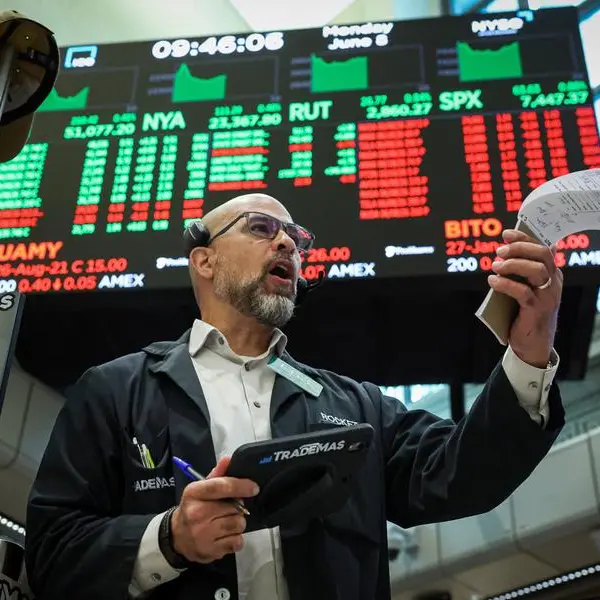
World markets rapidly reversed course on Monday after U.S. President Donald Trump said he would order the military to postpone any strikes against Iranian power plants and energy infrastructure, easing uncertainty and fear over the repercussions of a deeper oil shock.
The reaction from markets was swift and marked: Brent crude oil futures fell sharply, the dollar fell against other major currencies, stock markets rallied and government borrowing costs fell back.
"It's exactly what the market needed to hear to sort of reprice worst-case expectations. This means there is potential for the Strait of Hormuz to reopen; it's being priced in almost immediately," said Fiona Cincotta, senior market analyst at City Index.
"Whether this recovery in equities continues depends on whether we get more supportive comments, particularly from Iran as well, corroborating this idea that there is progress being made."
IRANIAN MEDIA CONTRADICT TRUMP'S COMMENTS
Trump said the postponement followed productive conversations with Iran.
But Iran's Tasnim news agency, citing an Iranian official, said that the Strait of Hormuz would not return to pre-war conditions and energy markets would remain unsettled, adding that no negotiations with the U.S. were underway.
The headlines from Iranian media contradicting Trump's comments tempered market moves, Mizuho multi-asset strategist Evelyne Gomez-Liechti noted.
But for now, optimism largely prevailed in markets and Brent crude prices were last down 7% to around $103 a barrel, though cutting losses after they plunged as much as 15% to $96 earlier. They had reached $119 on Friday.
Government bond yields, which had risen ahead of Trump's comments as investors doubled down on their expectations for central bank rate hikes in Europe, dropped sharply.
U.S. stock futures were 1.4% higher, pointing to a strong open on Wall Street, while European stocks were last up 0.7%.
INVESTORS TRIM RATE HIKE EXPECTATIONS
Britain's 2-year bond yield, which has borne the brunt of a bond selloff since the start of the conflict, was last down 6 basis points on the day, having risen 13 bps earlier. The 10-year yield dropped from its highest since 2008.
Investors trimmed their bets on Bank of England rate hikes, now fully pricing in two hikes by year-end versus more than three earlier on Monday, while they also cut expectations for the European Central Bank.
In the U.S., Treasury yields were 2-3 bps lower across the curve, with the 10-year yield last down to 4.37%.
The dollar was broadly soft, having traded higher against most other currencies until the headline hit.
The euro was last up 0.1% at $1.158, up from an earlier low of $1.1485.
"It’s clearly jawboning in the face of the meltdown that we've seen. We're seeing a bit of a knee-jerk reaction to this positive news," said Elias Haddad, global head of markets strategy at Brown Brothers Harriman.
"There's certainly room for a bit of an unwind in the fear trade. A more sustained rally in risk assets will depend on whether this is legit de-escalation or simply a pause before a next leg up in escalation."
(Reporting by Dhara Ranasinghe and Yoruk Bahceli; additional reporting by Lucy Raitano and Purvi Agarwal; Editing by Amanda Cooper, Elisa Martinuzzi and Alex Richardson)