PHOTO
It is a great time to be trading equities. Banks are reporting record revenue and traders may see record bonuses, according to pay analysis firm Johnson Associates.
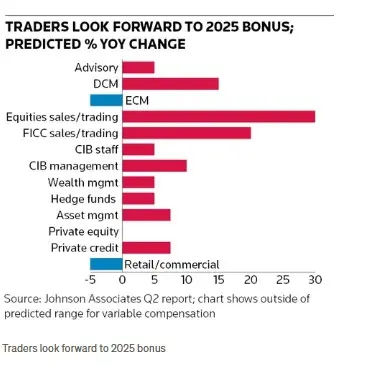
Incentive pay for equity traders for 2025 could rise between 20% and 30%, Johnson said in its latest compensation report. That’s on top of lofty levels last year.
That tracks with the performance of top banks in the second quarter and first half of the year. Across the five biggest US banks, including Goldman Sachs, Morgan Stanley and JP Morgan, revenue from equities trading was up 27% in aggregate in the first six months of the year.
Traders got a big assist early in the second quarter when president Donald Trump's administration unveiled a new trade and tariffs policy on April 2, boosting market volatility.
Equity trading revenue soared to a record US$4.3bn at Goldman in the second quarter, and top rivals were not far behind, with banks citing volatility and heightened engagement as key drivers of revenue gains.
Fixed income traders are in line for the second-best bonus boost, with incentive pay projected to rise 10% to 20% this year, Johnson said.
Revenue from fixed income, currency and commodities trading rose 10% in the first half of the year across the top five US banks.
M&A bankers rebound
Investment bankers may also have reason to smile by the end of the year. After a weak first quarter, pay estimates were sour for bankers in M&A advisory and equity underwriting. But that has turned around and Johnson has revised most of its pay estimates upward.
"The updated projections are a marked shift from our first-quarter estimates, which reflected muted business activity amid tariff uncertainty and declining equity markets," Johnson said. "While geopolitical concerns remain, equity markets have rebounded sharply and optimism is building, lifting sentiment across asset management, investment banking, and certain illiquid alternative strategies."
Johnson expects advisory bankers could see bonus pay for 2025 rise 5% from awards for 2024.
Revenue from advisory was up 21% in the second quarter and up 15% for the first half of the year across the top banks. Independent banks, including Evercore, Lazard, PJT Partners, Moelis and Perella Weinberg Partners, underperformed bulge-bracket peers in the quarter and their advisory revenue rose 14% in Q2, but matched bulge-bracket rivals with a 15% increase for the first half.
Incentive pay for ECM bankers is expected to be flat to down 5% this year as IPO activity remains muted, according to Johnson. While that is not a great outlook, it is better than the previous prediction when it forecast ECM incentive pay to fall as much as 20%.
Across the top five US banks, ECM revenue was up 9% in the April–June quarter from a year earlier, but down 3% for the first half of the year.
Johnson expects debt underwriting bankers could see bonus pay for 2025 rise 5% to 15% from last year as debt issuance continues to trend higher on refinancing needs. DCM revenue across the top five US banks was up 3% for the first half.
Bankers in global retail and commercial banking could see pay fall as much as 5%, according to Johnson, citing concerns over consumer credit stress. For general corporate banking employees, bonus pay is likely to be flat to up 5% as banks tighten expenses.
"Firms continue to focus on long-term expense management, with AI-driven efficiencies prompting increased scrutiny of staffing levels and compensation structures," Johnson said. "As automation accelerates, firms are reevaluating how and where talent is deployed across the organisation."
Traders are not the only ones expected to benefit from swollen trading profits. Bonuses for management could be flat to up 10%, as strength in trading propels business results, Johnson predicted.
Source: IFR