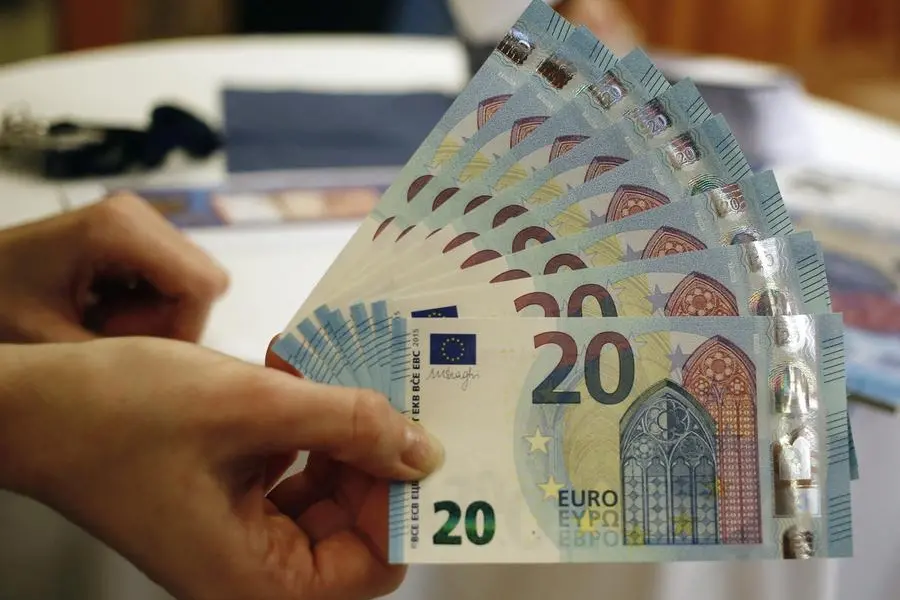
PHOTO
LONDON - Germany's 10-year bond yield edged higher on Tuesday on concerns a Middle East peace deal may still be some way off after the U.S. launched new strikes on Iran, although it remained near a roughly seven-week low hit the previous day.
U.S. and Iranian negotiators remain in talks to end the three-month war that has severely disrupted Middle Eastern oil and gas supplies and pushed global inflation higher. Expectations of a breakthrough and a reopening of the Strait of Hormuz had supported bonds in recent days.
But optimism was tempered overnight after the U.S. said it had carried out what it described as defensive strikes in southern Iran, suggesting any peace deal is not imminent.
"Some back and forth probably remains in the cards over the coming days but ultimately hopes for a reopening of the Strait of Hormuz prevail," said Commerzbank rates strategists in a note.
Germany's 10-year yield was up 2 basis points at 2.972%, after falling almost 9 bps on Monday to 2.93%, its lowest since April 8.
The 30-year yield was up 1 bp at 3.513% after touching 3.484% on Monday, its lowest since April 9.
ECB TO HIKE?
The European Central Bank has kept interest rates on hold for the past year but looks increasingly likely to raise them next month as sharply higher energy costs have pushed inflation well above its 2% target.
ECB policymaker Isabel Schnabel told Reuters that the central bank should raise rates in June even if a peace deal is struck, given the size and persistence of the energy shock.
Other policymakers have also recently made the case for tighter monetary policy.
Money market traders are pricing in about a 90% chance of a hike at the ECB's June meeting, while 57 bps of tightening is priced by year-end, implying at least two quarter-point hikes.
Germany's two-year yield, which is sensitive to changes in rate policy, was up 4 bps to 2.575%. It fell 10 bps on Monday to 2.523%, its lowest since May 7.
(Reporting by Samuel Indyk. Editing by Mark Potter)