Coming off the back of a global recession, tourism is on the rise internationally. In fact, the United Nations World Tourism Organization (WTO) has edifying news for tourist destinations.
For instance, international tourism receipts grew by 4% in real terms in 2012, hitting a new record of USD 1,075 billion (AED 3,948 billion) worldwide. International tourist arrivals also grew 4%, which highlighted yet again the correlation between arrivals and receipts.
Asia and the Pacific, the Americas and Africa all saw firm growth at 6%, with Europe mustering a passable 2%. Despite slower growth, Europe retains the largest share of international tourism, with 43% of receipts amounting to a hefty USD 458 billion.
TOURISM IN THE MIDDLE EAST
Receipts in the Middle East were down by 2% in 2012 due to the political upheaval in several countries. However, the picture was still rosier than the stark decline in 2011. Overall, the Middle East handled 52 million incoming arrivals in 2012, which was still a 5% overall drop. But individual destinations sometimes did well.
For instance, Egypt, which enjoyed a glimpse of stability before the most recent unrest, took advantage of a window of opportunity to rebound with 18% more tourism than in 2011. Palestine upped its numbers by 9% with Jordan also showing a 5% increase.
Dubai in the United Arab Emirates (UAE) consolidated consistent growth with a rise of 10% over 2012; but the cumulative analysis was dragged down by Lebanon, down 18% due to events in neighboring Syria. Saudi Arabia couldn't sustain its bull run in the tourism market, giving up the ghost to come in 22% down compared to 2011.
But Dubai, and the UAE in general, has always been lauded for a sustainable tourism strategy. As far back as 2006, Joan C. Henderson of the Nanyang Business School, Singapore, while writing for the International Journal of Tourism and Research, pointed out that tourism in the Middle East was patchy. But she did note that, "Despite these apparently unfavorable circumstances, international tourism has been adopted by the Dubai authorities as a core element in a program of economic diversification."
There are perhaps two reasons why the Middle East has recorded patchy tourism results. First, that some individual countries in the area have their very particular milieu, gamut of issues and stricter beliefs that make them less approachable than laxer, more liberal European destinations.
Second, that the number of tourist arrivals tells but half the story, because many of the receipts get transferred to a grey, informal economy that centralized government departments find difficult to enumerate.
DUBAI'S FORMAL ECONOMY
Dubai, as a microcosm of the role the UAE plays, has long been developing itself for a post-hydrocarbon economy by setting up tourism attractions, and also ensuring it has sufficient hotel rooms to house the growing inflows of people the city receives every year.
The hospitality sector is governed by a masterplan and a rigorous registration scheme. It is therefore easy to determine the size of this formal economy. For instance, a WAM (the official news agency of the UAE) press release quoting Dubai's Department of Tourism and Commerce Marketing (DTCM) figures noted that in 2011, the city had 575 hotels and hotel apartment buildings (a 5% increase from 2010) with 53,828 hotel rooms and 21,015 hotel apartment flats.
A 2010 DTCM press release included a table detailing the number of visitors to Dubai from key nationalities and regions.
The DTCM's July 2013report stated that Dubai hit 5.5 million visitors in the first half of 2013, up 11.1% compared to the same period in 2012.The DTCM also offers rigorous data on tourism source market, noting that the top 10 remained the same as for 2012, but with some changes in numerical hierarchy - Saudi Arabia, India, UK, USA, Russia, Germany, Kuwait, Oman, China and Iran.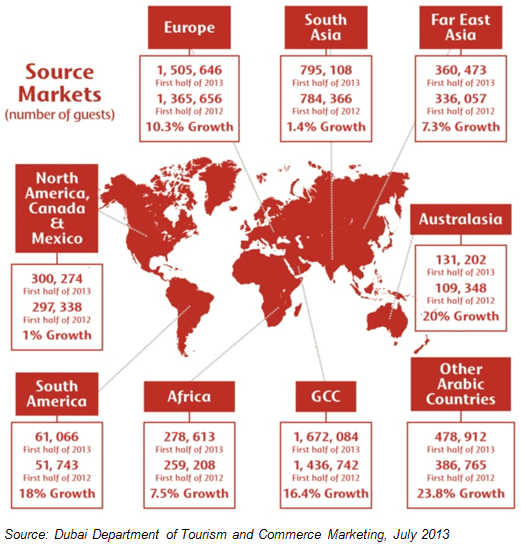
The DTCM also keeps records of the total room stock in Dubai, stating that hotels and hotel apartments have increased from 587 in 2012 to 603 in June 2013, leading to total room stock rising from 76,008 to 81,492. 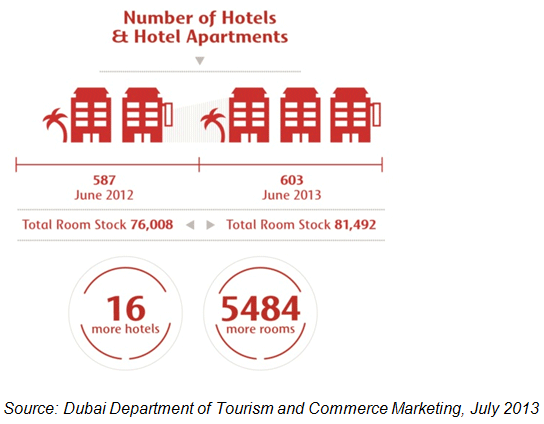
DESERT SAFARIS AND CRUISES
This formal economy has a number of activities attached to it including retail trips, desert safaris and boat and dhow cruises that are not as easily tracked.
Desert safaris are an example of this informal economy. The idea behind the safari is to take tourists from their hotel and drive them out to a recreated Bedouin campsite in the desert. The route taken is circumlocutory so customers can enjoy dune bashing, or the art of driving diagonally up sand dunes.
From Arabic coffee to delicious dates, camel rides to belly dancing, hennah painting to hookah, desert safaris are as popular as they are ubiquitous. Every concierge at every hotel apartment or tourist resort would be able to recommend a few.
But according to Ravinder Saini, manager, Business Development and Marketing for Lama Tours, a holidays and tourism company that offers both desert safaris and dhow cruises, there are no more than 40 to 50 officially licensed operators.
Yet that has not prohibited freelancers from using established camps to offer tourists discounted safari experiences. Qasim Badr is a collections officer at a private sector organization in Emaar Parks, Dubai, who used to drive tourists out into the desert for safaris.
"The deal always was that we were provided cars, but were to safely take people into the desert, make sure they have a good time, and take them to one of the camps in there. After they'd spent some time in the camp, we'd drive them back out again," he explains.
Qasim says that drivers used to get anywhere between AED 200-300 per trip into the desert in an SUV carrying up to five tourists. They would congregate at common camps used by licensed safari operators if they weren't full to capacity. There were also smaller, more adhoc camps set up by UAE nationals on desert land that would be rented out to independent operators for a day if needed.
Similar models have been known to work for dhow cruise tourism. While the craft would necessarily be licensed to ply UAE waters, with permission attached to a hotel establishment, the tourists themselves would be drawn by travel agents, booking companies and aggregating deal websites to the point that such activity would be difficult to track and account for. Commission-based structures with a number of intermediaries would also make this an informal part of the tourism economy.
Ahmed Shah, an independent cruise broker notes that the model "works on brokerage. So we know there is a hotel with a ship that can fit 50 people. We can call and see how many slots are available, and sell those on. We can get discounts on bulk and keep some overheads for us."
CHALLENGES AND OPPORTUNITIES
The future of outdoors tourism in the UAE is being defined by a number of stark influences and considerations, leading to interesting projections in the next five years.
The first defining issue with outdoor activities such as dhow cruises or desert trips is their sharply cyclical, seasonal nature. "Our peak season is from September till the end of May. And yes, the difference is noticeable, with a drop of 45% to 50% in summer," Ravinder said.
The popularity of dhow cruises and desert safaris has also resulted in a noisier, more cloistered market that is moving towards perfect competition with increasing overheads.
Greater traffic driving environmentally valuable desert ecosystems, and a sharp rise in unlicensed freelance drivers, has led to greater regulation, while also driving down fees.
Lama Tours is a fully licensed, established tourism concern. Ravinder estimates they run 40 to 50 cars daily, translating to around 250 guests. The monthly average, he says, is 5,000 to 7,000 guests, though those figures can easily double if large groups or corporate clients book in.
But for smaller independents contributing to the informal economy, competition and regulation have taken their toll. "In 2009, the rate paid to a driver in a desert safari was around AED300 a trip. In 2012, this had dropped to AED60 because so many drivers entered the market, and there were so many cars," Qasim said.
While the number of cars has increased, desert safari camps have reduced in number. The Dubai Roads and Traffic Authority (RTA) has partnered with Dubai Municipality to ensure independent smaller camps must now be licensed. This has led to numbers reducing down to a handful of larger camps. "I would estimate there are between 10 to 15 medium to large camps left on the popular routes," Qasim noted.
REGULATING THE MARKET
While smaller operators might be chafing under new regulations, Ravinder believes that stricter laws actually address one of the gravest challenges faced by the industry - that posed by unregulated cowboys. "Service quality is the biggest threat that can be seen in this industry; people generally look out for cheaper deals and don't get to experience the real desert safari. One should always provide the best service and memorable experience."
As health and safety regulations, insurance and licensing costs all rise, the day of the small, independent operator might be over. For some stakeholders this may not be a bad outcome.
"Yes, the regulations have got tougher but this in turn is good for the business because only professional and fully licensed companies will operate, and will have to be equipped to international standards. Desert driving licenses, insurance for the vehicle and all passengers, safety equipment and well maintained cars are all mandatory requirements to operate safely in the desert," Ravinder said. "And we are very pleased to partner with the DDCR - Dubai Desert Conservation Reserve - which promotes a natural habitat for experiencing desert safaris."
Dubai in particular and the UAE in general have obviously decided its international tourist image and fragile local ecology can no longer be left to laissez faire.
In 2012, the government estimated that 72 million tourists visited Dubai alone. Many would have gone on desert safaris. That year, the General Department of Tourism Security recorded 122 offences against desert safari rule breaches and 67 against those on other trips.
But greater oversight doesn't mean the demise of desert tourism. In fact, Ravinder believes it is only now that tour operators will start getting creative. "There is huge demand for different products in desert tourism, over and above the safari. Overnight stays, barbeque dinners, morning camps, etc. - these are all possibilities."
© Zawya BusinessPulse 2013