The Shaybah oilfield is the remotest of Saudi Arabias giant reservoirs, lying 800km southeast of Dhahran near the border with the UAE. Surrounded for many miles by the huge rolling sand dunes of the Rub? al-Khali, it is a project of which Saudi Aramco is immensely proud. The company flew journalists out to the Shaybah complex during the third OPEC summit in Riyadh this week, to reveal the efforts involved and the landmarks achieved in implementing and expanding this project which, as Simon Martelli reports, could achieve 1mn b/d output capacity.
On arrival at the airstrip in Shaybah, a 1.5 hour flight from Riyadh, journalists were met by a group of smiling Saudi engineers, welcoming us to their place of work. Some of them seemed visibly pleased to be making contact with the outside world. Five minutes later, we were climbing up one of the red sand mountains, to witness the sun setting behind the empty horizon of what could have been a distant planet. Below us lay the compound that houses 700 permanent staff, complete with football pitch, medical facilities, mosque and runway.
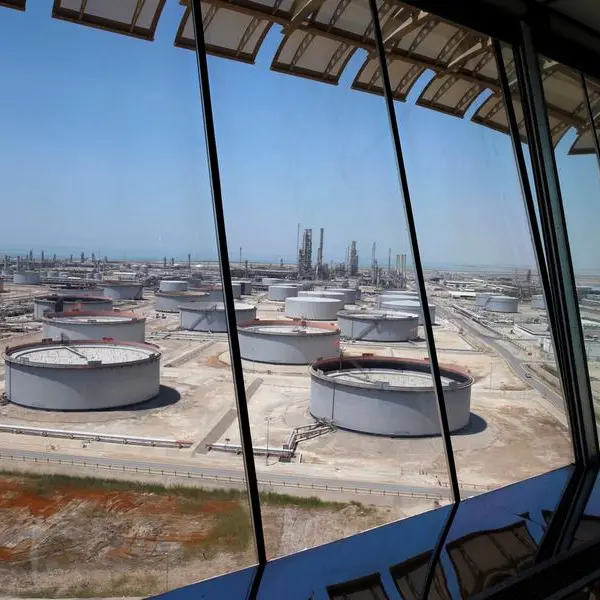
Shaybah was discovered in 1968, but its development at the time was not considered economically feasible, given the remote location and the lack of existing infrastructure. Subsequent technological developments, especially horizontal drilling, made the fields exploitation more attractive, but did not lessen the task of building a 640km, 46in pipeline to Abqaiq, and transporting the necessary equipment, by a newly built 400km road, to assemble three gas and oil separation plants (GOSPs) each with a capacity of around 200,000 b/d. Abqaiq itself required a major upgrade to accommodate the production from Shaybah, involving the construction of extra crude stabilizers, gas compression units and NGL plants.
Shaybah was brought on-stream in 1998, following a development period of just three years, and at a rate of 500,000 b/d. The output of light crude from the giant field is set to rise by another 250,000 b/d in 4Q08, as planned, with the construction of GOSP-IV. With proven oil reserves of 19bn barrels and natural gas reserves of 30 tcf, Shaybah could achieve 1mn b/d or more, Saudi Aramco officials there say. MEES understands that the companys decision on whether to aim for that level of production capacity will be taken around the time that the current expansion plan is completed. There are no firm plans at present for future gas production, but despite its remote location, the fields potential is huge and the options are being considered.
Construction of the new plant, launched in March this year, is already 30% complete and may even be finished slightly earlier than planned. There are 7,000 people working on the expansion project. Canadas SNC-Lavalin won the main engineering, procurement and construction (EPC) contract for the central processing facilities in April 2006 (MEES , 17 April 2006). The crude produced from Shaybah is among the highest quality in Saudi Arabia, with a 41 API and 0.04% sulfur content, which gives Saudi Aramco good reason to bring more barrels of the Arab Extra Light into production as swiftly as possible. It may also encourage the Saudi firm to embark on the following 250,000 b/d production hike within 12 months, although rising costs must be factored into any such decision. [Producing] the next 250,000 b/d is not more difficult, but it is more expensive maybe 50% more expensive, says Shaybah production manager ?Ali al-?Ajmi, although he declined to put a number on the size of the investment.
Unexploited Gas Potential
Driving through the brightly lit industrial complex during the evening added to the sense that we were visiting some highly sophisticated and carefully operated space station a vast tangle of steel girders, compression tanks and thick pipelines. Saudi Aramco officials said that 700mn cfd of gas is produced from the Shaybah fields, most of which is injected back into the fields through six re-injection wells, to maintain reservoir pressure and preserve gas for future use. A small quantity is used to supply the four combined gas turbine plants (CGTs) that power the entire complex. How Shaybah gas reserves might be exploited in the future remains undecided, but is likely to be the subject of intense discussion and planning over the next few years.
Shell has been looking to develop the Kidan sour gas field in its South Rub? al-Khali (SRAK) concession that is also located near the UAE border. SRAK is one of Saudi Aramcos four gas upstream joint venture partnerships with foreign companies, in this case Shell with 40%, and Total with 30%. Plans for the construction of a pipeline to transport sales gas from Kidan and Shaybah to the Hawiyah straddle plant in 2003 were eventually dropped. But the surge in domestic gas demand, with the implementation of number of petrochemical mega-projects, may force the kingdom to reconsider such initiatives.
After leaving the ground, our aircraft banked over the Shaybah complex as it turned in the direction of the capital. The rectangular industrial site was clearly visible from the night sky, as were the two gas flares nearby, and the numerous wells scattered beneath us. The total well count to date is around 200, and as an indication of its geographical size, the furthest lies 50km from the complex. Much work has gone into developing the Shaybah field the construction phase accounted for 50mn man hours. The field has produced a large quantity of high value oil over a period of almost 10 years, and could still double its output. On top of this, the exploitation of the fields gas reserves, when it eventually happens, will simply underline the significance of Saudi Aramcos achievement.
Copyright MEES 2007.