At the most basic level, every consumer across the world who switches to a vehicle not powered by a hydrocarbon-based fuel poses a threat to the fiscal stability of the Middle East's largest economy.
More urgently, however, changes in oil demand driven by global economics and geopolitics may hold the key to continuing fiscal prosperity in Saudi Arabia.
Saudi Arabia, which gets 80% to 90% (depending on the market price of crude) of its revenues from oil, faces a delicate balancing act. Should it tweak production levels to drive crude prices upward and support its fiscal budget? Or should it moderate crude prices to ensure that demand remains high and global industrial as well as individual consumers do not actively switch to other fuels?
The debate gathered momentum when the Economist Intelligence Unit reported last month that Saudi Arabia's traditionally surplus budget could become a deficit one as early as 2015. The International Monetary Fund issued a similar warning, but pushed the likely switch to a deficit as far back as 2017.
Both point to Saudi Arabia's massive increase in fiscal spending, announced in 2011 following the Arab Spring uprisings in the region, and a slowdown in oil revenue growth, as the factors to beware of.
According to the EIU, the tremors of the "knock-out government stimulus package will be felt starting 2015". It predicts that Saudi Arabia's fiscal performance will deteriorate, as the impact of benefits and wage rises, combined with a slower growth in oil revenue, is felt.
The IMF too has warned against the rapid pace of fiscal spending growth in Saudi Arabia, despite its positive overall assessment of the kingdom's economy, predicting that the Saudi budget surplus could turn to a deficit by 2017.
Saudi Arabia currently witnesses high levels of economic growth. Investment bank Jadwa predicts a GDP growth of 5.3% in 2012, the second highest in the past seven years. The kingdom's fiscal surplus is forecast to grow 28 times.
Geopolitics
"The Arab Spring forced the kingdom to increase its public expenditure in order to keep its 27 million people calm. Saudi Arabia's domestic expenses in 2011 increased to USD 129 billion, which is about half of its oil revenues," Dr. Sara Vakhshouri, president at Washigton D.C.-based SVB Energy International, told Zawya.
With the rise in geopolitical risk, the kingdom has increased its social spending to address the pressing issues of affordable housing shortages and unemployment. In March 2011, Saudi King Abdullah announced a generous USD 67 billion spending package to build half a million affordable housing units, as part of the measures to tackle the severe housing shortages in the kingdom.
Related article: Mixed prospects for Saudi middle-income housing market
"Increased oil prices and oil production have resulted in sharply higher fiscal and current account surpluses, providing fiscal space to increase spending to address longstanding social issues, including employment creation, the availability of affordable housing, and financing for small and medium-sized enterprises," said David Robinson, IMF mission chief for Saudi Arabia, in a September 18 note.
For 2011, the kingdom witnessed the highest growth in its non-oil economy since 1981, reaching 8%, according to the IMF. Its overall real GDP growth reached 7.1%, and it witnessed a 20% increase in real government spending. Fiscal surplus increased in 2011, despite increase in government spending, due to the surge in its oil revenues, which reached USD 81.6 billion, or about 14% of its GDP, according to ministry of finance estimates.
At the same time, the kingdom recorded a 39% overspending in its budget. That overspending was more than offset by the rise in oil revenues.
For 2012, the kingdom announced its highest ever expenditure of USD 184 billion. That is likely to push the fiscal surplus to about USD 81.6 billion, the second highest since 2008, according to Jadwa.
Clearly, the global price of oil plays a crucial factor in shaping the Saudi economy. And the price of oil is sensitive to global economic as well as geopolitical factors.
"Oil prices have been associated with waves of inflation and economic instability over the past three decades. They have fluctuated even more during the past five years. The return of geopolitics to the international oil market has made price trends totally unpredictable," Dr. Fereydoun Barkeshli, senior adviser on international affairs at Institute for International Economic Studies, told Zawya.
2015 or 2017?
The EIU forecasts that the Saudi budget will slip into deficit starting 2015. However, the deficit shortfall expected would be small, EIU adds, reaching 0.1% of GDP in 2015, and 0.5% of GDP in 2016.
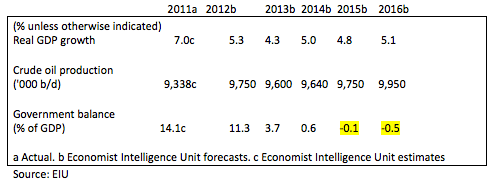
The IMF, on the other hand, predicts that the kingdom may fall into deficit starting 2017, as it forecasts a gradual decline in the oil price per barrel over the next five years. The fund expects expenditures to hit a massive USD 301 billion in 2017, while revenues would be at USD 290.6 billion.
"It is estimated that the country needs to sell its oil at least in the range of USD 80 to USD 85 per barrel to balance its budget. This number is expected to increase to above USD 110 per barrel within the next couple of years," Dr. Vakhshouri said.
Dr. Barkeshli also points out that it may be important to establish a correlation between Saudi Arabia's fiscal behavior and monetary policy formulation in the West.
"Inflationary consequences of a rise in oil prices depend on policy responses of the monetary authorities in consuming countries and fiscal policy makers in the producing countries, and especially more so for Saudi Arabia with huge revenues from oil production and exports," he said.
"To the best of my knowledge, Saudi Arabia's fiscal policy is impacted by and linked to monetary policies of the consumers. As we have witnessed, the G-20 misses no occasion to blame or accuse OPEC and Saudi Arabia for inflationary trends in OECD."
According to Jadwa estimates, the kingdom's oil output is expected to grow to an average 9.6 million barrels per day in 2012 from 9.3 million bpd in 2011.
"I am sure that [Saudi oil minister] Ali Al Naimi has little or no intention to boost production above 10 million barrels per day or see the world oil price rise above USD 100 per barrel fearing the long-term consequences and impact on global oil demand," Dr. Barkeshli said.
The main challenge that Saudi Arabia currently faces is delicately balancing the need to maintain high oil prices for fiscal reasons, on the one hand, whilst on the other ensuring a steady demand for its oil via lower prices, added Dr. Vakhshouri.
"If prices are too high for consumers, particularly in light of current economic dynamics, they might start switching from oil to alternative resources, as the gap between the prices of two will decrease. For instance, changing the fuel in the cars from gasoline or gasoil to renewable energies would be a long-term threat to the security of demand for Saudi Arabia and other major oil producers," she said.
Regional Role
Saudi Arabia's increasing revenues and fiscal spending has resulted in positive spillovers at the regional level, especially with pledges of financial assistance to several countries. The kingdom has also been commended by the IMF for its efforts to stabilize oil markets, creating positive spillovers at the global level as well.
"Saudi Arabia has historically played the role of 'price dove' in the market, increasing its production when demand is tight. In a change of events, it now has to keep prices relatively high for fiscal reasons," Dr. Vakhshouri said.
The rise in fiscal spending, however, demands more efficient spending and a broader tax base. Oil price volatility remains a critical source of instability, which pushes the need for more initiatives aimed at de-linking fiscal spending from oil prices.
© Zawya 2012