PHOTO
Dubai’s housing market is not in a bubble risk zone as it is in a fair-value territory after a two decade roller coaster, UBS said in a report.
According to the Swiss investment bank’s Global Real Estate Bubble Index, Toronto and Frankfurt have the highest risk levels among the 25 major cities analysed as the global housing boom comes to an end.
Dubai’s housing market has been on a roller coaster ride over the past two decades as demand is highly correlated to the development of oil prices. “Surging oil prices and a pick-up in immigration revived the market last year. Housing prices have risen by 10% between mid-2021 and mid-2022,” the report said.
“Rents have even outpaced home price growth over the last four quarters. Accordingly, the market remains fairly-valued,” it noted.
Housing prices had grown on average by 10% from mid-2021 to mid-2022, the highest growth rate since 2007, and there is an imbalance of global metropolitan housing markets, with highly elevated prices out of sync with rising interest rates. However, prices in Dubai, Milan, Sao Paulo and Warsaw were in “fair-value territory” the bank said, while Toronto and Frankfurt top this year’s Bubble Index, with both markets exhibiting pronounced price bubble characteristics, the report said.
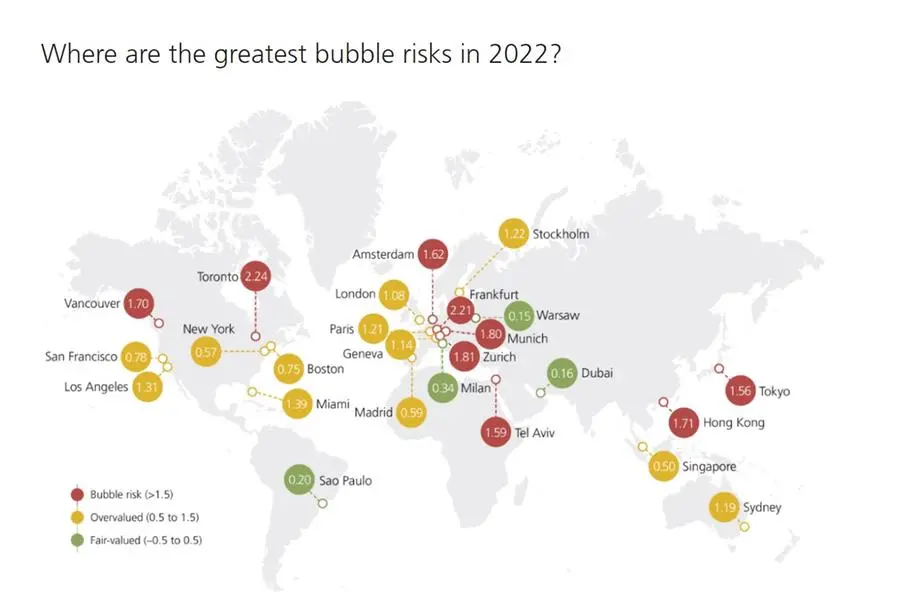
“Risks are also elevated in Zurich, Munich, Hong Kong, Vancouver, Amsterdam, Tel Aviv, and Tokyo,” the report added.
In the US, all five analysed cities are in overvalued territory, more distinctly so in Miami and Los Angeles than in San Francisco, Boston and New York.
Housing markets in Stockholm, Paris, and Sydney also remain overvalued despite some cooling trends, while Geneva, London, Madrid, and Singapore show signs of overvaluation, according to the UBS index.
The index scores fit into three categories - higher than 1.5 being a bubble risk, between 0.5 to 1.5 being over-valued, and -0.5 to 0.5 being fairly valued. Toronto had the highest score at 2.24, Miami was over valued at 1.39, while Dubai scored the second lowest at 0.16 of the 25 cities surveyed, with Warsaw having the lowest score at 0.15.
UBS said overall, index scores have not increased on average compared to last year. Strong income and rental growth have mitigated the further rise of imbalances. Housing prices in non-urban areas have increased faster than in cities for the second consecutive year, and ,price growth has slowed remarkably in inflation-adjusted terms. But, current valuations are highly elevated.
(Reporting by Imogen Lillywhite; editing by Seban Scaria)