Monday, Feb 06, 2012
-- Firms need to establish track record with exits
-- Will determine success of new rounds of fund-raising
-- Many bought assets during boom years
By Asa Fitch and Nicolas Parasie
Of ZAWYA DOW JONES
DUBAI (Zawya Dow Jones)--Many of the Middle East's young private equity firms face a crucial test this year as they look to exit some investments and establish a track record of delivering returns to their investors, against a backdrop of tough economic times and flagging regional stock markets.
Investors poured more than $18 billion into the Middle East private equity industry in the boom years between 2005 and 2008, when asset valuations were stretched. With the industry typically working on a five year cycle, those private equity firms are coming under increasing pressure to sell some of the assets in order to show returns and pave the way for a new round of fundraisings.
Some predict a shake-out in the industry as those with poor assets on their books are unable to exit their investments and attract funds for new ventures, forcing many funds to scale back or wind down their operations.
"An integral part of the 'story' when seeking investors - and what limited partner investors are particularly focused on - will be to demonstrate a successful track record of building value through the more difficult times," said Nick Tomlinson, a partner at the law firm Gibson, Dunn & Crutcher in Dubai. Those funds who can't exit their investments or who have been hurt by the economic crisis won't be able to raise new money, Tomlinson said. "As such there will be fewer active regional fund managers in the region, with a number of others in wind-down mode operating with a significantly reduced staff," he added.
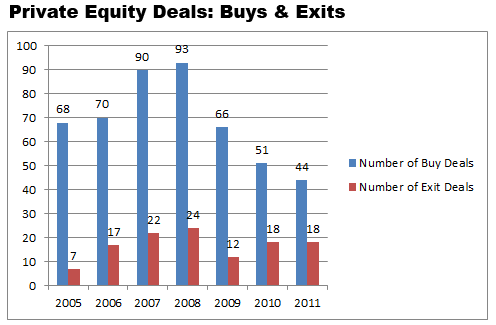
Source: Zawya Private Equity Monitor
A few recent private equity sales may foreshadow a rise in such activity this year - at least for players able to offer up good investments in defensive industries.
NBK Capital, the investment banking arm of National Bank of Kuwait, in January announced the sale of its stake in a Saudi vehicle leasing outfit called Hanco. That came on the heels of a big exit in December, when Dubai's Abraaj Capital, the largest private equity firm in the region, agreed to sell a stake in Turkish health care group Acibadem to Malaysian investors, and the sale last summer of a marine services company by Abu Dhabi's Gulf Capital and Amwal Al Khaleej of Saudi Arabia.
Yet even as exits pick up, some players will likely be left on the sidelines. Many funds are stuck with stakes in financial services, construction and real estate companies that have become difficult to sell. According to data from Zawya.com, more than 300 private equity transactions in recent years involved those sectors, which were in vogue during the boom but are now decidedly out of fashion.
And even buyout firms that invested well may find sales difficult in current market conditions. With trading on regional stock markets thin and prices well off pre-crisis highs, initial public offerings are a no-go. That leaves trade sales to competitors as perhaps the most viable avenue at a time when many potential acquirers are focusing on paying down debt and trimming balance sheets rather than expanding.
"Obviously maturity comes through exits, but what kind of exits?" said Paul Costers, the Middle East manager for Bureau van Dijk, a Dutch research firm. "IPOs are impossible to do, and if you have larger companies for sale you need to find buyers. Honestly I don't know."
The younger private equity firms with poor returns and a spotty first round of investments are especially vulnerable. They rarely go on to raise more money, industry insiders say, forcing them to explore mergers or sales of shares in their funds to larger and more successful competitors.
"These drivers will bring these smaller funds to a common-sense approach and say we will merge or outsource to fund managers," Costers said. "That's the kind of approach that seems to be happening slowly. But people in this part of the world don't like to say they failed."
Karim El Solh, the chief executive of Gulf Capital, also predicted a shake-up in the industry as the reckoning approaches for past investments. Having made smart investments in defensive sectors such as food, education and health care, he said, the better firms would emerge from the crisis in good health as bit-players fell by the wayside.
"The industry will go through a natural, Darwinian evolution where there will be some cleaning up and some of the leaders will get bigger and stronger and others will basically either stay as is, or may have to exit the business," he said. "It's a natural thing. You've seen it in Asia. In the nineties, there were a number of players, but the leaders of the pack today account for probably 80% of the total assets raised."
-By Asa Fitch and Nicolas Parasie, Dow Jones Newswires; +9714 446-1681; nicolas.parasie@dowjones.com
Copyright (c) 2012 Dow Jones & Co.
06-02-12 0536GMT
-- Firms need to establish track record with exits
-- Will determine success of new rounds of fund-raising
-- Many bought assets during boom years
By Asa Fitch and Nicolas Parasie
Of ZAWYA DOW JONES
DUBAI (Zawya Dow Jones)--Many of the Middle East's young private equity firms face a crucial test this year as they look to exit some investments and establish a track record of delivering returns to their investors, against a backdrop of tough economic times and flagging regional stock markets.
Investors poured more than $18 billion into the Middle East private equity industry in the boom years between 2005 and 2008, when asset valuations were stretched. With the industry typically working on a five year cycle, those private equity firms are coming under increasing pressure to sell some of the assets in order to show returns and pave the way for a new round of fundraisings.
Some predict a shake-out in the industry as those with poor assets on their books are unable to exit their investments and attract funds for new ventures, forcing many funds to scale back or wind down their operations.
"An integral part of the 'story' when seeking investors - and what limited partner investors are particularly focused on - will be to demonstrate a successful track record of building value through the more difficult times," said Nick Tomlinson, a partner at the law firm Gibson, Dunn & Crutcher in Dubai. Those funds who can't exit their investments or who have been hurt by the economic crisis won't be able to raise new money, Tomlinson said. "As such there will be fewer active regional fund managers in the region, with a number of others in wind-down mode operating with a significantly reduced staff," he added.
Source: Zawya Private Equity Monitor
A few recent private equity sales may foreshadow a rise in such activity this year - at least for players able to offer up good investments in defensive industries.
NBK Capital, the investment banking arm of National Bank of Kuwait, in January announced the sale of its stake in a Saudi vehicle leasing outfit called Hanco. That came on the heels of a big exit in December, when Dubai's Abraaj Capital, the largest private equity firm in the region, agreed to sell a stake in Turkish health care group Acibadem to Malaysian investors, and the sale last summer of a marine services company by Abu Dhabi's Gulf Capital and Amwal Al Khaleej of Saudi Arabia.
Yet even as exits pick up, some players will likely be left on the sidelines. Many funds are stuck with stakes in financial services, construction and real estate companies that have become difficult to sell. According to data from Zawya.com, more than 300 private equity transactions in recent years involved those sectors, which were in vogue during the boom but are now decidedly out of fashion.
And even buyout firms that invested well may find sales difficult in current market conditions. With trading on regional stock markets thin and prices well off pre-crisis highs, initial public offerings are a no-go. That leaves trade sales to competitors as perhaps the most viable avenue at a time when many potential acquirers are focusing on paying down debt and trimming balance sheets rather than expanding.
"Obviously maturity comes through exits, but what kind of exits?" said Paul Costers, the Middle East manager for Bureau van Dijk, a Dutch research firm. "IPOs are impossible to do, and if you have larger companies for sale you need to find buyers. Honestly I don't know."
The younger private equity firms with poor returns and a spotty first round of investments are especially vulnerable. They rarely go on to raise more money, industry insiders say, forcing them to explore mergers or sales of shares in their funds to larger and more successful competitors.
"These drivers will bring these smaller funds to a common-sense approach and say we will merge or outsource to fund managers," Costers said. "That's the kind of approach that seems to be happening slowly. But people in this part of the world don't like to say they failed."
Karim El Solh, the chief executive of Gulf Capital, also predicted a shake-up in the industry as the reckoning approaches for past investments. Having made smart investments in defensive sectors such as food, education and health care, he said, the better firms would emerge from the crisis in good health as bit-players fell by the wayside.
"The industry will go through a natural, Darwinian evolution where there will be some cleaning up and some of the leaders will get bigger and stronger and others will basically either stay as is, or may have to exit the business," he said. "It's a natural thing. You've seen it in Asia. In the nineties, there were a number of players, but the leaders of the pack today account for probably 80% of the total assets raised."
-By Asa Fitch and Nicolas Parasie, Dow Jones Newswires; +9714 446-1681; nicolas.parasie@dowjones.com
Copyright (c) 2012 Dow Jones & Co.
06-02-12 0536GMT