Young Sheikh Hamdan has taken over as Dubai's new crown prince after a year of chairing the emirate's government. Politics watchers across the UAE are watching the MBR sons' emergence and whether it influences their powerful father's thinking about his own future.
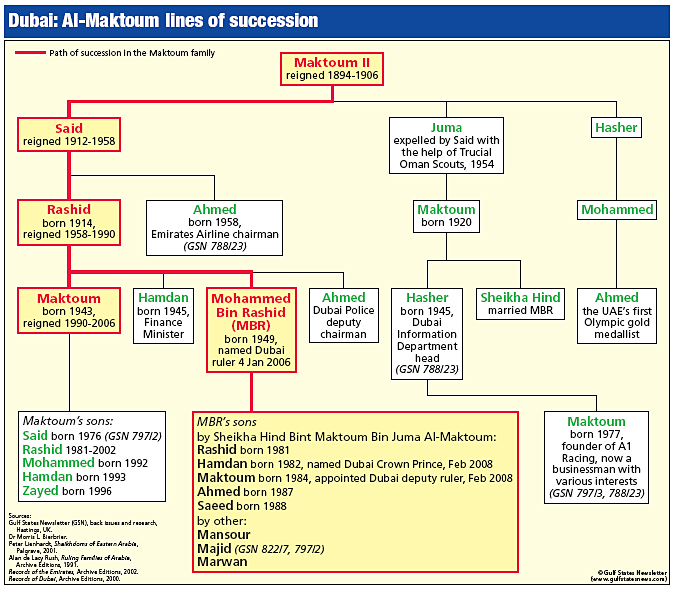
Dubai ruler, UAE Vice President and Prime Minister Sheikh Mohammed Bin Rashid Al-Maktoum (MBR) has appointed his second son by wife Sheikha Hind Bint Maktoum Al-Maktoum, Sheikh Hamdan Bin Mohammed Bin Rashid Al-Maktoum as Dubai crown prince. At the same time, MBR appointed his third son, Sheikh Maktoum Bin Mohammed Bin Rashid Al- Maktoum, as a deputy ruler of Dubai a post already held by the ruler's elder brother Finance Minister Sheikh Hamdan Bin Rashid Al-Maktoum.
MBR confirmed that the elder Sheikh Hamdan would retain his deputy ruler title, to which he was first appointed in 1995 by former ruler, the late Sheikh Maktoum Bin Rashid Al- Maktoum (brother of MBR and the deputy ruler). But the suspicion is that MBR is consolidating his hold on Dubai, at the expense of other family members.
MBR has also clearly bypassed his eldest son by Sheikha Hind, Sheikh Rashid, who is long said to have been uninterested in ruling Dubai. His main passion is horses. Observers have also told GSN that Sheikh Rashid was considered unsuitable for the position of leader and all the other emirates have been well aware of this.
Speculation that Sheikh Hamdan would be made MBR's successor had been boosted when on 8 September 2006 he was appointed chairman of the Dubai Executive Council (DEC). One Gulf-based policy analyst told GSN the appointment was expected, because of Hamdan's positioning at DEC; it was "only a matter of time before it would be announced."
Observers are asking whether Sheikh Hamdan Bin Mohammed is able to bring to his role the same sort of personal drive that has characterised the role played by his father since the 1980s, well before his accession to formal leadership of the emirate. MBR shows no sign of slowing the pace of his own personal activities or ceding much of his direct personal control over key decisions. While the DEC is the official heart of Dubai's day-to-day government, real power and decisions over the emirate's ambitious development strategy are concentrated in the Executive Office, MBR's personal base in the Emirates Towers office complex, where the management team is headed by his trusted retainer Mohammed Al-Gergawi.
Leadership of the DEC, and now a formal role as crown prince, are giving Hamdan Bin Mohammed an understanding of the functions of government and a window into the workings of senior leadership. But it remains to be seen how far he will actually assume the power to take major decisions on an autonomous, personally responsible basis.
There doesn't seem to have been any immediate pressure on MBR to appoint a crown prince. Indeed, MBR has had the luxury of not having to immediately appoint a crown prince.
He has had the time to wait and choose the right son - unlike, say, Qatari Emir Sheikh Hamad Bin Khalifa Al-Thani, who less than a year after he overthrew his father in 1995, had to appoint his most suitable son, Sheikh Jassim (then only 18 years old) as his heir - presumably to keep jealous relatives at bay. Sheikh Jassim later stood down to make way for the current heir apparent Sheikh Tamim.
According to the policy analyst, "had MBR left it any later, rumours might have started to emerge. But,MBR needed to give Sheikh Hamdan time in his role at the DEC to gain enough experience to enter into the role of a crown prince.
During this period,MBR would also have been in discussion with the rulers of the other six emirates to gain their approval for the appointment."
Despite this consultation, the January appointment of Dubai's heir apparent has no formal impact on the federal United Arab Emirates' structure. The younger Sheikh Hamdan is not yet in line for the posts of UAE vice president and prime minister, but much has been made of the new appointments in the UAE. Crown princes and deputy rulers of the other emirates came to congratulate Sheikhs Hamdan Bin Mohammed and Sheikh Maktoum on their new posts, and the pair were seen with Ras Al-Khaimah Crown Prince and Deputy Ruler Sheikh Saud Bin Saqr Al-Qasimi at a camel race meeting at Al-Sawan racetrack. Some 216 prisoners, both Emiratis and expatriates, received the Dubai ruler's pardon following the new crown prince's appointment.
One federal level source said that in his view, "on the appointment of the new Dubai crown prince, I wouldn't have thought that Abu Dhabi, or other emirates, had anything much in the way of input, although they were probably informed prior to the actual announcement. Given the fact that the number one son [Sheikh Rashid] had been more or less ruled out well in advance - which all of the other emirates would have known anyway, and were, I suppose, in agreement - then it would have been MBR's own decision, in consultation, I expect with his brother Hamdan... These things are very much the affair of the family concerned."
These moves are very much in the tradition of Emirati family management. But they raise interesting questions about government leadership, and how far MBR may be prepared to step back from the front line. Dubai is often compared with Singapore, where Lee Kuan Yew's similarly single-minded drive transformed a medium-sized port into a financial and trade hub of global importance. Lee stepped down as prime minister in 1990, but he remains a powerful senior figure.
Neither his bland immediate successor Goh Chok Tong nor his son Lee Hsien Loong, premier since 2004, have matched the personal impact of a man who still wields great influence as official 'minister mentor'. MBR is cut from the same determined mould - which poses the question: how long will Hamdan Bin Mohammed have to wait before he gets the chance to assume real responsibility?
Questions of succession
There is no formal succession policy in Dubai. Traditionally, it has passed from father to son, although MBR took over from his brother, the late Sheikh Maktoum. With MBR's accession, the succession skipped his elder brother, Finance Minister Sheikh Hamdan - seniority was thus not a key influence.
There is no formal law saying that the future leader must have full Emirati parentage, although observers questioned by GSN said that this is required. "There is nothing in the law, but family convention and custom says this is the case," one said. If so, MBR only had five sons to choose from (by his Al- Maktoum wife Sheikha Hind). MBR has other sons but the mothers are thought to be foreign. Of the five, two are still arguably too young to be considered for the crown prince position - Sheikhs Ahmed and Saeed are in their very early 20s, with little experience of government.
By this rule, looking at the late Dubai ruler's Sheikh Maktoum Bin Rashid Al-Maktoum's (MBR's brother who died in 2006) offspring, only one could theoretically be considered suitable 32-year-old Sheikh Said (who had an Al-Maktoum mother).
Sheikh Said had a younger full brother, Sheikh Rashid who was killed in a car crash in 2002. His younger half-brothers are thought to have a Moroccan-born mother and are still in their teens.
Gulf States Newsletter 2008