Most investing stories about Africa appear to mask the dangers of operating in the continent, says a new report by Canada's National Bank Financial.
Events in Mali and Algeria bring to the forefront problems international investors can expect to face in the region.
"Bullish depictions of Africa as an untapped investment frontier have gained momentum in recent years. However, we believe the markets continue to underestimate the significance of several geopolitical challenges likely to weigh on African development over the short and long term," wrote NBF analyst Pierre Fournier in a new report.
"Islamic militancy - specifically Jihadi Salafism - represents one of the most significant of these challenges, most recently witnessed in the fall of Mali's north to Al Qaeda-linked rebels, and the Al Almenas hostage crisis in eastern Algeria."
Iamgold, a Canadian minerals company that operates in Mali, said in January it is as suspending exploration activities at its Sadiola and Yatela mines in the country after France's intervention in the country.
"Increased input costs, such as higher security costs to protect remotely located projects, higher insurance premiums, difficulties securing financing and higher labour costs (both foreign skilled and domestic unskilled) due to the "fear premium" of working in at-risk locations," said Mr. Fournier.
The analyst argues that despite African nations' claim of progress, the region remains vastly underdeveloped. Key social indicators such as the Human Development Index, regularly ranks the region lowest in the world and is considered the least developed.
Foreign aid has hit USD47 billion, compared to USD35 billion in 2005, and governments have not been able to translate resource-derived dollars into growth opportunities for the wider population.
Mr. Fournier notes that compared with other developing economies with strong extractive industries (e.g., those in Latin America or Central Asia), the geopolitical risks facing investors in Africa remain "underestimated."
Key risks include:
(i) political instability;
(ii) lack of 'soft' infrastructure (e.g., low rule of law, widespread corruption);
(iii) prevalence of tribal and ethnic-based conflict;
(iv) rising competition from state-backed Chinese firms; and
(v) underdeveloped hard infrastructure.
"Of all the geopolitical threats, we believe the steady rise of religious/ideological militancy - predominantly Jihadi Salafism - has been vastly underestimated, and will pose significant risks to foreign investors in much of Africa."
This is a harsh, if fair, view of Africa.
Depending on one's frame of reference, Africa can be seen as a developing region full of opportunities, or an underdeveloped region that should be left alone until it is able to resolve its various conflicts.
The NBF report removes the rose-tinted glasses with which some investors may be viewing Africa and is a stark reminder of the challenges ahead.
Management consultant PWC highlights a number of other flashpoints in Africa that go blow up, with dire consequences for the wider region.
"The rebel group M23's November invasion of Goma, a strategic border town in eastern Democratic Republic of Congo, has returned focus on the country, its strained relationship with Rwanda, and the issue of conflict minerals," notes a Q1 2013 PWC report on mining.
"The Kivus province in eastern DRC, which borders Rwanda and Uganda, gas suffered years of recurring conflict owing to a legacy of civil war that formally concluded in 2005 but essentially never ended in the east as different factions continue to fight for control of the area's vast resources of gold, tin, tungsten and coltan."
WEIGHING RISK-REWARD
A careful assessment of the risk is crucial as investors are now pouring funds into Africa's natural resources.
The Metals Economics Group notes that the greatest increase in exploration expenditure took place in Africa and Latin America in 2011, with South Africa, Burkina Faso and Western African states leading the way.
"Gold accounted for more than half of African exploration spend, with diamonds accounting for only 6% in 2011−a far cry from 2004 when diamonds accounted for a third of all African exploration expenditures," said PWC in a separate 2012 report on global mining prospects.
Other analysts such as Ernst & Young argue that many of the risks stem from perceptions of instability in Africa.
"Despite... growth, lingering negative perceptions of the continent remain, but only among those who are not doing business in Africa," said E&Y in a presentation on African opportunities. "Although challenging, the story of Africa's progress needs to be told more confidently and consistently."
The management consultancy highlights the following challenges:
Still, the reward-risk ratio suggests African mining opportunities are comparable to anywhere in the world, as is evident from Business Monitor International data.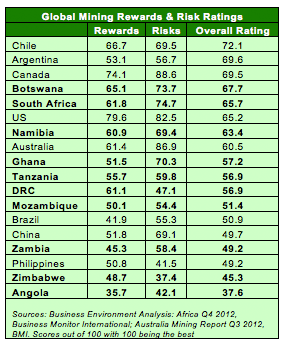
Clearly, Africa has problems, and each investor will have to make a shrewd call on whether the rewards are worth the risk.
© alifarabia.com 2013