PHOTO
Reporting a 76% Y-o-Y increase in sales, Zahraa El Maadi Investment and Development Company reported H1 2021 revenue of LE 120.68 million. As for bottom line, the companys net profit rose to LE 90.08 million during the same period from LE 69.45 million a year earlier. Meanwhile, the companys stock performance has jumped over 650% YTD.
Arab Finance sat down with Mohamed Ghanem, Managing Director and CEO of Zahraa El Maadi Investment and Development Company, to discuss the companys portfolio, its land bank, and some of its future plans to better understand how the company is maximizing its value for its shareholders.
Can we talk about how the company first started and when the company listed on the EGX?
Zahraa El Maadi was founded in 1980 specifically to develop the Zahraa El Maadi area. The company then began operations in 1984. All the land owned by the company is fully registered.
When we acquired the land back then, it was a complete dessert. The company built all the infrastructure itself from scratch, and we did sell some of the land back then back to the founding shareholders to assist us in developing the necessary infrastructure to the turn the land into what would later become the community it has become today.
We started the company with a paid-in capital of LE 25 million, which now stands at LE 264 million.
Zahraa El Maadi listed on the Egyptian Exchange in 1996 with each share priced at LE 100 (now at LE 1/share).
Lets discuss the companys existing portfolio, land bank, and assets please.
In a nutshell, our current land bank is spread across 3 main areas:
Zahraa El Maadi:
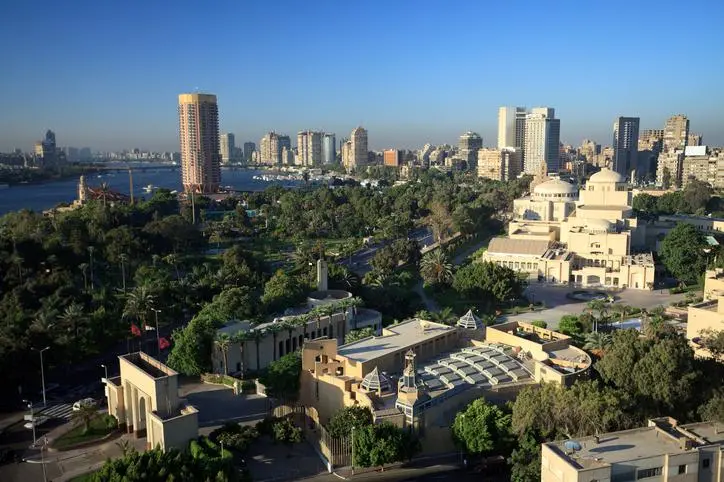
We have a total of 1,134 feddans in Zahraa El Maadi, with around 300 acres that are still undeveloped. That area is strategically nestled by the Ring Road to the north and the Autostrad to the west. The biggest catalyst to increasing our land value, aside from our construction activity and community development plans, is that there will be a major road network that will further connect to the Mokattam area. This new road network will not eat up any of our land bank, but will provide us with all the advantages of increased traffic and footfall, which will further serve our commercial and administrative tenants. Zahraa El Maadi features key services from Maadi City Centre as well as the Wadi Degla Sporting Club.
New Heliopolis:
We have 34 feddans in New Heliopolis that will comprise residential units as well as various community services. This project is pending masterplan approval and we will proceed with construction activity once we have secured all necessary approvals.
Shiekh Zayed:
We have 76 feddans in Patio Al Zahraa. This project is around 90% complete, with residents already living there as we speak.
Does the company plan to liquidate any part of its land portfolio in Zahraa El Maadi or enter into partnerships with real estate developers similar to the Patio El Zahraa project in Sheikh Zayed?
We are always studying partnership agreements to maximize our land value and maximize our shareholders returns.
What is the companys strategy to expand its land bank portfolio?
At the moment, we are studying new land in Upper Egypt or along the North Coast governorates. Our goal is not necessarily to just leverage on our brand equity by heading toward every geographic location, which is something other developers may be doing.
Instead, we try to ask ourselves 2 main questions:
1) Where is there potential demand, and
2) Where is there the necessary infrastructure to develop a real community?
There are land plots in fourth generation cities, such as New Assist and New Minya, where the government has provided some thousands of acres of land, complete with infrastructure ready for real estate development, supported by strong consumer demand. There are government plans there for schools, universities, infrastructure like water and electricity. This is the right foundation, the right ingredients, if you will, for us to consider potential land acquisition.
Again our ultimate goal is to increase the companys value for our shareholders, which means being smart about how and where to build and develop.
With the success of your revenue-sharing agreement in Zayed, do you plan to further partner with other developers in the future?
Yes, if we can leverage on our partners strong brand equity to deliver increased sales for resident units. As we have seen in several examples, revenue-sharing partners always benefit from the stronger pricing power of the partner with the stronger brand equity, so its a win-win situation for all parties involved.
Real estate consumers in Upper Egypt typically also puts a lot of trust in big, well established government names. This could create an opportunity for us to leverage our strong, government-backed brand equity to cater to potential demand.
How do you conduct most of your sales activity? What are your payments terms? How much do you charge per sqm on average?
We rely mostly on direct sales, with potential customers actually coming to us more frequently than not. We do not work with brokers.
As for payment terms, we collect 40% as a down payment, which we can also collect over two payments, with the remaining 60% collected over 10 years. The units are already built, so we offer immediate delivery of shell and core units.
We charge around LE 10,00011,900 per sqm and we target mainly the B+ segment.
A lot of major developers are looking into recurring revenue streams (commercial/retail leasing) as well as offering services (athletic clubs, schools, etc) to guarantee cash flow even after sale of residential units. Is Zahraa also pursuing this path?
We are currently looking into and studying various reoccurring revenue streams projects via the rental and leasing of commercial and administrative assets.
There are other real-estate developers in Egypt that build 140-160 sqm units and instead of selling them, they rent them. That guarantees income, while still owning the asset, so that is also something to think about. We are always studying various opportunities.
We are also studying participating in the CBEs mortgage financing initiative, which would entail the construction of residential units within certain specifications to meet the CBEs conditions.
Again, our goal is to always maximize the value of the company and its cash flows for our shareholders.
How did the company perform during H1 2021, and how do you expect the company to perform during H2 2021?
The company's sales rose 76% Y-o-Y to LE 120.68 million during H1 2021 from LE 68.74 million during the same period last year. As for bottom line, that rose 30% Y-o-Y to LE 90.08 million from LE 69.45 million a year earlier.
We expect the company to maintain the same level of growth during the first half to the year as previously communicated.
The company's share performance on the EGX rose by about 681% YTD. Do you think that this price actually reflects the real value of the firm, whether in terms of financial performance or assets?
The market price is heading in direction to reflect the fair value of the stock, in my opinion. When the new road network in Zahraa El Maadi is complete, this should also increase the companys value, which could in turn also reflect on stock market performance, but thats really not something we can comment on.
What we can say is that we believe the new road network around Zahraa El Maadi combined with our construction activity and plans to expand our land bank could have likely acted as a catalyst for stock market performance.
What is the companys dividend distribution policy? Are you planning to withhold distributions to finance expansion plans?
Our policy is distribute cash dividends on an annual basis. For FY 2020, we are distributing a total of LE0.45/share.
We could potentially propose changes to our distribution policy based on investment decisions on our expansion plans and financing needs, but that would ultimately require shareholder approval.
Copyright 2021 Arab Finance Brokerage Company All rights reserved. Provided by SyndiGate Media Inc. (Syndigate.info).