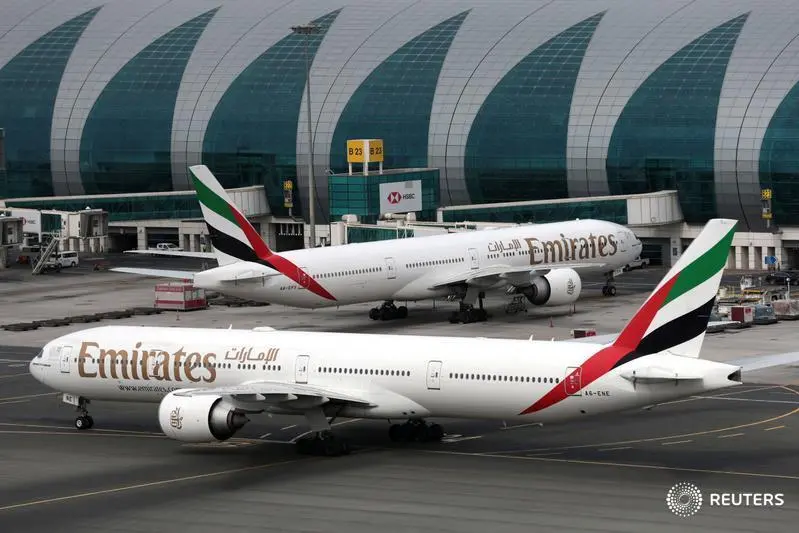
PHOTO
A codeshare agreement signed by Emirates airlines and SpiceJet, India's second-largest airline, is set to open new routes, offer more destinations and better fare options for passengers hit by travel disruptions in the wake of the grounding of Jet Airways.
The codeshare will primarily cover Emirates' 170 weekly flights between India and Dubai and SpiceJet's 68 weekly non-stop flights between various stops from India to Dubai.
The arrangement will benefit passengers of both airlines by enabling them to enjoy seamless connectivity. Passengers travelling from India will have more choice with minimum connection times, when flying to destinations in Emirates' Europe network such as London, Paris, Frankfurt, Manchester and Amsterdam.
Optimised scheduling will allow for minimal transit times between India and these global destinations and travellers on these codeshare routes will be able to book connecting flights using a single reservation, both airlines said in a statement.
SpiceJet passengers travelling from Delhi, Mumbai, Ahmedabad, Kochi, Amritsar, Jaipur, Pune, Mangalore, Madurai, Kozhikode and 41 other domestic destinations that the airline operates to, will be able to access Emirates' expansive network across the globe. They will also be able to leverage Emirates vast network across Africa, America and the Middle East, while Emirates passengers will be able to ensure easier connectivity to more than 50 destinations on Indian carrier's domestic network after regulatory approvals are in place.
Emirates will also benefit from six new non-stop destinations from Dubai operated by SpiceJet: Amritsar, Jaipur, Pune, Mangalore, Madurai and Calicut which aren't served by Emirates. Calicut is served by Emirates' another partner airline, FlyDubai. Apart from the non-stop flights, Emirates will put its EK code on SpiceJet's domestic flights covering 51 destinations in India.
Analysts said the codesharing agreement is a strategic move as it would help Emirates overcome seat quota curbs following Indian aviation ministry's 2017 decision against negotiating with Dubai on increasing bilateral flying rights. As per the current India-Dubai bilateral air traffic quota agreement, airlines from each side are allowed to operate 65,000 seats per week, a quota that has been exhausted. While Dubai had sought an increase of 50,000 seats, Indian authorities had sought preferential treatment in slot allocation for Indian carriers at Dubai airport.
Saj Ahmad, an analyst at London's StrategicAero Research, said Emirates' expansion has been stifled in India given the challenging and ageing aviation policy in play there. "Expansion is limited, so this pact with SpiceJet will allow Emirates to tap into those parts of the country it doesn't serve itself," he said.
Similarly, SpiceJet customers can connect on Emirates intercontinental network and avoid poorly run Air India - and with the demise of Jet Airways, this connection will prove a boon to passengers flying to Europe and the Americas.
"It's a deft move by both airlines and customers will be the big winners too," Ahmad said.
SpiceJet has emphasised that there will be minimum connection times when flying to destinations such as London, Paris, Frankfurt, Manchester and Amsterdam from Dubai. All the above destinations, except, Frankfurt were served non-stop from India by Jet Airways.
The codeshare will also expand to flights operated by Emirates to New York, Washington, Toronto, Sao Paulo, Jeddah, Kuwait and Amman apart from other destinations.
The two airlines said the pact would bolster Emirates' already-extensive network adding a total of 67 weekly connections between Dubai to those six fast growing destinations in India. This includes increased domestic connectivity from Emirates' nine Indian gateways to points such as Goa, Hubli, Guwahati, Vishakhapatnam and Tuticorin which would allow for a greater variety of travel options between both Emirates and SpiceJet flights.
"This partnership with SpiceJet and the mutual expansion of our network will go a long way in further enhancing the travel experience of our customers in India as well as those heading into India, benefiting travellers and businesses alike," said Adnan Kazim, Emirates' divisional senior vice-president, Strategic Planning, Revenue Optimisation and Aeropolitical affairs.
SpiceJet said the move was part of its international expansion strategy. "This new partnership should immensely benefit passengers travelling on both airlines," said Ajay Singh, chairman and managing director, SpiceJet.
This is SpiceJet's second partnership. In 2016, it signed an interline pact with German scheduled operator and service distributor Hahn Air. This will be SpiceJet's first codeshare agreement. In terms of access, this is bigger than the IndiGo-Turkish Airlines codeshare.
SpiceJet, India's second-largest airline in terms of domestic market share, was founded in 2005, and now serves 51 cities in India and nine international destinations.
Emirates launched flights from its Dubai hub to Delhi and Mumbai in 1985 and since then, the airline has grown its India operations to serve a total of nine destinations. These include Ahmedabad, Bengaluru, Chennai, Delhi, Hyderabad, Kochi, Kolkata, Mumbai and Thiruvananthapuram - with over 170 weekly flights.
The Emirates Group currently employs 13,707 Indian nationals globally - constituting 21 per cent of its workforce, most of them in high-skilled employment. Globally the airline flies to 159 destinations in 86 countries and territories."
SpiceJet operates 516 average daily flights to 60 destinations, including 51 domestic and nine international ones. The airline has a fleet of 48 Boeing 737, 27 Bombardier Q-400s and one B737 freighter.
Copyright © 2019 Khaleej Times. All Rights Reserved. Provided by SyndiGate Media Inc. (Syndigate.info).