PHOTO
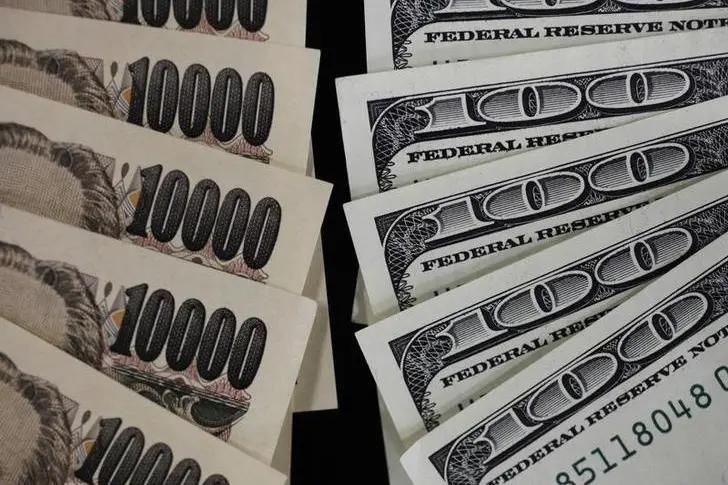
SINGAPORE: The yen held firm on Tuesday after two straight sessions of sharp gains as traders remained on alert to the prospect of a coordinated currency intervention by authorities in the U.S. and Japan.
The rising yen took a toll on the dollar, which languished near a four-month low as it was further pressured by problems of its own, including a looming U.S. government shutdown and President Donald Trump's erratic policymaking.
Much of the focus in currency markets recently has been on the yen, which has rallied as much as 3% over the past two sessions on talk of rate checks from the U.S. and Japan, a move often seen as a precursor to intervention.
That has helped the yen steady around the 153-154 per dollar level, with the Japanese currency last at 154.24 per dollar , some distance away from Friday's low of 159.23.
"It was very effective, and rightly so... the Fed move was unexpected," said Alicia Garcia Herrero, chief economist for Asia-Pacific at Natixis.
A source told Reuters that the New York Federal Reserve had checked dollar/yen rates with dealers on Friday, while top Japanese authorities said on Monday they have been in close coordination with the U.S. on foreign exchange.
The possibility that an official intervention could be on the horizon has in turn left investors hesitant to push the yen lower once again, even as concerns remain over Japan's fiscal health. Analysts also say coordinated intervention has a high bar to clear, and may not come as soon as markets expect.
"This is not the end of it. Yes, I think the market is slightly more wary, but if nothing happens after a while, I think there will be renewed attempts to test the resolve of the Japanese authorities," said Moh Siong Sim, FX strategist at OCBC.
"Perhaps at that point in time, then you might see actual intervention come in, to send an even stronger message."
Bank of Japan money market data indicated that a spike in the yen rate against the dollar on Friday was not likely due to official Japanese intervention.
DOLLAR UNDER WATER
In the broader market, spillover dollar selling in turn left most of its peers perched near four-month highs on Tuesday.
The euro was steady at $1.1878, having hit a peak of $1.19075 on Monday. Sterling similarly scaled a top of $1.37125 in the previous session and last bought $1.3678.
The Australian and New Zealand dollars also held to gains from the previous session and traded at $0.6914 and $0.5970, respectively.
The dollar has come under fire again in the first few turbulent weeks of 2026 as a growing range of factors prompts a rethink of investors' optimistic assumptions for a period of stability for the greenback.
Against a basket of currencies, the dollar has fallen more than 1% for the year thus far. It was last at 97.05, having hit a four-month low of 96.808 on Monday.
The Federal Reserve also kicks off its two-day policy meeting later on Tuesday - one set to be overshadowed by the Trump administration's criminal investigation of Chair Jerome Powell, an evolving effort to fire Fed Governor Lisa Cook, and the coming nomination of Powell's successor.
"I think markets will probably be focused on questions about the Fed's independence rather than the rate outlook," said Carol Kong, a currency strategist at Commonwealth Bank of Australia.
"If Powell does choose to resign as a governor after his Chair term expires in May, that could actually add to the perception that he is capitulating to political pressure, and that could add to concerns around Fed independence being compromised... (and) it is a downside risk to the dollar."
(Reporting by Rae Wee Editing by Shri Navaratnam)