PHOTO
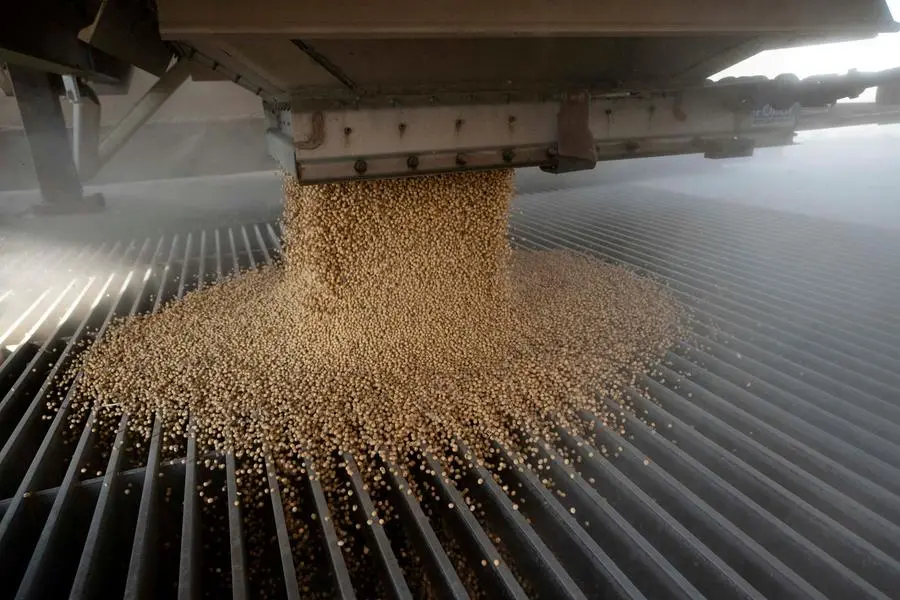
BEIJING: Chicago soybean futures rose on Tuesday as U.S. President Donald Trump's announcement of a delay to possible strikes against Iranian power plants roiled financial markets.
The most-active soybean contract on the Chicago Board of Trade (CBOT) was up 0.2% at $11.65-3/4 a bushel, as of 0340 GMT. CBOT wheat gained 1% to $5.93-3/4 a bushel, and corn climbed 0.7% to $4.62-3/4 a bushel.
Grains and oilseed prices have broadly tracked fluctuations in crude oil during the U.S.-Israeli war on Iran, reflecting the widespread use of corn and soyoil in biofuels and investor interest in the crops as an inflation hedge.
Oil prices rose in early trade on Tuesday on supply fears, as Iran denied it had held talks with the United States to end the war in the Gulf, contradicting President Donald Trump, who said a deal could be reached soon.
Brent futures rose $1.06, or 1.1%, to $101 a barrel at 0001 GMT, while U.S. West Texas Intermediate (WTI) climbed $1.58, or 1.8%, to $89.71. In South America, Brazil's soybean exports in March fell to a daily average of about 633,400 metric tons through the third week, down 17.9% from last year's full-March average, according to data from the Brazilian government on Monday. Brazil, the world's largest soybean producer, sent a government delegation to Beijing on Monday to discuss phytosanitary inspection rules for Brazilian soybeans following complaints from exporters that Chinese demands were complicating the certification process.
Brazil said discussions were only starting and no decisions had been reached. In Russia, a major grain producer, wheat export prices remained at the levels reached during the three-week rally triggered by the Iranian crisis, and analysts have raised their forecasts for March shipments amid an acceleration in exports.
The price of Russian wheat with 12.5% protein content for free-on-board (FOB) delivery in late April and early May was $238 a metric ton at the end of last week, unchanged from the previous week, Dmitry Rylko, head of the IKAR consultancy, said. (Reporting by Daphne Zhang and Lewis Jackson; Editing by Rashmi Aich)