Thursday, March 29, 2012
For the first time, China is not only the top exporter of information and communications technology (ICT) goods such as computers and cell phones but - since 2010 - the largest importer
New data from the United Nations Conference on Trade and Development (UNCTAD) showed that China or Hong Kong (China) are the top destinations for seven of the world's 10 largest ICT goods exporters.
That finding echoes other trends revealed by the Organization's just-released statistics for the period 2000 to 2010. These numbers indicate that developing nations are playing a larger role in ICT goods trade and that the sector displayed resilience during the global economic crisis.
The UNCTAD data break down the numbers into bilateral flows and by five categories of ICT goods.
The new statistics show that such goods, which include computers, smartphones, tablets, microchips, televisions and other audio equipment, weathered the financial and economic crisis that erupted in 2008 more successfully than most economic sectors. For example, the decline in ICT goods imports in 2009 was smaller (14 per cent) than that of total merchandise trade (24 per cent), and the recovery in 2010 was more robust (24 per cent compared with 21 per cent).
Share of developing countries surged
The crisis accentuated the trend towards a greater role for developing countries in the global production and consumption of ICT goods. In 2010, for the first time, developing countries saw larger imports of such products than developed countries. With $284 billion of ICT goods imports, China also overtook the United States of America as the largest importer. The expanding role of China and Hong Kong (China) partly reflects close intraregional trade links in this sector.
The importance of developing Asia as an exporter of ICT goods was further reinforced. It increased from 58 per cent of global ICT exports in 2008 to 63 per cent in 2010. China's exports of such goods were 10 times the level reported at the start of the decade. The country in 2010 exported close to $460 billion, ahead of Hong Kong (China) ($177 billion) and the United States ($135 billion). Between 2000 and 2010, The United States, Japan, the United Kingdom of Great Britain and Northern Ireland, Canada, Ireland, and several other developed countries have experienced steep falls in the absolute values of their ICT exports. By contrast, some of the fast risers are found among new European Union members such as Bulgaria, the Czech Republic, Latvia, Poland, and Slovakia. In other parts of the world, India, Mexico, Tunisia and Turkey have all gained market share.
UNCTAD also has released online data on the core indicators of international trade in ICT goods, as defined by the Partnership on Measuring ICT for Development.
These show the relative weight of ICT goods in each country's imports and exports. At the world level, ICT goods in 2010 accounted for 11.9 per cent of total merchandise exports.
Dominant exports
UNCTAD data further show that electronic components account for one third of all ICT goods exports. This is an illustration of the high degree of fragmentation characterizing the ICT goods production system as well as of the increasing use of such components in non-ICT products (for example, in transport equipment and domestic appliances). The second largest category is computer-related equipment, but its share has declined from 37 per cent to 29 per cent over the past decade. By contrast, communication and consumer electronic equipment has grown in importance.
The relative role of the categories of ICT goods varies considerably by importing country, reflecting differences in levels of development and the extent to which countries are part of the ICT production system. Computers and related equipment are the most important category in developed countries. By contrast, in developing Asia - the main ICT production hub - almost 60 per cent of trade is in electronic components. In Africa and in the least developed countries (LDCs), mobile phones and other communication equipment account for the largest share of imports.
A more detailed look at the most traded ICT goods reveals that different kinds of electronic integrated circuits occupied the top two places among the most traded items in 2010. Parts and accessories of computing machines, which excludes peripheral units, ranked third ($131 billion) down from the top rank in 2000 ($152 billion). Cell phones represented total world exports of approximately $131 billion in 2010, a doubling over the decade from $63 billion in 2000. The rate of increase was even more spectacular for laptops and other portable processing devices. These increased fivefold, from $25 billion to $125 billion. Also noteworthy is the sharp increase in exports of photosensitive semiconductor devices, which include photovoltaic cells. These devices made it into the top 10 of traded ICT items in 2010, multiplying their exports by a factor of 10 in a decade, from $7.2 billion in 2000 to $72 billion in 2010.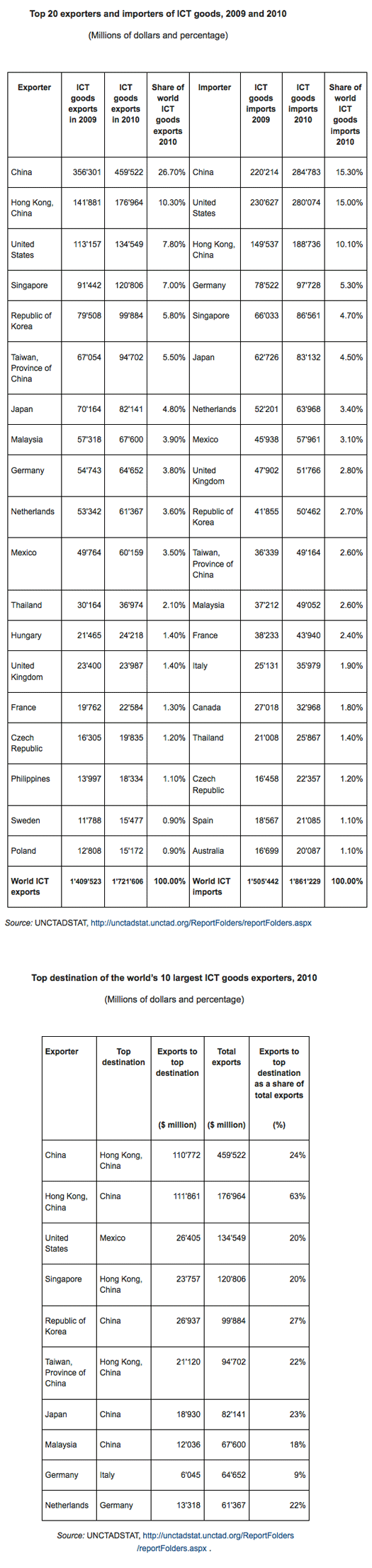
Emirates 24|7 2012