African governments are preparing for a new round of Eurobonds in the hopes of taking advantage of benign interest rate environments.
The Kenyan government is gearing up for its first Eurobond issue of between USD 1.5 billion to USD 2 billion, and has already launched an investor roadshow. Analysts believe Ivory Coast could be next in line to launch a Eurobond.
"African frontier markets weighing Eurobond issuances pose a fundamental dilemma for potential investors: strong growth prospects tempered by persistent deficits in most countries," said Eurasia analyst Philippe de Pontet.
"Given this dynamic, the key differentiators will include the likely uses of the proceeds (that is, investing in infrastructure versus patching budget holes), the credibility of the macroeconomic policy framework, and a country's political trajectory."
The European Central Bank's decision to cut interest rates could just be the tipping point for African nations to secure funding at favorable rates.
Konrad Reuss, the managing director for South and Sub-Saharan Africa from Standard & Poor's ratings agency, said in May that it was relatively easier for African countries to raise money on the international market in comparison to 20 years ago against the backdrop of strong investor appetite, emerging challenges in the global market pose significant risks to this positive development.
Apart from Kenya, Tanzania is also weighing issuing a Eurobond for the first time, but will likely delay plans until next year.
"In Tanzania, policy paralysis and a polarizing constitutional debate appear set to continue," Pontet said. "The country's long-delayed credit rating assessment - a precursor to any Eurobond - will likely remain stuck along with natural gas legislation and other government agenda items as the Jakaya Kikwete administration grapples with its increasingly lame duck status ahead of fall 2015 elections."
With higher growth during the past decade and a remarkable resilience to global shocks, Africa has also become more attractive for foreign investors, notes the African Development Bank. "This has enabled more and more African countries to tap international markets by issuing bonds denominated in foreign currencies."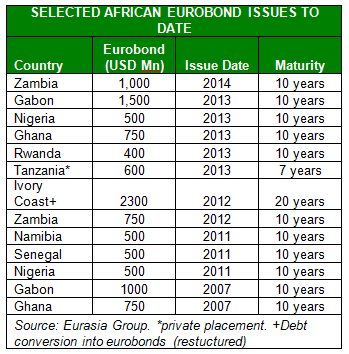
COASTAL PROMISE
In West Africa, Ivory Coast is poised to issue again this year, as the government appears to have a credible plan to develop its infrastructure.
Ghana, which had been an early candidate for a eurobond, has seen economic conditions deteriorate in recent months that may force the government to seek other alternatives.
"The John Mahama administration will need to double down on its fiscal reforms and monetary tightening cycle. This should put the country on a more sustainable path over the medium term, even as the short-term outlook remains turbulent," Eurasia noted.
Senegal is also likely to forego a eurobond for now, although this will be driven more by prudent borrowing cost concerns than by poor policy choices. "If prices appear to stabilize, the previously planned USD 500 million issuance would likely be considered again. In the interim, the Macky Sall administration will probably prioritize other funding options from bilateral and multilateral partners."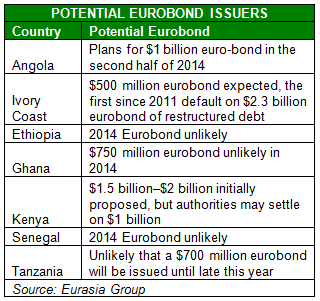
Rajiv Shah, the director of CEEMEA Debt Capital Markets at BNP Paribas, told a business audience in Kigali in Rwanda that investors are increasingly targeting Africa for the long term investment.
"The stage is now set where investors are looking for new areas to invest. They are looking at high growth countries in particular with what is going on in Russia at the moment," he said. "We are seeing investors looking away from Russia and looking at other regions such as Africa and this is technically supporting the demand for Africa."
WHAT ABOUT DOMESTIC BONDS?
Foreign investors are weighing a number of options as they eye African and other emerging market bonds. The U.S. Federal Reserve's decision to slowly roll back monetary stimulus has already seen investment outflows from emerging economies, and that remains a concern, if the U.S. continues to tighten policy.
The African Development Bank has proposed domestic infrastructure bonds to move away from external forces and deepen regional markets.
"Infrastructure bonds can be a more efficient form of financing as they reflect the long-term nature of infrastructure financing, which is often not available from the banking system," said AfDB in a report on infrastructure financing.
A number of African nations already have the financial infrastructure that could help lead to a proliferation of domestic bonds. South Africa has a strong banking system and institutional investor base, both of which are active in infrastructure finance. Major state-owned players such as utility firm Eskom and transportation infrastructure company SANRAL have already delved in infrastructure financing.
"Namibia and Botswana share many features with South Africa and are additionally a source of liquidity in the South African market," AfDB said. "In Namibia, the power utility is a notable issuer in the bond markets. However, market activity is limited and there is limited track-record with project finance."
Kenya and Nigerian markets also have strong institutional investor base that can be nurtured. Nigerian corporate bonds are tax exempt while Kenya has specific exemptions for infrastructure bonds, according to AfDB.
The telecom sector has issued bonds in both markets. In Kenya, state-owned enterprises such as Kengen have issued infrastructure bonds, while, Nigeria has a thriving municipal bond market. Both countries are keen to promote project financing for infrastructure projects.
The major challenges are to ensure that public borrowing, high inflation and high interest rates do not crowd out issuance by corporates and other non-government entities.
"Meanwhile, Uganda, Tanzania, Ghana and Zambia are at an earlier stage of capital market development, with less liquid government bond markets and extremely limited corporate bond issuance," AfDB said.
The feature was produced by alifarabia.com exclusively for zawya.com.
© Zawya 2014