The Central Asian states of Kyrgyzstan, Azerbaijan and Kazakhstan have the highest illiteracy levels in the region.
Around 83% of 15-year olds in Kyrgyzstan are "functionally illiterate", while 73% of young Azerbaijanis and 59% of Kazakhstanis are unable to read and write, according to the World Bank. In total, four million people in Central Asia and nearby regions fail to complete their primary schooling.
The problem highlights Central Asian countries' inability to instill a strong education culture and create employment opportunities for the disaffected youth.
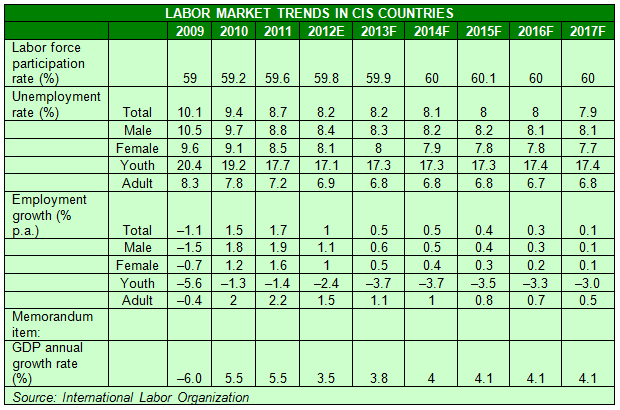
The International Labor Organization notes that unemployment in the region is expected to decline from a peak of 10.1% in 2009 to 8.2% in 2012, and fall further to 7.9% in 2017 - still a relatively high number.
But the young may not particularly benefit from the falling employment rates.
"Young people and women in CIS countries and Georgia continue to face high barriers to employment," said ILO in a recent report. "By 2017, the youth unemployment rate in Central and South-Eastern Europe (non-EU) and CIS is projected to reach 17.3% for young men and 17.7% for young women."
In places like Armenia, youth unemployment stands as high as 39.1% with female unemployment higher still at 48.2%.
As a result, informal sector - which is neither taxed nor monitored by the government -- accounts for 49% of total employment in places like Armenia.
Indeed, informal unemployment has increased particularly sharply in Caucasian and Central Asian countries such as Azerbaijan (+14%), Turkmenistan (+11%) or Georgia (+7 %), especially after the 2009 global crisis.
"This generalized increase in informality in the region is in stark contrast with other emerging regions in the world where broadly informal employment has declined as countries managed to implement anti-poverty measures and successfully applied formalization strategies," said the ILO in a report.
Jobs spiral down
While resource-rich countries such as Kazakhstan have seen employment rise steadily, the labor market has lost momentum.
"In particular the sharp increase in unemployment inflows - mainly triggered by faster job destruction - has not yet fully returned to pre-crisis levels," said the ILO. "Also, there seems to be a secular decline in the unemployment outflow rate, linked to a loss in job creation dynamics, that has set in since the beginning of the 2000s."
Long-term unemployment is also rising with 32% of job seekers unemployed for more than six months.
"By 2017, the youth unemployment rate in Central and South-Eastern Europe and CIS is projected to reach 17.3% for young men and 17.7% for young women," the organization noted.
A less-than-productive workforce
Labor productivity in the CIS states remains way below Eastern European levels.
Poor productivity levels have impacted the economies of Kyrgyzstan, Tajikistan, Uzbekistan, which are unable to provide viable job opportunities for their large young populations.
"Rather than being unemployed or working in the informal economy in their home countries, these young people often prefer to move abroad," the World Bank said.
"Up to 500,000 (according to some estimations even up to 1 million) Kyrgyz citizens are estimated to work abroad often without finding much better employment opportunities, and have to accept vulnerable employment."
Investing in education may be the ticket to reducing unemployment and growing the economy. The United Nations Educational Scientific and Cultural Organization (UNESCO) estimates that a dollar spent in the education sector will yield USD 10-USD 15 in economic growth.
But regional governments seem far more focused on investing in energy projects, and hard infrastructure projects such as roads and rail, rather than education and healthcare.
In Kyrgyzstan, employment opportunities are hampered by lack of reliable power supplies. The country's new government has launched a USD 13 billion to fix the energy shortage and create employment in the process.
Armenia, meanwhile, has not been able to capitalize on its favorable business climate.
"Pursuing structural reform will enhance Armenia's attractiveness to foreign investors and eventually improve the job market and living standards," the Asian Development Bank said in a report.
Georgia's impressive growth has fallen short in achieving poverty alleviation, job creation, and balanced regional development. A key development challenge is to make growth more inclusive, which would generate productive employment opportunities of particular benefit to subsistence farmers and others in Georgia's poorer rural regions, said the ADB.
As growth in the Central Asian economies falters, authorities are pre-occupied in keeping their fiscal house in order rather than create jobs for the unemployed youth.
It may be dangerous to let the problem fester. Central Asia has similar dynamics to some of the countries impacted by the Arab Spring: large youth populations, authoritarian rulers, high unemployment and lack of social freedoms. It didn't turn out too well for many of those Arab rulers.
© alifarabia.com 2013