Turkmenistan has emerged as China's largest supplier of natural gas, which makes the reclusive nation one of the Asian giant's strategic energy allies.
Thanks to surging natural gas exports, Turkmenistan's economy has risen 9.4% in the first half of 2013, compared to the 11.1% posted during each of the past two years.
The International Monetary Fund (IMF) expects GDP to grow 12.2% this year and 10.4% in 2014.
Turkmenistan's meteoric rise as China's foremost natural gas supplier, underlines the government's efforts to monetize the world's fourth largest natural gas reserves.
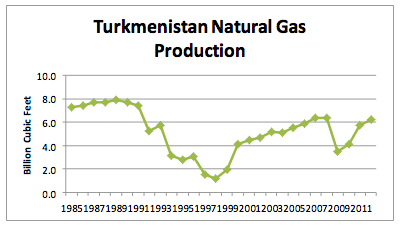
The country expects to produce as much as 80 billion cubic meters (bcm) of natural gas this year, compared to 70 bcm in 2012. By 2030, the country hopes to expand production more than three-fold to 250 bcm.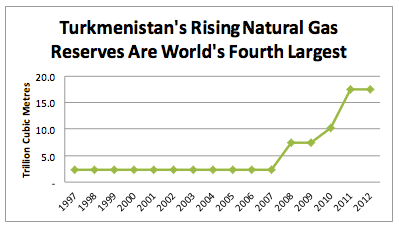
The country once sent majority of its natural gas to Russia, but those exports have dwindled as Moscow's domestic production has risen.
Turkmenistan is also looking to expand its customer base westwards and in May signed an agreement with neighboring Turkey to help transport Turkmen gas to European markets.
The outlet will also allow Turkmenistan to move away from troubled Iran, which is under heavy sanctions by Western nations.
AZERI PIPELINES
Turkmenistan could also find new outlets for its natural gas if Azerbaijan co-operates.
Turkey and Azerbaijan are working together to build the Trans Anatolian Natural Gas Pipeline Project (TANAP) to supply natural gas from Azerbaijan to Turkey and Europe.
The project is planned to run from the Georgia-Turkey border across Turkey en route to Europe. On August 6, TANAP pipeline called for bids to build the 1,800-kilometer pipeline.
The project may be financed by export credit agencies or other long-term financial institutes, such as European Investment Bank, European Bank for Reconstruction and Development, International Finance Corporation and Turkish/International commercial banks etc.
"TAP forms the westernmost segment of the planned Southern Corridor to Europe for Caspian gas," said Vladimir Socor, analyst at Jamestown Foundation, who tracks Central Asian economies.
"The plan involves moving the gas from the Caspian offshore via Azerbaijan, Georgia and Turkey to the European Union's border and onward into EU territory. The Turkish segment, longest by far, is the Azerbaijani-led Trans-Anatolia Pipeline (TANAP) project designed to feed into TAP and potentially other continuation pipelines into Europe."
Azerbaijan, which has a 51% stake in the project, has not made any commitment that it would allow Turkmenistan gas into the pipeline system.
A 300-kilometer pipeline would need to be constructed on the sea bed of the Caspian Sea to get Turkmen gas to Azerbaijan, called the Trans-Caspian Gas Pipeline. Its biggest advantage is that it allows Turkmenistan to get its supply out to Azerbaijan and onwards, without crossing Russian or Iranian borders.
The project had gained momentum in the 1990s, but the discovery of Azerbaijan's massive Shah Deniz, apart from disputes over gas fields, left Turkmenistan's gas stranded.
CONNECTING TAP TO TANAP
Of course, Azerbaijan and its international partners recently picked the Trans-Adriatic Pipeline (TAP) consortium to transport natural gas from its Shah Deniz field to European markets, after a four-year competition with the Nabucco West Pipeline consortium.
Nabucco West's failed bid to transport natural gas from Central Asia to Europe was a blow to Turkmenistan, which was hoping to secure space on the pipeline.
"A trans-Caspian pipeline from Turkmenistan is integral to the European Union-planned Southern Gas Corridor," Socor said. "From Ashgabat's perspective, a section of the planned gas highway to Central Europe has now fallen off. Nabucco's capacity (even as Nabucco-West) could have accommodated significant volumes of Turkmenistan's gas. The TAP project does not have sufficient capacity for that, and its shareholders prefer dedicating TAP's capacity to their own gas."
TANAP and TAP offers Azerbaijan tremendous strategic advances and it is unclear whether the Azeris would want to share the European market with Turkmenistan.
"Strategically located in the South Caucasus and with access to several proven gas fields, Azerbaijan has been the focal point of EU and Turkish energy security discourse," said Centre for Global Energy Studies analyst Keith Weber in a comment piece.
"In the last several years, Turkmenistan has also entered the picture in order to link Eastern and Western Caspian oil deposits en route to Europe. However, the prospects for this potentially lucrative and mutually beneficial partnership remain tenuous at best."
CASPIAN SEA GAS FIELDS
The two countries are also in dispute over control of some gas fields in the Caspian Sea that has often led to military escalation.
Turkmenistan has other outlets too.
In July, Turkmengas signed a gas sales purchase agreement with Afghanistan as part of an Afghanistan, Pakistan and India pipeline (TAPI) to supply 33 bcm of natural gas by 2018.
"The construction of the gas pipeline TAPI will ensure long-term supplies of Turkmen gas in the countries of Southeast Asia in the near future," Turkmen president Gurbanguly Berdymukhamedov said. "The Turkmen energy strategy is aimed at the creation of a multi-variant system of supplies of the energy resources on the largest world markets."
Turkmenistan is keen to replicate the success of the Turkmen-China gas pipeline that has transformed the country's fortunes.
Ashgabat is also conscious that while China has been a key customer recently, that might change as the Asian giant is signing up multiple contracts with scores of countries including Russia, Myanmar, Australia and Canada, which will eat into Turkmenistan's market share over time.
© alifarabia.com 2013