The Middle East North Africa regional insurance and takaful market is expected to rise just under 5% this year, despite tough economic conditions across the region.
"Whilst the MENA insurance markets have experienced double-digit premium growth in recent years, the pace of growth has slowed in 2011 and 2012, with most markets expected to achieve increases in total gross premiums written (GPW) of less than 5% this year," noted ratings agency A.M. Best in a report.
Declines in the gross premiums have been more pronounced in countries affected by the Arab Spring where growth has either declined or stagnated in 2011, with difficult trading conditions this year.
The region's economy has been hit by the global crisis and the regional turmoil, although pockets of growth in the Gulf remain largely insulated.
In an earlier report, A.M. Best had noted the Arab Spring protests will negatively impact the insurance industries of the affected countries, with premiums as a whole projected to be only 0.7% lower in 2015 than they would have been otherwise.
"Eleven of the 16 MENA countries are expected to experience lower premium growth than they otherwise would have before the protests, while five other MENA countries are projected to experience modest increases," the report noted.
The regional outlook for takaful also remains uncertain. Standard & Poor's said in a recent report it remains concerned by "widespread use of high-risk investment strategies by takaful providers, and by the sector's lack of global standards in areas such as accounting standards and Sharia'h compliance."
The ratings agency argues that it is unclear how many of the companies involved will sustain their profitability over the longer term, particularly in the GCC region, where regulations remain weak.
The insurance companies are also hamstrung by lower interest rates globally. Moody's rating agency expects local insurers' to remain exposed to real estate and equities for the foreseeable future.
"However, insurance regulators in the region are increasingly embedding prudential insurance regulatory supervision philosophies into their monitoring of local insurance companies, particularly in Saudi Arabia and the UAE.
The agency recommends a more effective regulatory framework for insurers, combined with a future rebound in bank-deposit interest rates, leading to a reduction in real estate and equity exposures and an overall increase in lower-risk assets could moderate these rating pressures over the medium term.
In Saudi Arabia, majority of the insurers made losses, although the big players were in the black.
Most companies were hamstrung by low customer base and zakat burden, which A.M. Best expects will continue to create a difficult operating environment and pose a risk to shareholders' equity.
However, risk profiles for insurance are not alarming, especially as the Saudi Arabian Monetary Agency is seen as an astute regulator.
"Despite widespread loss-making and deteriorating capitalisation, capital levels are broadly considered to be good as a result of the low premium leverage, limited retention of insurance risks, highly conservative investment strategies and low credit risk associated with companies' panels of international re-insurers," wrote A.M. Best.
IMMATURE MARKET
The regional conventional and Islamic insurance remains 'immature', says A.M. Best.
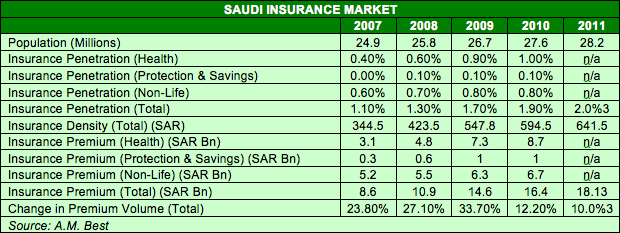
Non-life insurance accounts for 80% of the premiums while life sector remains largely untapped in many countries.
"The MENA insurance markets tend to be immature, with very low penetration rates compared to their international peers," according to A.M. Best.
Slowly but surely, demand is growing as many compulsory lines of business such as medical healthcare and automotive insurance are introduced in various countries.
"Obligatory medical schemes are considered to present the greatest opportunities in the region, although they remain fiercely competitive and need to be controlled to produce profitable growth."
These developments have ushered in a new league of players coming into the market. In Saudi Arabia alone there are 30 plus operators with a vast majority having existed for less than five years. Safder Jaffer, Partner and the Head of International Business Development for FWU Group, thinks it's a Catch-22 situation.
"Why do I say it's a Catch-22? If you're a young company, you try to get distribution through a bank channel," said Mr. Jaffer in a panel discussion organised by Zawya in the summer. "The bank has a certain due diligence process, which they apply equally to a Zurich or a Prudential and a young takaful operator. So, these operators are sometimes unable to get into the channel. Even if they do, the race begins for shelf-space management."
REGULATORY CHALLENGES
Finally, the wider insurance market faces regulatory challenges are registering promising growth.
"Overly optimistic projections for increases in insurance penetration resulted in high expectations on profitability and company valuations," notes A.M. Best. Consequently, new shareholders entered the market with high expectations of returns on their capital and little appreciation for the riskiness of the insurance business. This coupled with the significant emphasis that many companies traditionally have placed on investment returns, has resulted in many insurers becoming akin to high-risk investment funds."
A World Bank report has identified the following regulatory challenges in a 2011 paper:
1. Require minimum aggregate retentions above a certain threshold, e.g., 30% - 40%.
2. Consider measures to foster market consolidation.
3. Develop a risk-based supervisory model.
4. Ensure that supervisors are provided consistent, timely and high-quality data.
5. Establish more rigorous requirements for "fit and proper" regimes.
6. Ensure separation between life and non-life business.
7. Avoid moral hazards by discouraging guarantee funds (except for life business).
A.M. Best believes minimum aggregate retention of 20% to 30% would help companies improves their profitability and discourage new entrants to the market.
Secondly, the regional market is highly fragmented and has much smaller premiums compared to other emerging markets. Investors were attracted to the market in the hopes of regulatory changes but they have not been able to increase insurance penetration.
But M&A activities remain a distant dream.
"Individual/family owners of several companies... are reluctant to cede control to third parties, especially to acquirers from the same market," notes A.M. Best.
The consolidation and M&A is oft-repeated but there is no movement, notes Sohail Jaffer, Managing Director and Consulting Actuary of the Milliman Dubai. "Everybody talks about it but nothing happens," he said at the Zawya panel on the takaful industry.
"The only way that this can be triggered is for the regulator to be proactive. The regulator has to put in a framework of requirements for solvency, capital, annual submission of financial condition reports from companies... all of which is not happening. If this is implemented properly, you may suddenly find more than half the companies in the UAE technically insolvent."
However, the regulators are not equipped to identify which companies have operations that are considered insolvent or non-viable.
Insurers are also struggling due to a poor real estate market and low interest rates which are impacting profitability.
"For years, the high growth rates of the MENA economies and insurance markets, combined with very strong investment results, resulted in insurers posting very good results, and the need for regulatory intervention was reduced," notes A.M. Best.
"This is no longer the case as the economies and most of the insurance markets are slowing down, while investment yields have decreased."
CONCLUSION
Regulators will need to play a strong role and raise their own standards in order to compete with dynamic changes taking place in the regional conventional and takaful industry.
Greater controls over new entrants and greater awareness could ensure that the faltering market gets back on its feet once again.
Clearly, the fundamentals in the market are all there. Despite the volatility in parts of the region, the demographics and economic dynamics, especially in the three biggest markets, Saudi Arabia, UAE and Egypt suggest those markets are ripe for conventional and Islamic insurance to prosper.
Regulators, acting as the protectors of policyholder interests, need to adapt to the new market conditions, notes A.M. Best. The introduction of RBC regimes and the establishment of stringent data requirements will be imperative for their ability to evaluate the viability of insurance operations and take corrective actions.
© alifarabia.com 2012