The low-key Kyrgyz Republic found itself on the front pages of the world's media when the Boston Marathon bombing suspects were revealed to have lived in the Central Asian country.
While originally from the troubled Caucasian region of Chechnya, the Tsarnaev brothers lived in Kyrgyzstan for a period of time.
"The family probably ended up in Kyrgyzstan after mass deportation of Chechens from the North Caucasus in 1944," said Mairbek Vatchagaev, analyst at Washington-based think tank Jamestown Foundation. "Today, there are approximately 20,000 ethnic Chechens still residing in Kyrgyzstan."
Religious terrorism remains a growing issue in Central Asia including Kyrgyzstan, but the country has more immediate issues to contend with.
The predominantly Muslim country practices a peculiar version of Islam and often combines it with shamanic practices. But religious extremism in other parts of Central Asia could well infect the country.
According to Ubaidullo Khakimov, a former Uzbekistani law enforcement officer and security expert, the Islamic Movement of Uzbekistan (IMU), which is banned throughout Central Asia, has been making attempts recently to smuggle its fighters into Tajikistan, Kyrgyzstan and Uzbekistan. "Instability in the Ferghana Valley and along the Kyrgyz and Uzbek borders stems from an upsurge in terrorist activity in the region."
Kyrgyz can ill-afford such distractions. The young country recently went through a peaceful transfer of power in 2011 and saw a swift formation of a new government in 2012.
But decline in output at its flagship gold mine led to a 0.9% contraction in GDP last year.
Much depends on the fate of the Kumtor gold mine which accounts for 12% of the country's GDP and half of its exports. The gold mine has been embroiled in a dispute after the authorities accused Centerra Gold, the Canadian company that owns the development, of paying too little for the mine and was also held responsible for environmental damages worth nearly USD 500 million.
"The company is studying the claim but believes that the allegations contained in the claim are exaggerated or without merit," Centerra said in a statement.
A Kyrgyz state commission is expected to decide on the fate of the project by June 1. With Kyrgyzs having toppled two governments within the past decade, the authorities are conscious of the weight of responsibility on their shoulders.
Pacifying investors
Authorities also don't want to alienate prospective investors either. In recent years, nationalists have attacked other mines as they believed the deals did not serve the interest of the country, and authorities will have to find a balance between appeasing citizens and making foreign investors feel welcome in the country.
In a bid to open up the economy, the country has begun soliciting bids for Jeeroy, its second biggest mine with 84 metric tons of gold deposits. But the bidding process ran into trouble after a Kazakhstan-based private equity filed a USD 400 million arbitration claim with Washington-based International Center for Settlement of Investment Disputes.
The Kazakh firm once had a 60% stake in a joint venture to manage the Jeeroy mine, but the license was revoked after the government accused the company of delays in getting the project off the ground.
The Jeeroy bid is a crucial part of the government's 2013-2017 Sustainable Development Strategy, which is considered a roadmap to business reforms and improvement in the country's investment climate.
The Asian Development Bank (ADB) expects GDP to rise 5.5% on increased gold production and investment from Russia and China in energy and transport infrastructure projects.
However, the recent crash in gold prices means that the country would struggle to meet ADB's new forecast of 5.5% growth.
"The restoration of public confidence and greater political stability should raise domestic demand, spurring growth in the private sector apart from gold," said the ADB.
"Good economic conditions in the Russian Federation and Kazakhstan will likely promote growth by generating higher remittances and external demand. Reform in state governance also holds promise."
The country will also join the customs union with Belarus, Kazakhstan and Russia in 2014 which would likely boost the country's trade flows.
But to take advantage of the new trade streams, Kyrgyz will have to work hard to ensure reliable electricity generation.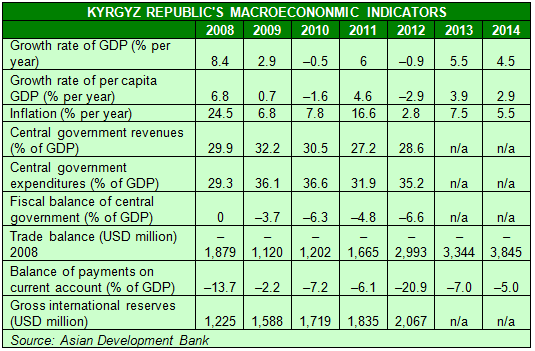
Import-dependent energy sector
Around 70% of the country's electricity is generated by imported hydrocarbons, and the sector is riddled with poor maintenance and technical losses and low rates.
"The government is negotiating several energy projects, including Kambar-Ata II and a cascade of smaller hydropower stations on the Naryn River," noted ADB.
"However, sustaining the energy system will require billions of dollars of investment in new projects and the rehabilitation of existing assets."
All the ambitious projects and plans would require strong gold prices and even stronger stability.
At the same time, the authorities will need to create fiscal space for priority spending such as health, education and infrastructure, notes the International Monetary Fund in a recent report.
"Shallow financial markets remain an impediment to growth, and the large government footprint in the banking sector hampers innovation in the sector. Better governance and institutions are essential for continued strong economic performance and inclusive private sector-led growth over the medium term."
© alifarabia.com 2013