Georgia's economic prospects are improving after a period of uncertainty following elections in late 2012.
Growth is expected to moderate to 5.5% in 2013 compared to 6.1% last year, according to the Asian Development Bank (ADB), as uncertainty in the political and investment climate slows domestic demand.
To jumpstart the economy, Bidzina Ivanishvili's, the country's recently elected billionaire prime minister, is taking matters into his own hands.
So much so that he is willing to invest his own funds to help the economy, which has raised concerns of the blurring lines between Ivanishvili's personal wealth and that of the government's coffers.
Ivanishvili was elected prime minister in October in the country's first democratic transfer of power, after his Georgian Dream coalition defeated president Mikheil Saakashvili's party.
While the PM has sought the president's resignation since then, Saakashvili will likely cling to his seat till the next presidential elections in 2014.
Forbes magazine ranked Ivanishvili as the 229th richest man in the world with net worth of USD 5.3 billion in the latest edition of the annual list.
And the country's enthusiastic new leader is putting his own funds to work.
"The government is forming two large investment funds, partly funded by prime minister Ivanishvili, to provide financing to agriculture and structural investment projects," said Vladimir Osakovskiy, analyst at Bank of America Merrill Lynch (BAML).
The agriculture fund is set to have a capital of around USD 1 billion (over 6% of GDP), while the other investment vehicle is estimated at USD 3-4 billion.
These projects are crucial for the economy that saw foreign direct investment flee due to political risks surrounding the elections. FDI fell 40.2% in the last quarter of 2012, to register a decline of 5.4% for the year.
Embracing growth
Despite all the worries, the country experienced a peaceful political transition.
"The new government has committed to promoting more inclusive growth with additional support for agricultural, rural, and small town development and increased social spending," said ADB in its latest assessment of the country.
"The government aims to improve trade ties with the Russian Federation. While differences remain, a resumption of these ties should increase Georgia's exports in agriculture, light manufacturing, and services."
An armed conflict with Russia in 2008 has raised political risks in the country, marring investor interest.
"Georgia continues to have high level of political risk at home and in its relations with Russia, stemming from an ongoing territorial dispute with Russia over two separatist republics that culminated in a five-day military conflict in 2008, leading to a deterioration of fiscal and external balances," said Aon Crisis Management in a report on political risks.
While the country has enforced reforms, external imbalances remain and FDI flows have not fully recovered, said Aon.
Ivanishvili is making concerted efforts to improve relations with its neighbor, but it will have to walk a tight rope as it may not want to upset the carefully crafted ties with the European Union, which is actively looking to loosen Russia's tight grip on Caucasian and Central Asian states.
BAML's Osakovskiy, who visited the country recently, notes that most of the Georgian officials he spoke to are optimistic about Georgia signing an EU Association agreement later this year, which would bring the country closer to the economic bloc.
"In our view, the feedback is particularly encouraging [and] along with tentative progress on Georgia's relations with Russia, it should reduce political risks," the analyst noted.
Manageable deficits
The business-minded PM is focused on business creation, and has moved away from distractions such as opposition to president Saakashvili, or fighting other branches of government.
The new government is likely to maintain low taxes, focus on crime and government transparency, which was initiated by the previous administration.
But there is a lot more to be done. Current account deficit rose to 13.5% of GDP last year but could narrow to 12.8% in 2011 if slower growth and greater structural reforms kick in.
"Over the next two years fiscal policy is expected to tighten," ADB said. "The consolidated budget deficit is projected to shrink to 2.8% of GDP in 2013 and 2.5% in 2014. This reflects further cuts in government expenditure alongside a shift in spending toward social programs."
Georgia was the 9th best country in the world to do business with, according to the World Bank, which is reward for some sound and business-friendly policies. But while the country has been lauded for its economic and social reforms, the prosperity has not trickled down to the wider population.
Poverty alleviation, unemployment and lack of development in parts of the country remain key issues.
"While Georgia has been a global leader on business environment reforms, outpacing slower Black Sea counterparts, corruption, rule of law and property rights protection still remain major weaknesses," noted Aon in its risk report.
Another key issue is the proposed amendment to the labor code, which could hurt the country's long-term growth.
"[There is a] plan to amend the labor code to tighten restrictions on the hire/fire of employees and increase the minimum wage," said BAML's Osakovskiy. "These [initiatives] could damage Georgia's extremely business-friendly investment environment, which we see as its critical competitive advantage."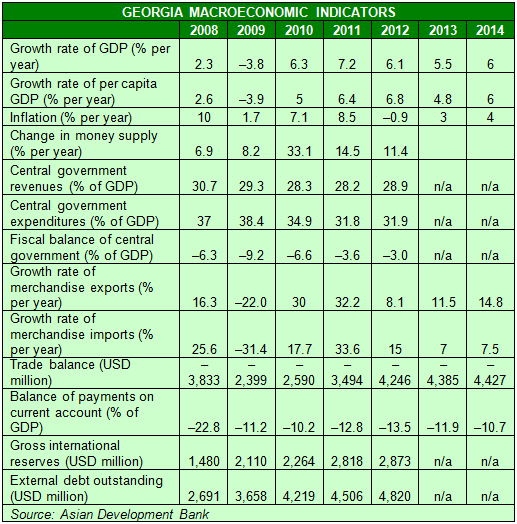
© alifarabia.com 2013