Recent claims by the Yemeni government that they have thwarted attempts to paralyze its energy installations, has brought this nation back into the global limelight.
Rajeh Badi, media adviser to prime minister Mohamed Salem Baindwa, told Reuters that the Al Qaeda was plotting to seize the "Al-Dabbah oil export terminal in Hadramout and the Balhaf gas export facility, as well as the city of Mukalla."
Yemen may be a small oil producer, but it's a frequent hunting ground for terrorists and unsavory elements.
"It is important to the global oil trade because of its strategic location at the tip of the Arabian peninsula on the Bab el-Mandab, one of the world's most important shipping lanes, through which an estimated 3.5 million barrels of oil passed daily in 2010," according to the Centre for Global Energy Studies in a note on Yemen.
"Disruption to shipping in the Bab el-Mandab could prevent tankers in the Persian Gulf and the Gulf of Aden from reaching the Suez Canal/Sumed pipeline complex, requiring a costly diversion around the southern tip of Africa to reach western markets."
The country has three billion barrels of reserves and production of around 170,000-180,000 barrels per day (bpd) that sustains much of the economy. Oil and gas receipts account for 87% of exports and 63% of government revenues.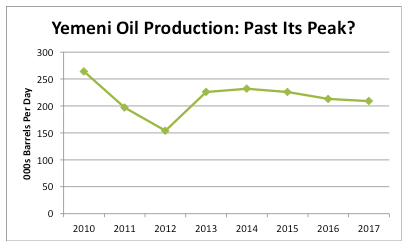
"Yemen's production is estimated to remain steady in 2014, averaging 180,000 bpd; the security situation is seen to limit the growth," said OPEC in a recent report.
The IMF notes that exports are expected to decrease in the medium term reflecting declining oil productions.
"However, a gradual increase in non-oil exports and, more importantly, in LNG exports is to offset a decrease in oil exports in the long run."
LOCK DOWN
US embassies across the Middle East were in lock-down mode last week after reports of possible attacks on American interests. Terrorists groups attacked an Algerian gas plant earlier this year, while the US ambassador to Libya was assassinated in Ben Ghazi in a brazen attack, and there were fears that a similar event was being planned.
Social unrest and the presence of Al Qaeda in Yemen have also kept investors and investments at bay. The country's oil production has fallen 440,000 bpd in 2001 to below 200,000 bpd this year, and is unlikely to return to its peak unless significant investments are made.
"In 2011, anti-government strikes, attacks on pipelines, and the evacuation of foreign staff combined to reduce annual production to below 200,000 bpd," said the US Department of Energy in its report on the country.
Other incidents over the past two years includes blowing up the main crude oil export pipeline from the Marib and Shabwa fields, which saw oil exports fall 70%.
Sporadic attacks on pipelines and refinery shutdowns have been a feature of the Yemeni oil industry as the country goes through a rough transition.
A number of oil majors have a stake in the country's oil and gas operations.
French giant Total SA has a 39.6% stake in Yemen LNG, and the company's Yemen operations account for 2.8% of its production, mainly through natural gas (55,000 barrels of oil equivalent).
YLNG's production was down last year, reaching 5.2 million tons per annum (mpta), compared to 6.9 mpta in 2011 mpta in 2011, but is hoping to raise production to 7.4 mpta this year. Total has contracts to take 2 mtpa from YLNG, along with Kogas (2 mtpa) and GDF Suez (2.55 mtpa).
Crucially, the Al Dhabi oil terminal is around 125 miles from the YLNG terminal and features two main export pipelines.
"The pipeline to the southern coast carries around 115,000 bpd, while 95,000 bpd flows to the western coast, operated by Safer," said Peter Hutton, analyst at RBC Capital Markets.
"It is this western pipeline which has seen repeated bombing attacks since early 2011, blamed on al-Qaeda but also tribal elements in the Marib region."
YEMEN VULNERABLE
The Marib pipeline is one of the most notorious sabotage targets in the region, and had only recently recovered from an attack by tribesmen in late July.
"Given the consistent history of attacks over the last few months and current situation, it is only matter of time before flows are halted again," said Barclays Capital in a note.
Analysts expect sensitive economic places in the Arab World to be a target, which makes poorly governed countries like Yemen especially vulnerable.
"The new generation of Al Qaeda--AQ 3.0, if you like--is more focused on the nearby enemy close to home than the faraway enemy in America and Europe. For now at least," wrote Bruce Riedel, an analyst at Brookings Institution.
"But easy targets like the natural-gas plant in Algeria attacked last winter by an Qaeda cell based in Libya and Mali allow local groups to kill dozens of foreign 'crusaders'. And embassies are always favorite targets. After all, that is how al Qaeda started 15 years ago this month when it blew up our missions in Kenya and Tanzania."
The recent thwarted attempt by terrorists to seize Yemeni oil installations highlights the security challenges facing the country. A successful attack would have plunged the country into turmoil and raised alarm bells across Riyadh, Washington and London, triggering a global crisis.
"Because of Yemen's position - geographic, geostrategic -- in a very important part of the world. It controls one of the most important trade routes," said Dr. Abu Bakr Al-Qirbi, minister of foreign affairs, Government of Yemen at an event in London earlier this year.
"It is very close to very rich countries, on whose resources and oil the rest of the world depends. Therefore instability in Yemen, with 25 million plus, is going to be a threat to the stability of the region as a whole, and to the economy and the world as a whole."
© alifarabia.com 2013