South Africa's African National Congress led by Jacob Zuma will soon be contesting elections for the first time this year without the moral support of legendary statesman Nelson Mandela, who passed away earlier this year.
The absence of a towering figure in South African politics will hurt the ANC at a time when the party is reeling from a whole host of pressures.
"Criticism of the government over the continued high rate of unemployment, inadequate provision of government services and pervasive official corruption are leading to deepening dissent within the ruling African National Congress (ANC) and also between the ANC and its tripartite alliance partners," says Moody's ratings agencies.
"These complaints have also led to increasingly vociferous challenges to the way in which the ANC-led government has approached these problems over the nearly two decades that it has been in power, which will likely lead to a more competitive election."
While most analysts don't expect the May 7 elections to be a "game changer", it may see the ANC return to power with fewer votes.
Anything below 60% would be seen as a shock, especially if the ANC also lost control of Gauteng province, noted Deutsche Bank. "The result is hard to predict. There are polls putting the ANC share of the vote as low as 53% but their reliability is dubious. Disaffection may also manifest itself in a low turnout."
While the ANC has not entirely been effective in putting in place a strong economic program, other parties don't pose a major challenge.
NEW CHALLENGER
Mamphele Ramphele, a major liberation figure recently merged her Agang party with the Democratic Alliance (DA) - the country's largest opposition and seen as representing interest of white South Africans. But the alliance broke up soon as Ramphele did not wish to be associated with a 'white party'.
"The DA loses the opportunity to gain more middle class black votes and promote a multi-racial re-alignment of South African politics; and its push toward 25% of the vote and co-governance of Gauteng province now become quite unlikely," said Mark Y. Rosenberg, senior analyst, at Eurasia Group. "But the party will still build on its 17% vote count in 1999 (we expect it will win about 20%) and maintain control of Western Cape province."
The ANC may also see some of the labor unions desert the party and move towards the populist policies of the Economic Freedom Fighters, which labels itself as "a radical, leftist, anti-capitalist and anti-imperialist movement with an internationalist outlook anchored by popular grassroots formations and struggles."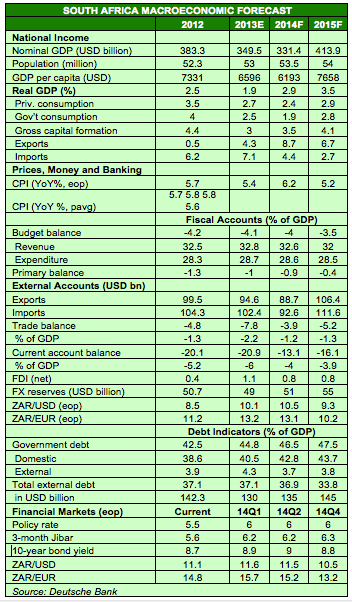
ECONOMIC PRESSURES
Rivals are eating into the ANC's vote bank, as there is general dissatisfaction with the country's economic prospects. Africa's largest economy has been a laggard in the continent thanks to structural bottlenecks and tense labor relations combined with weak external demand, according to the World Bank which estimated a 1.9% GDP growth last year and 2.7% this year.
The recent drop in the rand also forced the South Africa Reserve Bank (SARB) to raise interest rates by 50 basis points last week.
"The weaker rand has so far not generated much of an export response as infrastructure bottlenecks, strikes, and high wage growth have eroded competitiveness," said Robert Burgess, analyst at Deutsche Bank.
"There is some optimism that we will see a stronger recovery in exports this year on the back of faster US and European growth and that some stage, the weaker rand has to help. This is probably true. But underlying competitiveness problems will continue to limit these gains."
South Africa has also been rocked by labor mining troubles over the past few years, which have driven investments away from the country, as mining companies sought more pliant jurisdictions in Africa.
"A depreciating rand and growing exchange rate volatility, the negative feedback loop from nearly a decade of weak growth (which underperformed the rest of Africa), and wider uncertainties in the national mining regulatory framework and tax regime are all starting to take their toll," said Oladiran Bello, analyst at South African Institute of International Affairs.
INVESTORS' APPETITE SOURS
Mining companies, already under pressure to cut costs due to over investment over the past decade, are shying away from South Africa as productivity is at a low ebb, while the mines are either exhausted or maturing.
"A serious dialogue involving all industry stakeholders is needed fast if the country is to wrestle back traditional advantages and leverage the head start it once held over emerging alternative investment destinations," said Bello, in his note in the SAIIA. "Moving fast and purposefully towards addressing ingrained weaknesses will be essential to reassure investors spooked by the recent worrying developments."
Another psychological blow for South Africa could come when the country is displaced by Nigeria as the continent's largest economy after Lagos rebases the country's GDP this year.
South African authorities are also expected to unveil a new budget at a time when investors are worried that South African credit is deteriorating in the absence of prudent fiscal policies.
"A significant improvement in labor relations could also avert a downgrade although this seems even less likely, even after the election," said Deutsche Bank analysts.
However, there are grounds to feel optimistic. The ANC can use this current strife to improve its own governance and create more robust economic policies and resolve the chronic electricity issues that are holding back the country's economy. The country continues to have a strong financial framework, robust capital markets and a banking sector that is well entrenched in the region.
In addition key infrastructure developments focused on energy, especially exploration for shale gas, could boost the country's economic prospects.
The feature was produced by alifarabia.com exclusively for zawya.com.
© Zawya 2014